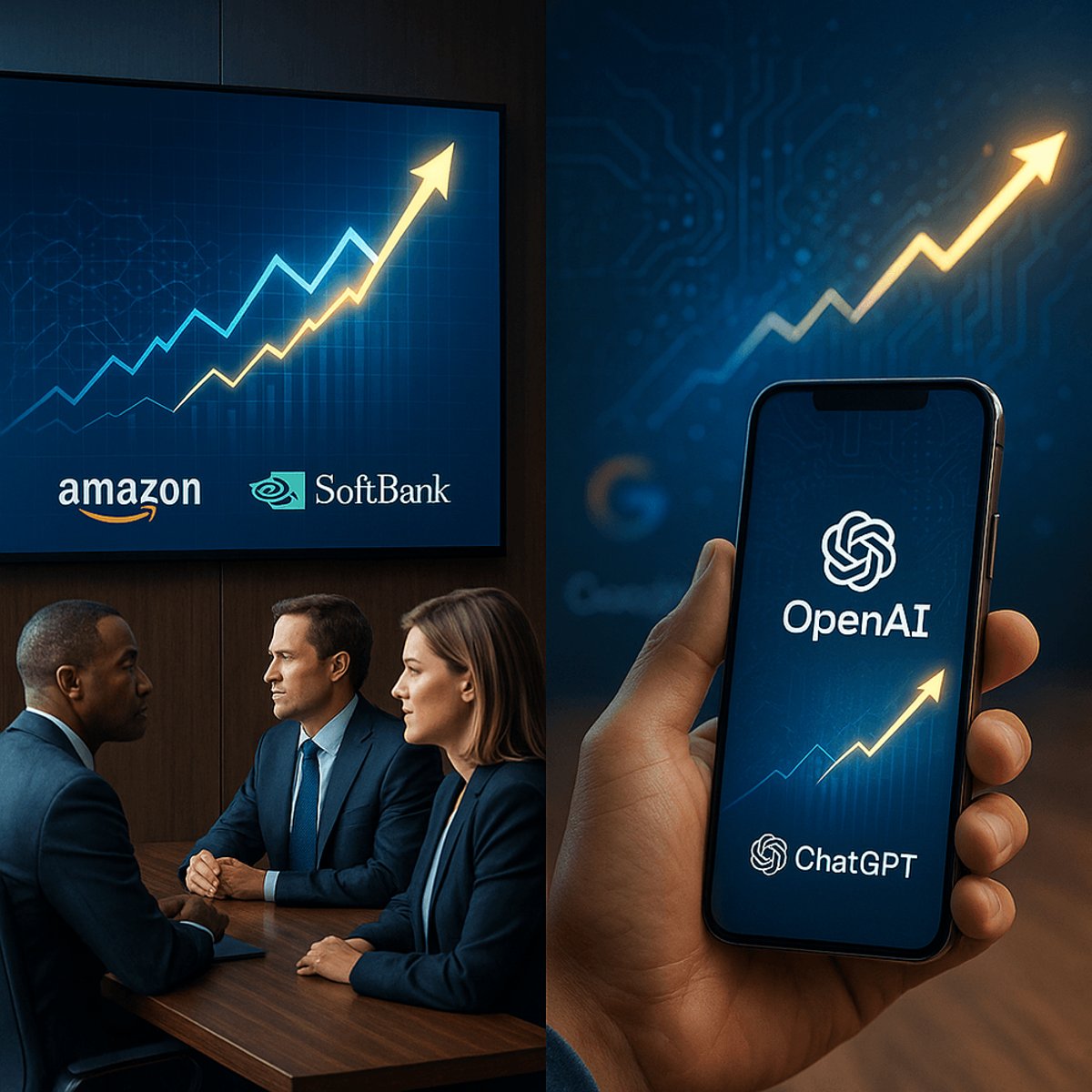
OpenAI just cracked open the vault for everyday investors. The AI powerhouse is letting retail investors pour $3 billion into its monster $122 billion funding round, valuing the ChatGPT maker at a staggering $852 billion as it barrels toward an IPO. Led by Amazon, Nvidia, and SoftBank, this marks one of the largest private funding rounds in tech history and a rare chance for non-institutional money to get in before the public offering.
OpenAI is rewriting the playbook on pre-IPO fundraising. The company behind ChatGPT just opened the doors to a $122 billion funding round that includes a $3 billion slice specifically carved out for retail investors, according to TechCrunch. It's an unprecedented move that gives everyday investors a crack at what's shaping up to be one of the most valuable private companies on the planet.
The numbers are eye-watering. At an $852 billion valuation, OpenAI is now worth more than Tesla and closing in on Amazon's market cap. This represents a massive jump from the company's previous funding round, which valued it around $300 billion. The new valuation puts OpenAI in rarefied air, second only to a handful of mega-cap tech companies in the public markets.
Amazon, Nvidia, and SoftBank are anchoring the institutional side of the raise, a power trio that signals where the smart money sees AI heading. Nvidia's involvement is particularly telling since OpenAI remains one of the chip giant's largest customers, burning through thousands of H100 and newer B200 GPUs to train its models. Amazon's participation deepens an already complex relationship, with the e-commerce giant both competing with OpenAI through its own AI initiatives while also serving as a major cloud infrastructure provider.
But it's the retail component that's turning heads. Allowing non-institutional investors into a pre-IPO round of this magnitude is virtually unheard of for a company at OpenAI's scale. The move appears designed to generate public enthusiasm and create a built-in investor base ahead of what many expect will be a blockbuster public debut. It's a strategy that borrows from the playbook of companies like Robinhood, which reserved IPO shares for its own users.
The timing isn't coincidental. OpenAI has been on a tear, with ChatGPT's user base reportedly crossing 500 million active users and enterprise adoption accelerating across industries. The company's revenue run rate has exploded from virtually zero three years ago to what insiders estimate could be north of $10 billion annually. That kind of growth justifies aggressive valuations, but it also puts immense pressure on OpenAI to maintain momentum as competitors like Google's Gemini and Anthropic's Claude chip away at market share.
The fundraising blitz comes as OpenAI navigates a delicate transition from research lab to commercial juggernaut. The company recently completed its conversion from a capped-profit structure to a more traditional for-profit entity, clearing one of the major roadblocks to an eventual IPO. That restructuring has been controversial, with some early supporters questioning whether OpenAI is abandoning its founding mission to ensure artificial general intelligence benefits all of humanity.
Investors are betting that OpenAI's first-mover advantage in consumer AI will translate into durable competitive moats. The company's API business has become infrastructure for thousands of startups and enterprises, while ChatGPT has evolved into a verb in the cultural lexicon. But the burn rate is astronomical. Training runs for frontier models cost hundreds of millions of dollars, and OpenAI is reportedly spending over $3 billion annually just on compute costs.
The retail investment window also raises questions about risk distribution. While giving everyday investors access to pre-IPO opportunities sounds democratizing, it also exposes them to the volatility and information asymmetry that typically only institutional investors navigate. OpenAI remains unprofitable despite its revenue surge, and the path to sustainable margins in AI is still being figured out industry-wide.
For SoftBank, this represents a doubling down on AI after mixed results from its Vision Fund investments. Founder Masayoshi Son has been vocal about believing we're in the early innings of an AI revolution, and backing OpenAI at this stage aligns with that thesis. Nvidia's involvement further cements the symbiotic relationship between chipmakers and AI labs, a dynamic that's reshaping the entire tech stack.
The $852 billion valuation also sets a new benchmark for private AI companies. Anthropic raised at a $18 billion valuation earlier this year, while xAI, Elon Musk's AI venture, has been valued around $24 billion. OpenAI's valuation is nearly 35 times higher, reflecting both its market position and the frothy state of AI investment.
As the company barrels toward an IPO, likely sometime in the next 12 to 18 months, this funding round serves multiple purposes. It provides the capital runway to continue expensive model development, it validates the company's trajectory with marquee investors, and it begins building the retail investor excitement that can fuel a successful public debut. The question is whether OpenAI can deliver on the immense expectations now baked into its valuation.
OpenAI's decision to open its $122 billion funding round to retail investors marks a pivotal moment in AI's evolution from research curiosity to mainstream investment vehicle. The $852 billion valuation is a bet that the company's early lead in consumer and enterprise AI will compound into sustainable dominance, but it also reflects the speculative fervor gripping the sector. For retail investors getting their first taste of pre-IPO AI opportunities, this is either a historic chance to ride the next tech mega-cap or a cautionary tale about buying at the peak. The answer will depend on whether OpenAI can turn its technological prowess into the kind of durable, profitable business that justifies a valuation higher than most Fortune 500 companies. With Amazon, Nvidia, and SoftBank writing massive checks alongside everyday investors, the pressure is on OpenAI to prove it's not just riding the AI hype cycle but defining it.