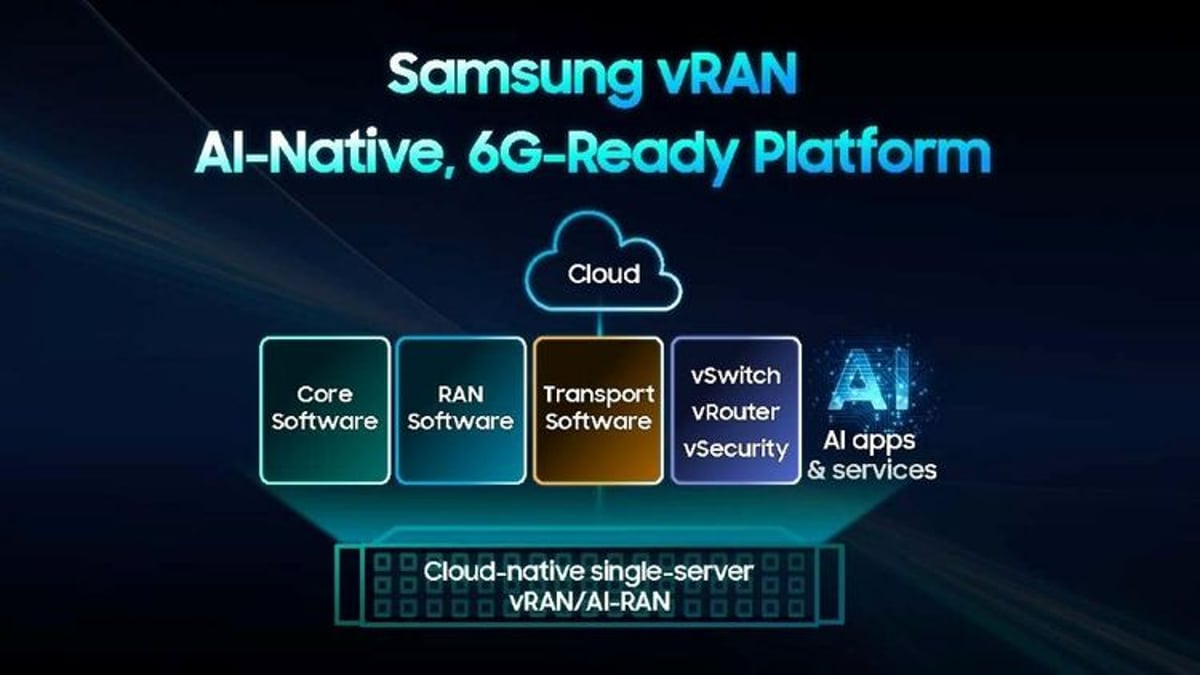
Samsung just made 5G network infrastructure fundamentally simpler. The company successfully completed the industry's first commercial call using its virtualized RAN (vRAN) platform with Intel's latest Xeon 6700P-B processors on a Tier 1 U.S. carrier's live network. This isn't lab magic anymore - it's working in production, and it means telecom operators can finally consolidate years worth of hardware onto single servers while preparing for 6G.
The telecom industry just hit a critical inflection point. Samsung announced today that it's successfully run the industry's first commercial call on a live carrier network using its virtualized RAN (vRAN) solution powered by Intel's latest Xeon 6700P-B processors with up to 72 cores. The deployment happened on a Tier 1 U.S. operator's network, marking a shift from theoretical performance gains to production-ready infrastructure.
What makes this milestone significant isn't just that it happened - it's what it means for how carriers build networks going forward. The platform ran on a single commercial off-the-shelf server from Hewlett Packard Enterprise with Wind River's cloud platform. Previously, the functions Samsung just demonstrated on one box would have required multiple servers spread across network sites, creating operational nightmares and burning through power budgets.
"This breakthrough represents a major leap forward in network virtualization and efficiency," said June Moon, Executive Vice President of R&D for Samsung's Networks Business, in a statement. "It confirms the real-world readiness of this latest technology under live network conditions, demonstrating that single-server vRAN deployments can meet the stringent performance and reliability standards required by leading carriers."
The technical specs tell part of the story. Samsung's vRAN taps Intel's Advanced Matrix Extensions (AMX), Intel vRAN Boost, and those 72 cores to handle significantly more AI processing, memory bandwidth, and energy efficiency compared to previous generation chips. But the real win is architectural. Operators can now consolidate software-defined network elements like mobile core, radio access, transport, and security onto a single box. That means less hardware, less power consumption, dramatically simpler management, and lower capital and operational expenses.
For carriers looking to deploy AI-RAN and AI-powered services across their networks while preparing for 6G, this is the kind of foundation they've been waiting for. Intel's Cristina Rodriguez, VP and GM of Network & Edge, emphasized the practical impact: "This collaborative achievement with Samsung, HPE and Wind River enables greater consolidation of RAN and AI workloads, lowering power and total cost while speeding innovation."
The timing matters here too. This came only a few months after Intel made its Xeon 6 SoC commercially available. Samsung had already completed a lab test with the chip in 2024, but moving from controlled environment to live carrier network is where engineering meets reality. Daryl Schoolar, an analyst at Recon Analytics, sees the breakthrough as industry-changing. "By demonstrating multiple network functions running on next-generation processing technology, Samsung is showing what future networks look like - more cloud-native, more scalable and significantly more efficient," Schoolar told us. "This achievement moves the industry beyond theoretical performance gains and into practical, deployable innovation that operators around the world can leverage to modernize their networks, accelerate automation and better support AI-driven use cases."
Samsung's been building toward this moment for years. The company has shipped vRAN solutions to major operators globally and hit previous industry firsts, including the first call on a commercial network and large-scale deployments using Intel Xeon processors with vRAN Boost. But this represents something different - proof that the next generation of network infrastructure actually works at scale on real traffic.
The sustainability angle shouldn't be overlooked either. Carriers are under intense pressure to reduce their power consumption and carbon footprint. Running the same network functions on fewer, more efficient servers means real energy savings at scale. For operators managing thousands of network sites, consolidation down to single-server deployments adds up fast.
What this really signals is that the industry is finally turning the corner on software-defined networks. Carriers spent years hearing about the promise of vRAN, Open RAN, and cloud-native architecture. Now they're seeing it work in production with hardware they can actually buy. That's the moment when adoption accelerates.
Samsung's successful commercial deployment of vRAN on a live carrier network is the moment when next-generation telecom infrastructure stops being a roadmap and becomes reality. For carriers planning their 6G transition and looking to deploy AI services on their networks, this proves the technology works at production scale. For equipment makers and silicon vendors, it validates the entire software-defined networking strategy that's been in development for a decade. And for the broader tech industry watching how carriers modernize infrastructure, it's a signal that architectural transformation is finally here - not someday, but now.