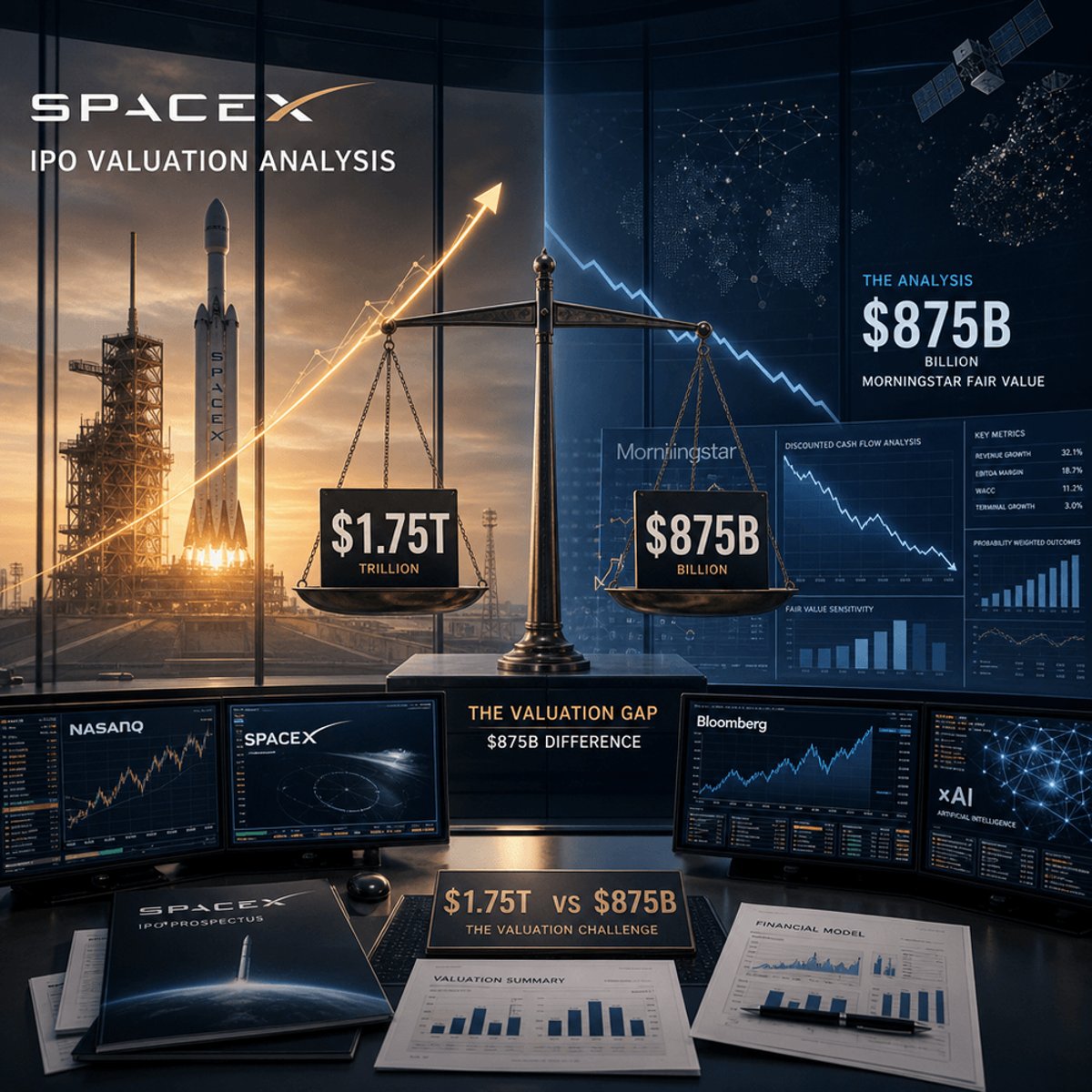
SpaceX's path to what could be the largest IPO in history just hit a major credibility check. Morningstar analysts have valued Elon Musk's rocket company at less than half its rumored $1.75 trillion IPO target, citing uncertainty around sister company xAI's competitive advantages. The assessment arrives as investment banks prepare for what would be a landmark public offering, with questions swirling about whether SpaceX can justify a valuation that would eclipse Apple's current market cap.
SpaceX is facing its first major reality check from Wall Street analysts, and the numbers tell a sobering story. Morningstar has pegged the rocket manufacturer's valuation at less than half the $1.75 trillion target that's been circulating in pre-IPO discussions, according to CNBC. That puts SpaceX somewhere south of $875 billion - still massive by any measure, but a significant haircut from the stratospheric numbers Elon Musk's team has reportedly been shopping to investors.
The core issue isn't SpaceX's rocket business, which has fundamentally reshaped the space industry with its reusable Falcon 9 and Starship programs. Instead, Morningstar analysts are struggling with how to value xAI, Musk's artificial intelligence venture that's become increasingly entangled with SpaceX's growth narrative. The analysts describe xAI's economic moat as "indeterminate" - Wall Street speak for "we can't figure out if this company has any lasting competitive advantage."
That's a problem when you're trying to justify a valuation that would make SpaceX worth more than Apple, Microsoft, or Nvidia. The $1.75 trillion figure would represent one of the boldest bets in IPO history, banking not just on SpaceX's dominance in launch services and Starlink's satellite internet business, but on xAI somehow catching up to OpenAI, Anthropic, and the other AI leaders who've spent years building their moats.
Morningstar's skepticism reflects broader Wall Street uncertainty about how to price companies at the intersection of multiple moonshot industries. SpaceX alone has revolutionized space access, slashing launch costs by roughly 90% compared to traditional providers and securing contracts with NASA, the Department of Defense, and commercial satellite operators worldwide. The company's Starlink constellation now serves over 3 million customers across 60 countries, generating billions in recurring revenue.
But xAI is a different story. Launched in 2023, the AI company is racing to compete with models from OpenAI, Google, and Anthropic - companies that have multi-year head starts and deep partnerships with cloud providers. While xAI has released its Grok chatbot and secured access to Twitter's massive data trove (another Musk company), analysts see a "wide range of possibilities" for how that competitive position shakes out.
The valuation gap creates a delicate dance for SpaceX's IPO underwriters. Investment banks have reportedly been preparing for a Nasdaq listing that could come later this year, but pricing tension between company expectations and analyst assessments often forces last-minute adjustments. Companies can either lower their targets to match market reality or make the case that analysts are missing something fundamental about their business model.
SpaceX has some ammunition for that argument. The company has maintained profitability even while investing heavily in Starship development, and Starlink's subscriber growth continues accelerating. SpaceX also benefits from being essentially the only game in town for reliable, cost-effective launches - a near-monopoly that traditional competitors like Boeing and Lockheed Martin have struggled to challenge.
The xAI wildcard complicates everything. If Musk's AI venture manages to carve out a defensible position - perhaps by leveraging SpaceX's satellite network for distributed AI training, or by integrating deeply with Tesla's autonomous vehicle data - the combined valuation story becomes more compelling. But that's a lot of "ifs" for public market investors to swallow at a $1.75 trillion price tag.
Morningstar's conservative stance may also reflect lessons from recent tech IPO disappointments. Companies that went public with sky-high valuations based on multiple business line synergies have often seen their stocks crater when those synergies failed to materialize. Analysts learned the hard way that paying for potential rather than proven economics is a risky bet.
For SpaceX, the path forward likely involves either adjusting expectations or providing more concrete data about xAI's traction and its integration with the core space business. The company has historically been tight-lipped about financials, but public market investors demand transparency. That cultural shift alone could prove challenging for a company that's thrived on Musk's vision and secrecy.
The $875 billion gap between Morningstar's valuation and SpaceX's IPO ambitions represents more than just analyst skepticism - it's a fundamental question about how to price companies building multiple futures simultaneously. SpaceX has earned its dominance in space launch and satellite internet through execution and innovation. But asking investors to pay a premium for xAI's uncertain competitive position against established AI leaders is a harder sell. The coming months will reveal whether Musk can bridge that credibility gap with data, or whether SpaceX will need to moderate its public market expectations and let the rocket business speak for itself. Either way, this IPO will set the benchmark for how Wall Street values the next generation of multi-planetary, AI-augmented companies.