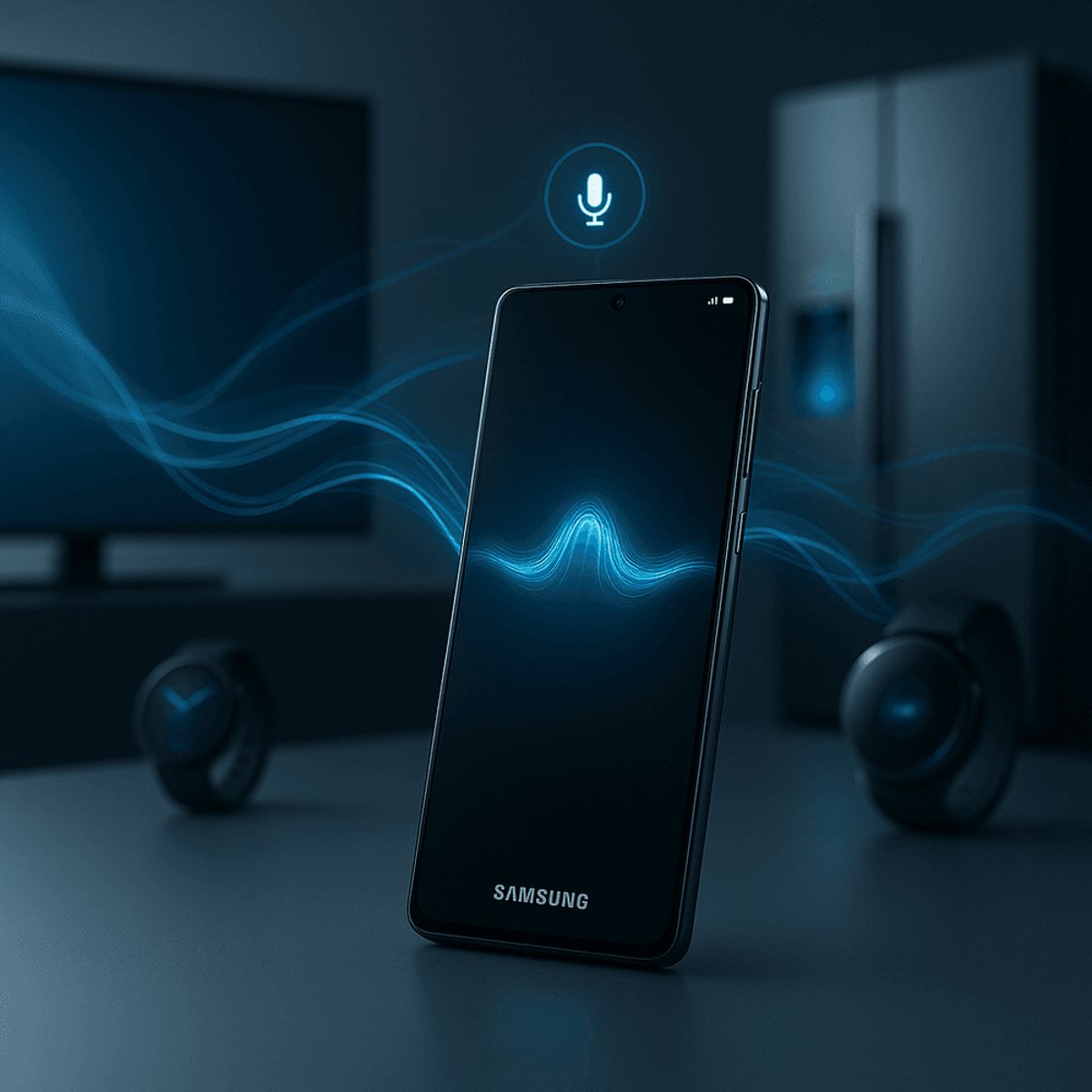
Samsung just made its biggest play yet in the agentic AI race. The company officially launched Bixby 4.0 on March 31, transforming its voice assistant into what it's calling a "device agent" - one that uses large language models to understand context, plan multi-step tasks, and act autonomously on behalf of users. In an exclusive interview with Samsung Newsroom, Jisun Park, Corporate Executive Vice President and Head of Language AI at Samsung's Mobile eXperience Business, detailed the complete architectural overhaul that's positioning Bixby as the primary entry point for every Samsung device.
Samsung isn't just updating Bixby - it's completely reimagining how users interact with their devices. The March 31 launch of Bixby 4.0 marks a fundamental shift from executing preset commands to what the industry calls agentic AI: systems that understand intent, reason about context, and autonomously complete tasks.
"Bixby has evolved into a more powerful device agent, going beyond a traditional assistant," Jisun Park, who leads Samsung's Language AI team, told Samsung Newsroom. "Optimized for each user's device, it deeply understands device status and capabilities to provide more relevant responses and tailored solutions."
The technical transformation runs deep. Samsung gutted Bixby's old architecture - which relied on classifying user input and matching it to preset scenarios - and rebuilt it around a large language model core. The company transformed individual device functions into callable agents that the LLM can invoke and combine as needed, enabling Bixby to generate its own execution plans on the fly.
"Previously, Bixby classified user input and executed tasks based on preset scenarios," Park explained. "Now, with an LLM at its core, it can interpret intent more flexibly and generate its own execution plans." The shift lets Bixby handle complex, multi-step requests that would have stumped the previous version - like asking "My eyes are tired, how can I make the screen easier to look at?" and having the assistant both recommend and activate the Eye Comfort Shield feature immediately.
The changes show up most clearly in how intuitive device control has become. Users don't need to know feature names or navigate settings menus anymore. Saying "Make my screen visible only to me" activates Privacy Display. Ask for three Korean restaurant recommendations in Seoul for a family of four, and Bixby pulls real-time web results directly into the conversation - no browser switching required.
But getting here wasn't simple. Park highlighted Korean language support as particularly challenging. "Korean's extensive use of particles and verb endings creates significant variation in word forms, while its flexible word order and reliance on context allow meaning to vary widely," she noted. The team refined their LLM training approach, improved model architecture, and strengthened context-based learning until Korean performance exceeded initial targets.
The implications extend far beyond Galaxy phones. Samsung is rolling out this evolved Bixby across its entire device ecosystem in phases, integrating it with SmartThings for home appliance control. Users can now tell their Galaxy device to start the robot vacuum or switch the air conditioner to dehumidification mode before arriving home.
"Through SmartThings integration, users can also control home appliances remotely via Galaxy devices," Park said. "This allows users to manage their home environment more seamlessly, even when they are away."
The strategy positions Bixby as infrastructure rather than just another app. Samsung wants it to become what Park calls "the primary entry point for interacting with Samsung products" - replacing the traditional pattern of searching for apps, navigating menus, and switching between screens with simple conversational requests.
This puts Samsung in direct competition with Google Assistant, Apple Siri, and Amazon Alexa, all of which are racing to add similar agentic capabilities. But Samsung has an advantage in controlling the entire hardware stack - from phones to TVs to refrigerators - giving Bixby deep access to device context that third-party assistants can't match.
The timing coincides with broader industry momentum toward AI agents. OpenAI has discussed agent capabilities for GPT models, while Microsoft is building Copilot agents into Windows and Office. Samsung's approach differs by focusing on device-level integration rather than cloud services, making Bixby more of a control plane for physical hardware.
Park emphasized that democratizing AI access drives Samsung's vision. "With Bixby, users can discover and use a wide range of Galaxy AI features without needing technical expertise," she said. "In this way, Bixby lowers the barrier to AI and helps more people enjoy AI experiences in their daily lives."
The company is betting that as AI becomes essential infrastructure, the interface that feels most natural will win. Samsung thinks that's conversation, not app grids. And with Bixby now able to understand "Turn on the air conditioner in dehumidification mode" as easily as "Recommend restaurants," the assistant is finally delivering on the promise of just speaking to get things done.
The rollout continues in phases across Samsung's product lineup, with the team continuously advancing natural language understanding, context-based reasoning, and planning capabilities. For Samsung, success means users reaching for their voice before reaching for app icons - making Bixby the default way to interact with any device bearing the Samsung name.
Samsung's Bixby reboot represents more than a feature upgrade - it's a fundamental bet on how we'll interact with technology in the AI era. By rebuilding its assistant around LLMs and agentic capabilities, Samsung is trying to collapse the friction between intent and action, making voice the primary interface for its entire hardware ecosystem. Whether users actually prefer talking to their devices over tapping apps remains the billion-dollar question. But with Bixby now spanning phones, TVs, and home appliances while understanding complex natural language and planning multi-step tasks, Samsung has positioned itself as a serious contender in the race to become your default AI agent. The company that wins this interface battle won't just control how you use devices - it'll shape how you think about interacting with technology itself.