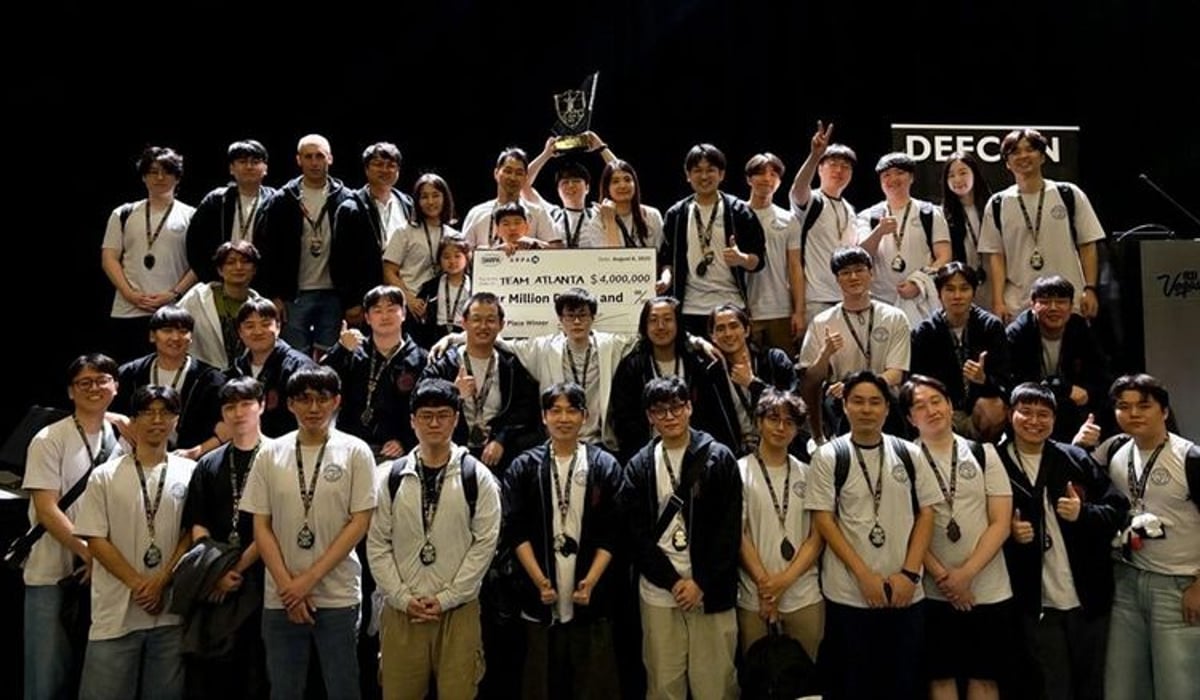
Samsung just dominated the world's largest cybersecurity competition. Team Atlanta, led by Samsung Research, claimed the $4 million grand prize at DARPA's AI Cyber Challenge after developing breakthrough AI agents that autonomously detect and patch software vulnerabilities faster than any competitor.
The tension was electric in Las Vegas on August 8 as seven finalists waited to learn who would claim victory in the world's most prestigious cybersecurity competition. When Team Atlanta's logo flashed on screen, confirming their $4 million grand prize win at DARPA's AI Cyber Challenge, two years of relentless innovation had paid off in spectacular fashion.
Samsung Research wasn't just participating—they were leading a 40-person coalition that included top talent from Georgia Institute of Technology, KAIST, and POSTECH. Under the leadership of Taesoo Kim, Samsung's Corporate Vice President who also serves as a Georgia Tech professor, the team assembled what would become the world's most advanced AI-powered vulnerability detection system.
The stakes couldn't have been higher. DARPA's AI Cyber Challenge featured a $22.5 million prize pool, with sponsors including Google, Microsoft, and OpenAI. The competition's mission: accelerate development of AI security technologies capable of protecting critical infrastructure from transportation to healthcare systems.
"Because our members came from such diverse locations, we structured our collaboration framework around each member's base," Kim told Samsung Newsroom. "Some of our colleagues in Korea even carved out time from their busy schedules to travel to the Georgia Institute of Technology so we could work side by side."
The technical challenge was formidable: build an AI-driven Cyber Reasoning System capable of autonomously detecting software vulnerabilities and generating security patches. Teams were scored on two critical components—how quickly they could identify weaknesses in code and how accurately they could fix them.
Team Atlanta's secret weapon came from Samsung Research's Security & Privacy Team. Joonun Jang developed a sophisticated large language model agent specifically for detecting vulnerabilities in Java programs. "Team members each developed their agents in various ways, and by bringing them together, we were able to build a system capable of covering a wide range of weaknesses," Jang explained to Samsung's interview team.
Meanwhile, Yunjae Choi from Samsung's AI Productivity Team tackled the patching challenge. His AI agents automatically remediate vulnerabilities once detected. "Since AI was a common tool provided to all participants, true technological excellence lay in how effectively we could harness it," Choi noted. "The key challenge was creating AI agents flexible enough to respond to newly discovered vulnerabilities."
The final moments tested nerves as much as technology. When third and second place were announced without Team Atlanta's name, tension peaked. "Given how many outstanding teams were competing, I thought that even placing in the top three would have been a great achievement," Jang recalled. "So in those moments before the first-place announcement, I was worried but cautiously hopeful at the same time."
Then came vindication. Team Atlanta didn't just win—they dominated with a decisive lead, uncovering more vulnerabilities and patching them with superior accuracy compared to world-class competitors. The victory erupted into celebration as the audience recognized the culmination of extraordinary technical achievement.
But the path wasn't smooth. Kim revealed the dramatic final hours: "Just before the final submission deadline, we had discovered a critical bug in the system we had submitted early to stay ahead of schedule. We worked frantically until the very last minute. I even had to wake the entire team up at 5 a.m. to fix the problem."
The win positions Samsung at the forefront of AI security innovation at a critical moment. As cyber threats grow more sophisticated, autonomous vulnerability detection becomes essential for protecting everything from mobile devices to smart home ecosystems. Samsung's victory demonstrates practical AI security capabilities that extend far beyond academic research.
"Samsung's AI security technologies are already being applied to strengthen the protection of products and services, including Galaxy devices and AI TVs," Kim confirmed to Samsung Newsroom. The company plans advancing next-generation AI security solutions with increasingly autonomous vulnerability identification and remediation capabilities.
The timing couldn't be more strategic. While competitors focus on large language models and consumer AI, Samsung is building foundational security infrastructure that protects the entire AI ecosystem. Through continued open-source contributions and community engagement, the company aims to cement its position as a global AI security leader—a goal now backed by DARPA's most prestigious validation.
Samsung's DARPA victory signals a fundamental shift in AI competition—from flashy consumer features to mission-critical security infrastructure. As AI systems become ubiquitous across industries, the company that can autonomously protect them holds the ultimate competitive advantage. Team Atlanta's triumph isn't just about winning $4 million; it's about positioning Samsung as the guardian of the AI revolution.