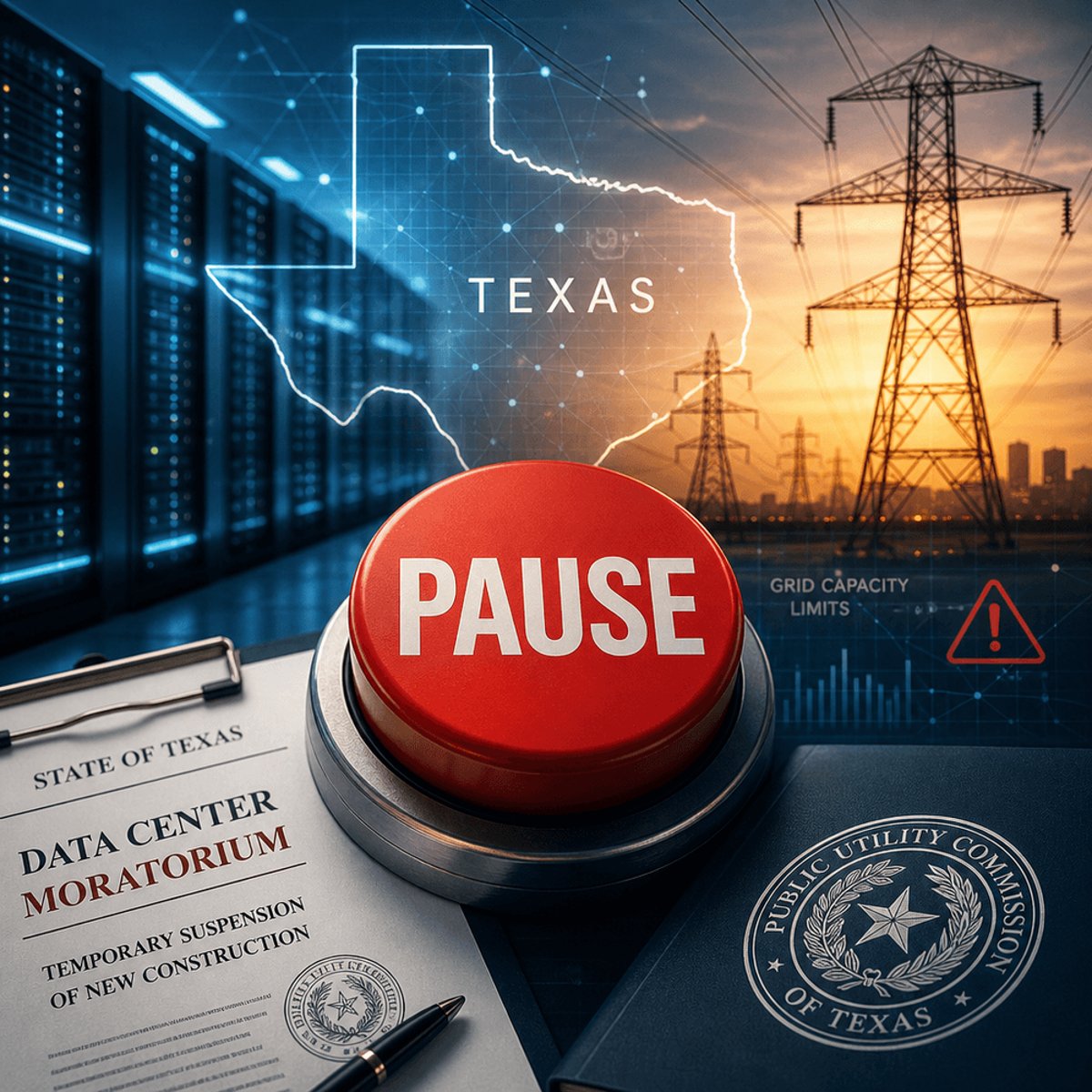
Texas just threw a wrench into the AI infrastructure boom. Governor Greg Abbott announced an immediate pause on all new data center development across the state until a comprehensive audit of grid capacity and energy usage is completed, according to a statement from the governor's office. The move sends shockwaves through an industry that's been counting on Texas as a critical hub for AI computing power, with billions in planned investments now hanging in the balance.
Texas Governor Greg Abbott just hit the emergency brake on the state's data center gold rush. The surprise announcement freezes all new data center permits until state officials can complete what Abbott's calling a "comprehensive energy impact assessment" of the industry's strain on Texas' already-stressed electrical grid.
The timing couldn't be worse for the AI industry. Texas has positioned itself as ground zero for AI infrastructure expansion, luring companies with rock-bottom energy prices, minimal regulation, and vast tracts of available land. Amazon, Microsoft, and Google have collectively announced over $15 billion in Texas data center investments over the past 18 months alone, while AI startups like OpenAI have been quietly scouting locations for massive training clusters.
But the state's electrical grid has been sending warning signals. During the summer of 2025, the Electric Reliability Council of Texas issued multiple conservation alerts as data centers pushed demand to record highs during heat waves. Industry insiders have been whispering about an inevitable reckoning between Texas' deregulated energy market and the insatiable power appetite of AI training facilities - some of which can consume as much electricity as a small city.
"We need to understand the full scope of what these facilities are demanding from our grid before we approve another megawatt," Abbott said in a statement released Tuesday afternoon. The governor's office didn't specify how long the audit would take, but energy analysts are estimating a minimum of six to nine months for a thorough review.
The ripple effects are already visible. Meta was reportedly weeks away from breaking ground on a $2 billion facility outside Austin that would have supported its next-generation AI research. Nvidia partners were evaluating sites for GPU clusters needed to train increasingly large language models. All of that is now on indefinite hold.
Texas isn't alone in grappling with data center growing pains. Virginia's Loudoun County - the world's largest data center market - implemented new restrictions last year on facility sizes after residents complained about noise and power line construction. Ireland paused new data center connections to its grid in 2022 due to capacity concerns. But Texas represents something different: it's been the escape valve for companies frustrated by regulations elsewhere, and now that valve is closing.
The moratorium reveals a deeper tension in the AI infrastructure buildout. Tech companies need massive amounts of reliable, cheap power to make AI economics work. Training a single large language model can cost tens of millions in electricity alone. States and countries are competing fiercely for these investments because they promise jobs and economic growth, but the infrastructure requirements are colliding with grid realities and climate commitments.
Energy experts have been sounding alarms about this collision for months. Data centers already account for roughly 4% of U.S. electricity consumption, and projections suggest that could double by 2030 as AI workloads explode. Texas' grid operator has struggled with reliability ever since the devastating 2021 winter storm exposed serious vulnerabilities in the state's isolated power system.
For AI companies, the Texas freeze forces an uncomfortable recalculation. Alternative locations like Georgia and the Carolinas are already seeing increased interest, but they don't offer Texas' unique combination of cheap land, minimal permitting friction, and (until now) enthusiastic government support. Some companies may look overseas - Singapore, UAE, and Nordic countries have been aggressively courting AI infrastructure - but that creates data sovereignty complications.
The audit itself will likely reveal uncomfortable truths about the sustainability of current growth trajectories. If data centers are already straining the grid during mild weather, what happens when Texas hits another extreme heat event or winter freeze? And if the state decides to cap data center growth or impose strict energy efficiency requirements, it fundamentally changes the economics that made Texas attractive in the first place.
Industry lobbyists are already mobilizing, arguing that data centers are critical national infrastructure and that Texas risks losing its competitive edge. But Abbott's facing pressure from multiple directions - residential ratepayers angry about rising electricity costs, renewable energy advocates concerned about fossil fuel dependence, and local officials dealing with community pushback against industrial-scale facilities.
The governor's move also carries political calculation. Texas has built its brand on business-friendly deregulation, but even conservative voters get frustrated when their air conditioning struggles during summer peaks because data centers are sucking up available power. Abbott's positioning this as prudent oversight rather than heavy-handed regulation - a way to ensure sustainable growth rather than a boom-bust cycle.
What happens next will set precedent far beyond Texas. Other states watching this unfold will draw lessons about the risks of unchecked data center expansion. Tech companies will factor regulatory uncertainty into their site selection calculus. And the broader conversation about AI's energy footprint - often abstract and future-focused - just became very concrete and very immediate.
Texas' data center moratorium marks a turning point in how states balance tech industry growth against infrastructure reality. The audit results will determine whether Texas remains an AI infrastructure hub or whether companies need to fundamentally rethink their expansion strategies. For an industry built on exponential growth assumptions, this forced pause might be the wake-up call that power availability - not just chip supply or talent pools - will be the binding constraint on AI's next chapter. Every state and country courting data center investments is now watching Texas closely, wondering if they'll face similar choices between grid stability and tech industry promises.