Samsung just unveiled the third generation of its WindFree air conditioner line, and it's less about screaming tech and more about disappearing into your walls. The new Bespoke AI WindFree Pro, which just snagged winner awards at both the iF Design Award 2026 and Red Dot Design Award 2026, marks a decade since the company first introduced draft-free cooling in 2016. But this time, the focus isn't just performance - it's about making air conditioners feel like architecture, not appliances.
Ten years after disrupting the air conditioner market with draft-free cooling, Samsung is rewriting the rules again - but this time, the revolution is visual. The company's new Bespoke AI WindFree Pro air conditioner doesn't just cool your room. It vanishes into it.
The third-generation WindFree line represents a fundamental shift in how Samsung thinks about home appliances. Where the first generation in 2016 introduced the world's first draft-free cooling technology, and the second generation pushed appliances into furniture territory, this latest iteration treats air conditioners as architectural elements. The result earned winner awards at both the iF Design Award 2026 and Red Dot Design Award 2026 - validation that the industry is taking notice.
"As technology becomes more advanced, appliances should blend into the background of a space rather than draw attention to themselves," Yuna Park of Samsung's HVAC Design Group told Samsung Newsroom. The third-generation WindFree design creates what Park calls "a sense of unity that blurs the boundary between appliances and architecture."
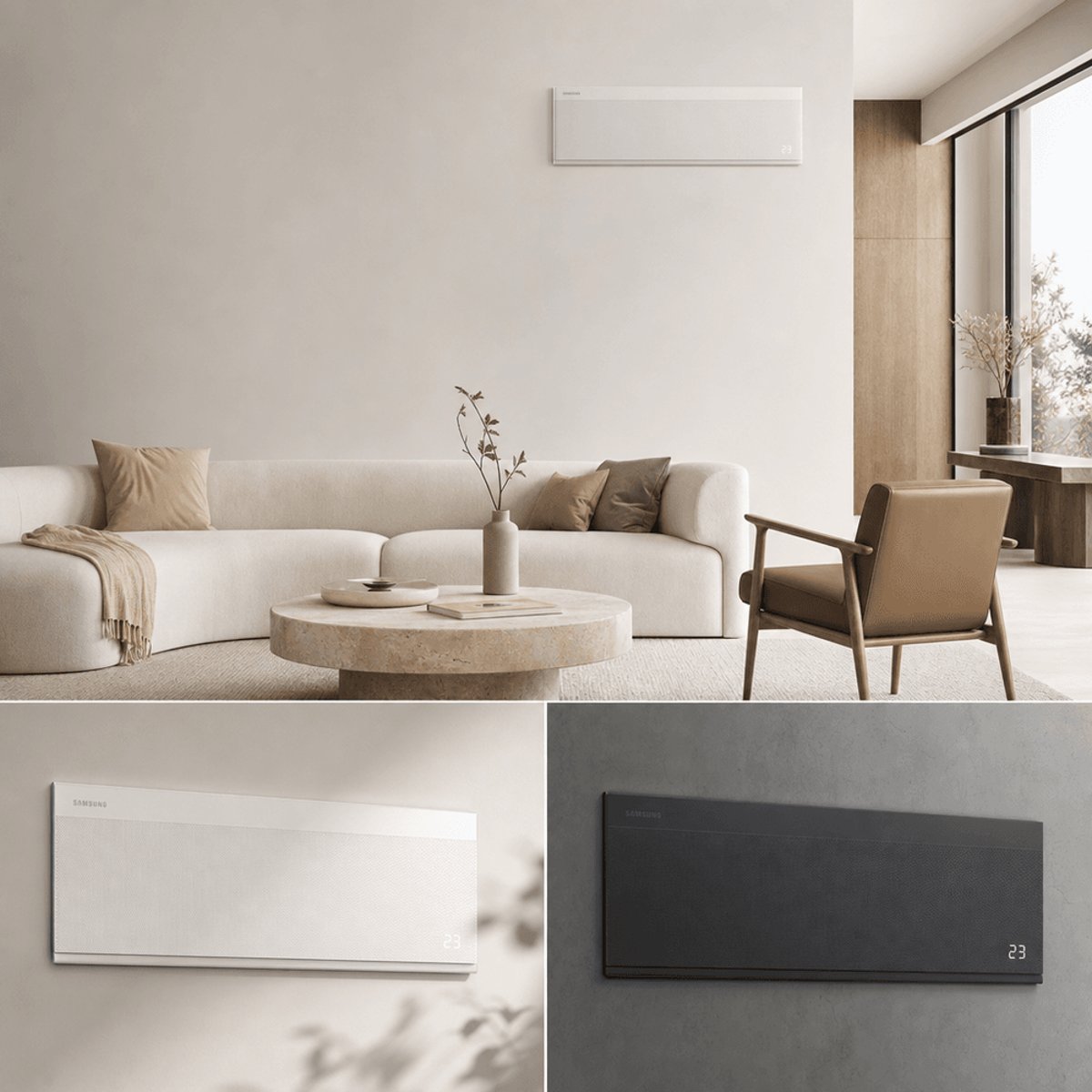
That philosophy translates into tangible design choices. The Bespoke AI WindFree Pro ditches the ornate "canvas design" of its predecessor for clean vertical and horizontal lines inspired by architectural proportions. The upper section - where eyes naturally rest - stays minimal to merge visually with surrounding walls. The functional cooling area sits at the bottom, clearly separated. It's a wall-mounted unit that actually looks like it belongs on your wall.
But making an air conditioner disappear while maintaining powerful cooling performance isn't simple. The multi-blade system that precisely controls airflow is a complex mechanical structure. Expose it, and you destroy the clean aesthetic. Samsung solved this by incorporating a sophisticated secondary blade that conceals internal structures even when the main blades are fully open during operation. Engineering and design teams collaborated from day one to ensure the product could maximize cooling without compromising its minimalist appearance.
The AI-powered features represent more than marketing speak. Radar sensors precisely recognize users and their living environments, delivering cooling optimized to specific situations and lifestyles. It's intelligent climate control that operates invisibly - exactly the point.
Material choices reinforce the architectural approach. Sujong Kim of Samsung's Aesthetic Intelligence Group explains that neutrality drove every decision. "Personal spaces tend to reflect individual tastes more strongly than shared spaces such as living rooms," Kim told Samsung Newsroom. The team eliminated prominent gloss finishes and bold patterns, instead applying a subtle etched texture that softly absorbs light and reduces visual fatigue.
Two color options anchor the lineup: Essential White for broad appeal, and Soapstone Charcoal - a deep yet soft dark tone designed for global markets where demand for darker interior styles continues growing. Both finishes create what Kim describes as "a calm and restrained atmosphere."
The details matter, even when invisible. Park's team carefully refined both the size of WindFree's signature micro air holes and the density of their arrangement. It's a subtle detail designed to create perfect visual balance within the product's clean outline. Even internal structures visible during operation are finished to appear visually organized and refined.
Sustainability factors heavily into future development. Kim confirms that the next direction for CMF (Color, Material and Finishing) design involves maintaining WindFree's unique character while actively incorporating recycled materials and environmentally conscious finishing processes. The team is exploring natural materials often found in premium furniture and architectural interiors - fabric, wood, stone - to create products that feel less like appliances and more like original architectural elements.
"I want to create a moment when users move beyond saying that the air conditioner has an impressive design and instead feel that their space - their home - has become more refined because of their WindFree air conditioner," Kim says.
The broader market implications are significant. Samsung isn't just selling cooling technology anymore. It's selling spatial refinement - a value proposition that positions air conditioners alongside furniture and architectural fixtures rather than alongside competing HVAC brands. That shift opens new premium positioning opportunities and potentially higher margins.
Competitors from LG to Daikin have focused primarily on energy efficiency and cooling performance. Samsung's design-first approach with the Bespoke AI WindFree Pro creates differentiation that's immediately visible to consumers walking through showrooms or scrolling through e-commerce listings.
The design awards validate this strategy. Both the iF Design Award and Red Dot Design Award represent top-tier recognition in industrial design circles. Winners influence purchasing decisions among design-conscious consumers and architects specifying equipment for high-end residential projects.
Park sees the evolution continuing as AI technology advances. "What matters most is not showcasing technology but delivering experiences that feel natural and comfortable to users," she explains. Future WindFree designs will continue softening the mechanical presence of air conditioners while strengthening the sense of stability they bring to relationships between people and spaces.
The first-generation WindFree launched in 2016 as a functional innovation - the world's first air conditioner to eliminate uncomfortable direct airflow through 23,000 micro holes that disperse air gently. The second generation expanded that functional foundation with aesthetic ambition, treating appliances as furniture. This third generation completes the transformation by treating appliances as architecture.
It's a progression that mirrors broader trends in consumer electronics. As core technologies mature and performance differences narrow, design becomes the primary differentiator. Apple proved this with computers and phones. Dyson demonstrated it with vacuum cleaners and fans. Now Samsung is applying the same logic to air conditioners.
Samsung's Bespoke AI WindFree Pro signals where premium home appliances are headed - toward invisibility. As AI handles the intelligence and performance advances become table stakes, design becomes the battleground. The double design award wins suggest Samsung found something that resonates beyond tech specs. For consumers, it means air conditioners that elevate spaces rather than occupy them. For the industry, it's a reminder that the future of appliances isn't about doing more - it's about being less visible while doing it better. Watch for competitors to follow with their own architecture-inspired designs, but Samsung just claimed first-mover advantage in a category that's been purely functional for decades.