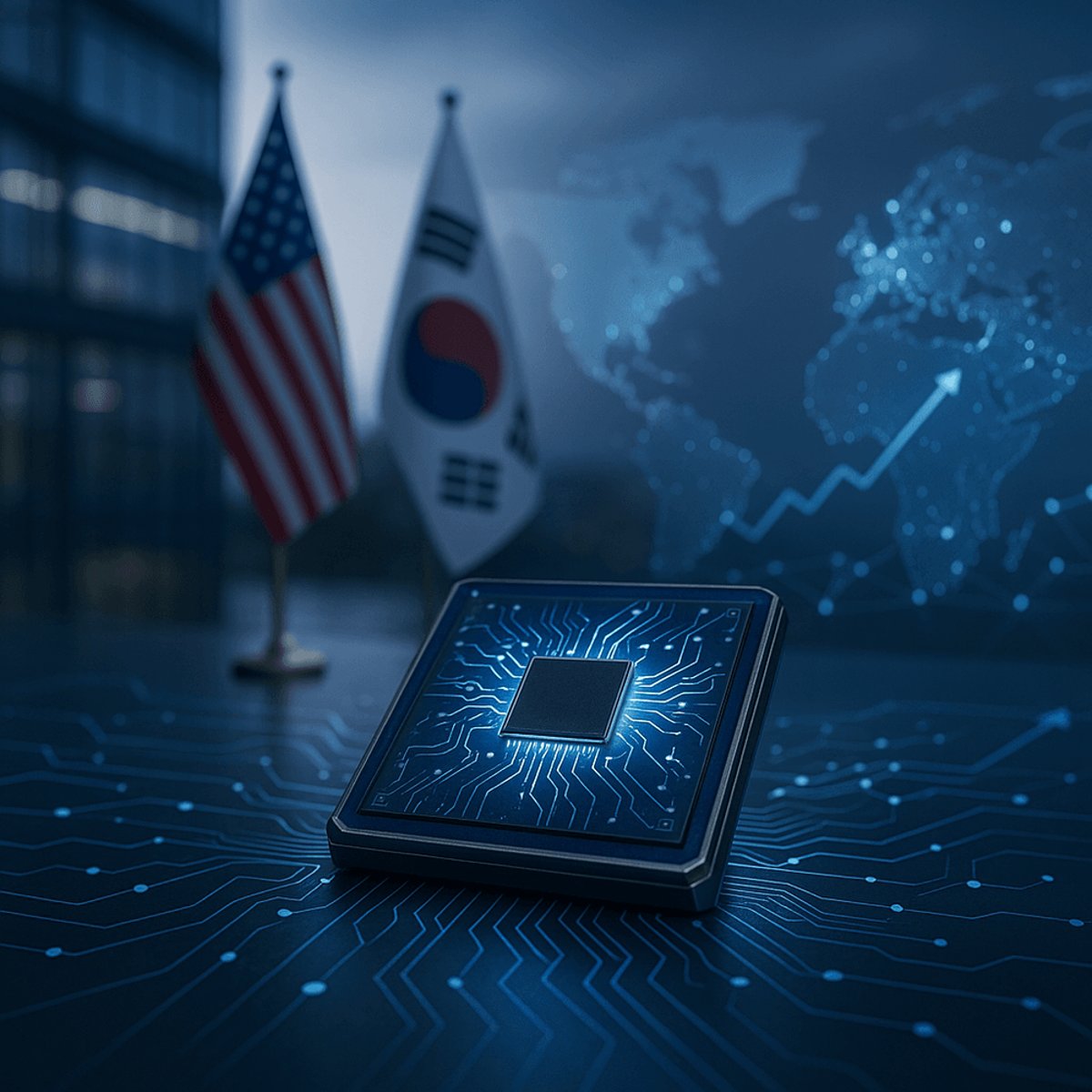
South Korea's SK Hynix just made a $10 billion bet on America's AI future. The memory chip giant announced Wednesday it's setting up a dedicated U.S.-based AI company, marking one of the largest foreign investments in American artificial intelligence infrastructure. The move comes as SK Hynix rides a historic wave of AI-driven memory demand, transforming itself from a traditional chipmaker into a crucial player in the global AI supply chain.
SK Hynix is planting its flag in America's AI gold rush. The South Korean memory giant revealed plans Wednesday to establish a dedicated U.S. artificial intelligence company backed by at least $10 billion in committed capital, signaling a dramatic expansion beyond its core memory chip business.
The new entity, tentatively dubbed "AI Company" or "AI Co.," will serve as the strategic nerve center for SK Group's global AI ambitions. According to the announcement via CNBC, SK Hynix plans to restructure its California-based subsidiary Solidigm—an enterprise solid-state drive manufacturer created in 2021—into this new AI-focused operation. Solidigm's existing SSD business will spin off into a separate entity called Solidigm Inc.
The timing couldn't be more strategic. Just hours earlier, SK Hynix reported forecast-beating fourth-quarter earnings powered by relentless demand for high-bandwidth memory chips. These specialized HBM chips have become the bottleneck in AI infrastructure, commanding premium prices as ongoing shortages ripple through the supply chain.
"SK Hynix has emerged as a major AI player in recent years due to its leadership in high-bandwidth memory chips, a type of memory used in AI chipsets like those from Nvidia," the company noted in its statement. That leadership position has translated into record profits and positioned SK Hynix as one of the few companies capable of meeting hyperscaler demand for next-generation AI memory.
The $10 billion investment will be deployed on a capital-call basis, giving SK Hynix flexibility to scale spending as opportunities emerge. But the company's ambitions extend beyond internal development. SK Hynix explicitly outlined plans for "further strategic investments in American AI firms to boost synergies across SK Group affiliates," suggesting a shopping spree for U.S. AI startups and technology companies.
This isn't SK Hynix's first major American expansion. The company is already constructing a $3.87 billion advanced chip packaging facility in Indiana, announced back in 2024. That facility will manufacture HBM specifically for AI applications when it comes online in 2028. Back home in South Korea, SK Hynix recently committed nearly $13 billion to build an advanced packaging plant to capitalize on surging AI memory demand.
But the U.S. AI company represents something different—a pivot from pure manufacturing into AI solutions and software integration. By establishing an American hub for AI strategy, SK Hynix positions itself to work directly with U.S. tech giants building frontier AI models and infrastructure.
The political calculus is equally clear. President Trump has repeatedly threatened tariffs on semiconductor manufacturers unless they commit to substantial U.S. investments. Trump's administration has been engaged in broader trade negotiations with South Korea in recent months, though the president signaled Tuesday that Washington would "work something out" with Seoul, potentially easing trade tensions.
SK Hynix's $10 billion commitment offers exactly the kind of headline investment the Trump administration has been demanding from foreign chipmakers. It also insulates the company from potential tariff exposure while securing access to the world's most lucrative AI market.
The competitive implications are significant. As Meta, Google, Amazon, and Microsoft race to build out AI infrastructure, memory supply has become a critical constraint. SK Hynix's move to establish U.S.-based AI operations gives it direct proximity to these customers and their evolving needs.
It also puts pressure on competitors. Samsung, SK Hynix's main rival in HBM production, has struggled with yield issues and quality concerns in its own advanced memory manufacturing. Micron, the sole major U.S. memory manufacturer, now faces a well-capitalized Korean competitor operating on American soil with deep pockets for AI acquisitions.
The $10 billion figure represents one of the largest foreign direct investments in U.S. AI infrastructure announced to date. For context, that's more than double what OpenAI raised in its recent funding round and comparable to the capital commitments major cloud providers make annually on data center expansion.
SK Hynix hasn't disclosed which American AI companies might be acquisition targets, but the shopping list likely includes firms working on AI memory optimization, chip design tools, and AI inference acceleration—all areas where hardware-software integration creates competitive advantages.
SK Hynix's $10 billion U.S. AI company isn't just about manufacturing chips—it's about owning a seat at the table where America's AI future gets decided. By combining capital firepower with acquisition strategy and direct customer proximity, SK Hynix is betting it can evolve from memory supplier to AI solutions provider. For U.S. tech giants facing persistent memory shortages, that's welcome news. For SK Hynix's competitors, it's a signal that the memory wars just expanded into a much broader battlefield. Watch for acquisition announcements in the coming quarters as SK Hynix deploys that $10 billion war chest.