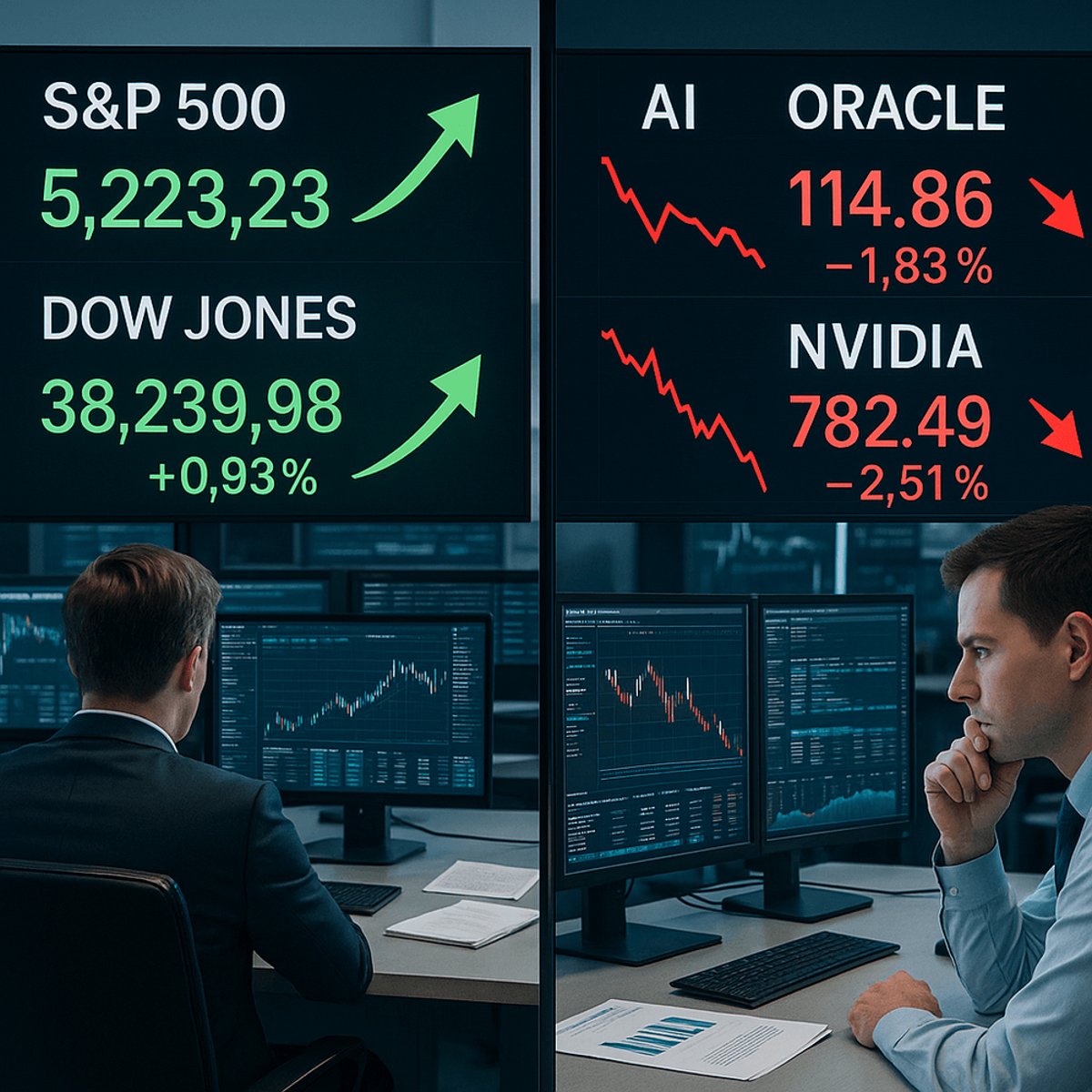
The S&P 500 and Dow Jones just closed at fresh records, but there's a catch. Oracle reported weak quarterly revenue and watched its stock plunge nearly 11%, sending shockwaves through the AI sector and dragging down Nvidia and Micron in the process. While the broader market celebrated the Fed's interest rate cut, investors were quietly rotating out of technology and into financials. For tech investors, it's a moment that reveals just how fragile AI momentum might be—even when the rest of the market is celebrating.
The stock market just handed investors a lesson in reading between the lines. Sure, the S&P 500 and Dow Jones Industrial Average both closed at fresh records Thursday, and the Russell 2000 hit a new high following the Fed's quarter-point rate cut. That's the headline. But dig into the individual stock movements and the real story emerges: AI is having a credibility crisis, and the market's enthusiasm is shifting elsewhere.
The catalyst was Oracle. The enterprise software giant reported weak quarterly revenue Wednesday, and investors responded by sending the stock down nearly 11%. That single miss echoed across the sector, dragging down every AI-adjacent name worth owning. Nvidia felt the pressure. So did Micron. The ripple effect was immediate and unmistakable.
Broadcom felt the same headwinds. The chipmaker actually beat Wall Street's earnings and revenue expectations—net income nearly doubled from a year ago, and it issued a strong forecast for the current quarter on the back of AI demand. By every traditional metric, Thursday should have been a win. But shares still fell 4.5% in extended trading. The reason: CEO Hock Tan failed to adequately address investor concerns about Google, their largest customer, eventually making more of its own chips in-house. There's also lingering uncertainty about rising memory prices pressuring margins and whether the company's chip deal with OpenAI actually comes with binding commitments.
This is where it gets interesting. The Nasdaq Composite, which is heavily weighted toward tech, fell 0.26% despite the broad market celebrating. That wasn't a coincidence. It's evidence of a calculated rotation. Investors are moving money out of technology and into other parts of the market. The S&P 500 financials sector, for instance, closed at a fresh record. Visa and Mastercard both jumped. The interest rate cut, which would normally boost growth stocks in the tech sector, instead benefited traditional financial services.
What's driving this? The Fed's quarter-point cut came alongside signals from Fed officials that the U.S. economy remains resilient. That's actually good news for investors—it means the economy isn't so weak that the Fed needed to step in with emergency measures. A healthy economy favors a broader swath of the market, not just the AI darlings that have dominated 2025. Add in holiday-season buying and the rotation becomes self-reinforcing.
But there's a warning buried in these movements. The AI narrative, which has driven the entire market's valuation expansion for two years, is hitting some friction. Oracle is a cloud and enterprise AI player. If enterprises are pumping the brakes on database spending and AI infrastructure investments, that's a signal the hype cycle is normalizing. Not collapsing—just normalizing. Investors who've been all-in on AI are taking their chips off the table and diversifying.
What comes next depends on how broader earnings season unfolds. If more tech giants report underwhelming AI spending or deployment numbers, the rotation could accelerate. If Google, Microsoft, and Amazon deliver on AI promises when they report, enthusiasm could snap back. For now, though, the market is sending a message: the era of AI-at-any-price is over. Today's winners are the companies proving they can actually deliver on the hype—and everyone else is going to face harder questions about what they're spending on AI and why.
Thursday's market action tells a clearer story than any headline can: the AI boom's stranglehold on market leadership is loosening. Oracle's weak earnings and Broadcom's post-beat selloff aren't random events—they're signals that investors are rethinking where growth actually lives. The Fed's rate cut and a resilient economy mean the whole market is rising, but the AI sector's relative dominance is fading. For tech investors, that's both a warning and an opportunity. Warning because any other AI misstep will likely trigger bigger selloffs. Opportunity because valuations are starting to get more reasonable, and the market is finally asking companies to prove their AI investments actually matter. That's healthy, even if it's uncomfortable for those who got drunk on the AI narrative.