Samsung just dropped a spec bomb that'll make competitive gamers' heads spin. The company's new Odyssey G6 monitor hits 1,040Hz - yes, over a thousand frames per second - while its entire 2026 OLED TV lineup now supports NVIDIA G-SYNC. It's a dual-front assault on the premium gaming display market that puts Samsung squarely in competition with specialized gaming brands while leveraging its OLED manufacturing prowess.
Samsung is making a serious play for the hardcore gaming crowd. The company announced its 2026 OLED TV lineup and next-generation Odyssey gaming monitors are now NVIDIA G-SYNC compatible, bringing tear-free, stutter-free gameplay to both living room and desktop setups. But the real headline is the Odyssey G6 G60H - a 27-inch monitor that just became the first in the world to break the 1,000Hz barrier.
The G60H hits 1,040Hz refresh rates through what Samsung calls Dual Mode, though there's a catch. That eye-watering refresh rate only kicks in when running HD resolution. Drop down to the monitor's native QHD resolution and you're still getting a blazing 600Hz. For context, most premium gaming monitors today max out at 360Hz or 480Hz, making this a genuine leap forward for competitive esports players where every millisecond matters.
"Our goal is simple: deliver a consistently great gaming experience, no matter what you play or where you play it," Kevin Lee, Executive Vice President of the Visual Display Business at Samsung Electronics, told press. "With new innovations across OLED TVs and gaming monitors, we're bringing more power, precision, and immersion to every kind of player."
Samsung's also hedging its bets with a second Odyssey G6 variant. The G61SH model swaps raw speed for visual fidelity, featuring a QD-OLED panel with QHD resolution at 240Hz. That's still plenty fast for most gamers, but the real draw here is the quantum dot OLED technology delivering richer colors and deeper blacks. With a 0.03ms gray-to-gray response time and HDR10+ GAMING support, it's aimed at players who want their games to look as good as they play.
Both monitors come with NVIDIA G-SYNC compatibility, which syncs the display's refresh rate to the GPU's frame output. The technology has become table stakes for premium gaming displays, eliminating screen tearing and stuttering that can break immersion during intense gameplay.
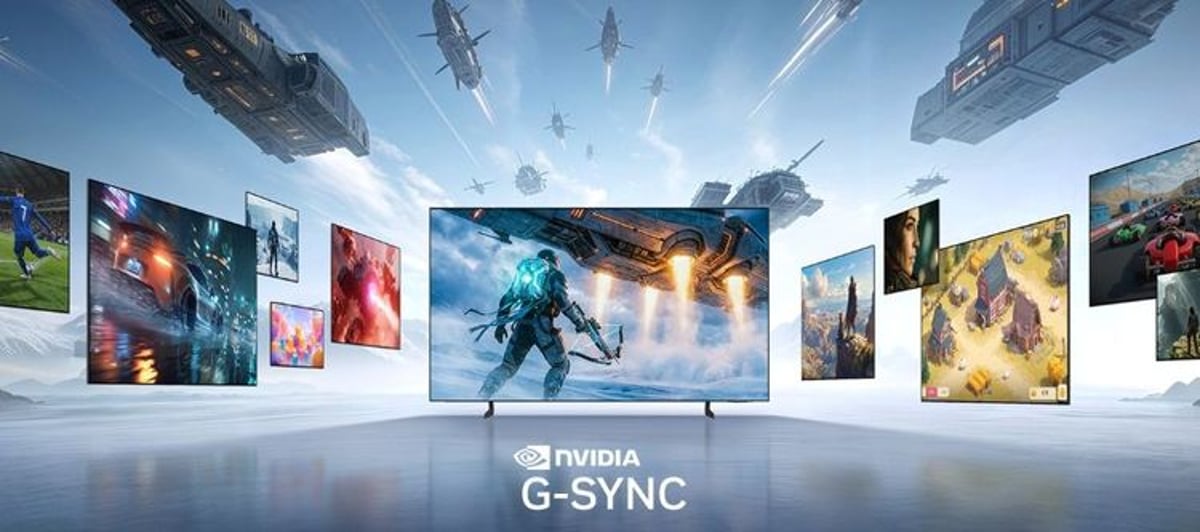
On the TV side, Samsung's entire 2026 OLED lineup is getting the gaming treatment. The flagship S95H and S90H models support refresh rates up to 165Hz, while the S85H handles 120Hz - all with NVIDIA G-SYNC compatibility. They're also supporting AMD FreeSync Premium Pro (though some S90H and S85H sizes only get standard FreeSync Premium), giving console and PC gamers platform-agnostic variable refresh rate technology.
This is Samsung playing catch-up and leapfrog simultaneously. LG has dominated the OLED gaming TV market for years with its G-SYNC and FreeSync support, but Samsung's bringing new tech to the fight. The 2026 lineup introduces HDR10+ ADVANCED, an enhanced HDR format promising better brightness, contrast, motion handling, and color accuracy across all content types.
Samsung's also applying its proprietary Glare Free technology to the S95H and S90H models. The anti-reflection coating reduces glare without degrading OLED picture quality - a persistent challenge for displays in brightly lit rooms. It's the kind of practical feature that matters more in real-world living rooms than spec sheets.
The timing is strategic. The gaming display market is booming as more players invest in high-end hardware to match increasingly demanding games. NVIDIA's latest RTX 50-series GPUs can push frame rates high enough to actually benefit from 1,040Hz displays in competitive titles like Counter-Strike 2 and Valorant. Samsung's betting that gamers upgrading their GPUs will want displays that can keep pace.
What's less clear is pricing and availability. Samsung hasn't announced when these monitors and TVs will ship or what they'll cost. The G60H's 1,040Hz capability will likely command a premium, while the QD-OLED G61SH could slot into the $800-$1,200 range based on current QD-OLED monitor pricing. The OLED TVs will compete directly with LG's C-series and G-series, where 55-inch models typically start around $1,500-$2,000.
For competitive gamers, the refresh rate arms race continues. A few years ago, 144Hz was considered high-end. Then came 240Hz, 360Hz, 480Hz. Now Samsung's pushing past 1,000Hz. Whether human eyes can actually perceive the difference between 500Hz and 1,000Hz remains debatable, but in esports where prize pools reach millions, even marginal advantages matter.
The broader play is Samsung leveraging its display manufacturing scale. The company produces both traditional OLED and QD-OLED panels, giving it flexibility to target different price points and use cases. By offering G-SYNC and FreeSync support across its entire gaming-focused lineup, Samsung's making it easier for retailers and consumers to simply choose Samsung rather than comparing specs across brands.
Samsung's making a legitimate run at the premium gaming display market from two angles - desktop monitors pushing absurd refresh rates for competitive players, and OLED TVs bringing cinema-quality visuals to console gamers. The 1,040Hz Odyssey G6 is a genuine technical achievement, even if the real-world benefits remain unclear. More importantly, the company's bringing its full OLED lineup into the gaming fold with G-SYNC and FreeSync support, directly challenging LG's long-standing dominance. For gamers, more competition means better tech at (hopefully) better prices. The question now is whether Samsung can translate impressive specs into actual shelf space at retailers and desks in gaming setups.