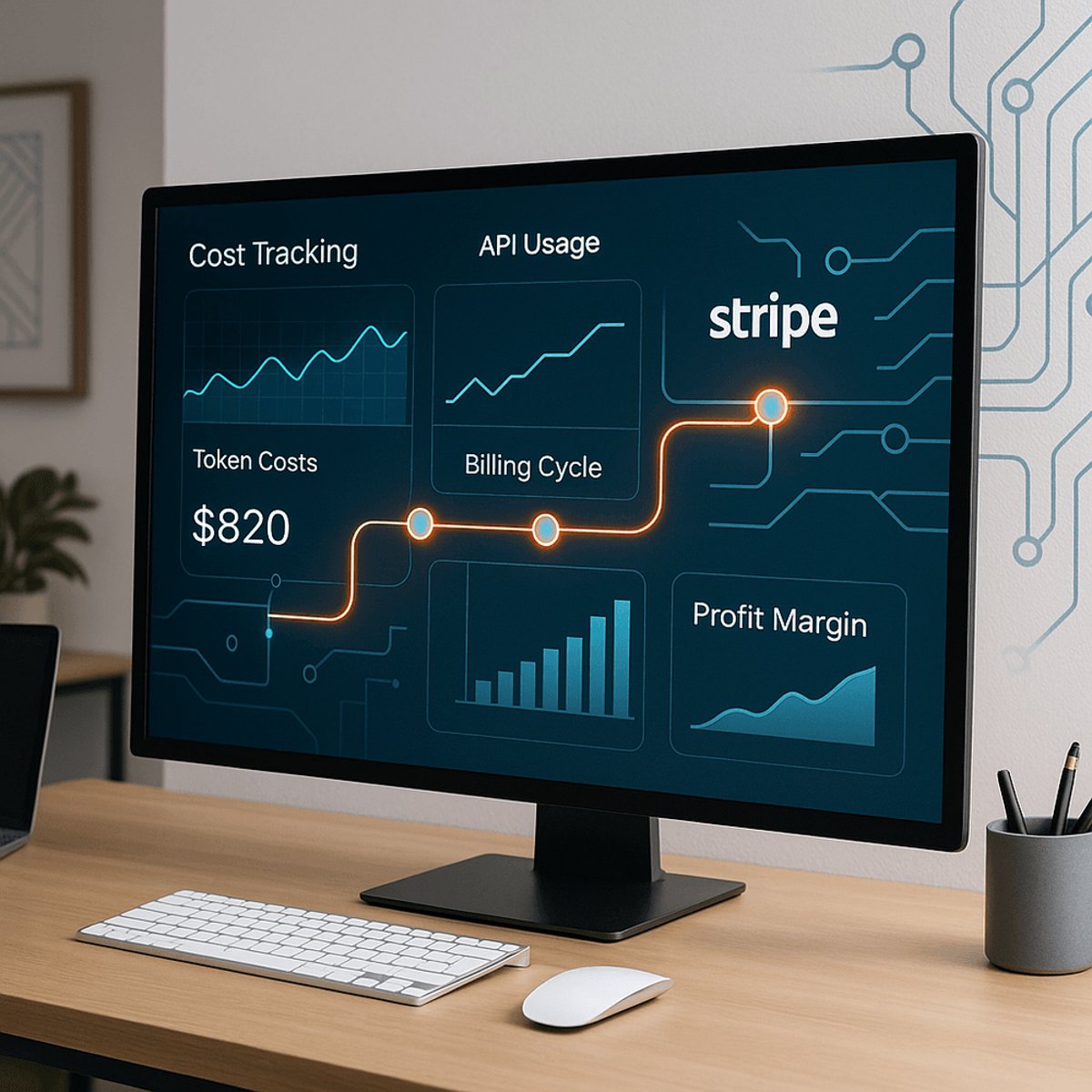
Stripe just tackled one of the thorniest problems in AI business models - how to actually make money when your costs fluctuate with every API call. The payment giant released a preview of new infrastructure that lets AI companies track underlying model fees, pass them through to customers, and layer on their own margins. It's addressing a pain point that's been quietly bleeding AI startups dry: the gap between what they pay OpenAI or Anthropic and what they can charge users.
Stripe is making a calculated bet that the AI economy needs better plumbing. The company's new preview release targets a problem that keeps AI startup CFOs up at night - how do you build a sustainable business when your core costs are completely variable and tied to token consumption?
The infrastructure lets companies using large language models track every API call, calculate the underlying cost from providers like OpenAI or Anthropic, and automatically bill customers with their own markup included. It sounds simple, but it's been a nightmare for AI companies trying to move beyond free tiers and investor subsidies into actual profitability.
Traditional SaaS pricing breaks down completely in the AI world. A customer using an AI coding assistant might burn through $50 in API costs one month and $500 the next, depending on how much they're shipping. Flat subscription pricing means you're either overcharging light users or getting crushed by power users. Usage-based pricing makes sense theoretically, but implementing it without purpose-built infrastructure has been brutal.
Stripe's solution plugs directly into the payment stack that many AI companies already use. Instead of building custom billing systems to track tokens, calculate costs across different model providers, and reconcile everything at month's end, companies can now offload that complexity to Stripe's infrastructure. The system automatically tracks usage, applies the company's pricing rules, and handles the actual billing.
This matters because AI companies have been stuck in an awkward middle position. They're paying OpenAI or Anthropic based on tokens consumed, but charging customers through completely separate systems that don't talk to each other. The disconnect creates accounting headaches, makes it hard to understand unit economics, and often results in companies accidentally subsidizing heavy users.
The timing is significant. As AI applications mature beyond demos and prototypes, the industry is hitting a reckoning around business models. Venture capital has funded an explosion of AI wrappers and tools, but investors are starting to ask harder questions about paths to profitability. Being able to cleanly pass through costs while maintaining margins isn't just nice to have - it's existential.
For Stripe, this is a smart land grab in the emerging AI infrastructure stack. The company already processes payments for thousands of AI startups and SaaS companies. By building specialized tools for AI billing, Stripe embeds itself deeper into these businesses and becomes harder to rip out as they scale. It's the same playbook that made Stripe indispensable to the first wave of SaaS companies.
The preview release suggests Stripe is testing demand before a full launch. AI companies can start integrating now, providing feedback that'll shape the final product. That approach makes sense given how quickly AI business models are evolving - better to iterate with real customers than build in isolation.
What's not clear yet is how Stripe's pricing for this service will work. The company typically takes a percentage of payment volume, but AI billing involves more complexity than standard e-commerce transactions. There's also the question of how this fits with existing billing platforms like Stripe Billing or whether it's a separate product.
Competitors are watching closely. Other payment processors and billing platforms could rush out similar features, but Stripe has a head start thanks to its existing relationships with AI companies and its reputation for developer-friendly tools. The company that solves AI billing infrastructure first could own a critical piece of the stack.
For AI startups, the calculation is straightforward. Building billing infrastructure in-house takes engineering resources away from the actual product. Using Stripe's tools means faster time to market and one less system to maintain. The trade-off is another dependency and whatever fees Stripe charges, but for most companies that math works out.
Stripe is doing what it does best - identifying friction in how internet businesses get paid and building infrastructure to smooth it out. AI companies have been cobbling together homegrown solutions to track and bill for model costs, creating technical debt and unit economics blind spots. By offering purpose-built tools for this exact problem, Stripe positions itself as essential plumbing for the AI economy. The companies that adopt this early get cleaner financial operations and faster paths to profitability. Stripe gets deeper hooks into the fastest-growing segment of tech. As AI applications shift from experiments to revenue-generating products, the infrastructure enabling that transition matters just as much as the models themselves.