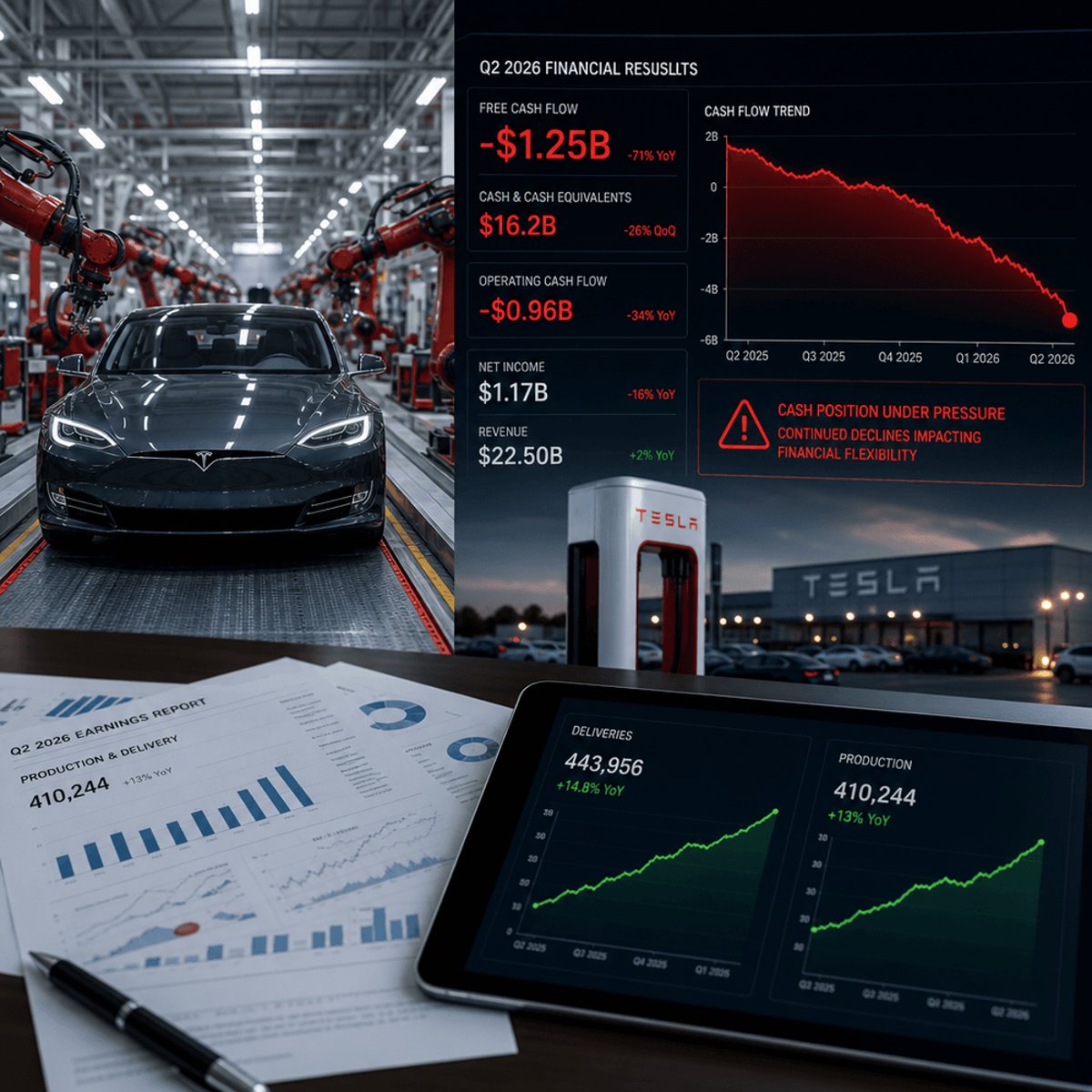
Tesla just delivered a mixed bag that has investors spooked. The electric vehicle giant beat revenue expectations in Q2 2026 but missed on earnings, with free cash flow flipping negative for the first time in years. The news comes as Tesla's stock continues sliding despite signs of recovery in its core automotive business, raising fresh questions about the company's capital allocation strategy and whether its aggressive expansion plans are stretching finances too thin.
Tesla is burning through cash faster than it's making it, and Wall Street is taking notice. The company's Q2 2026 earnings report reveals a troubling shift: free cash flow has gone negative, even as the top line beat analyst estimates. It's a paradox that speaks to the mounting pressures facing Elon Musk's electric vehicle empire.
The revenue beat should have been good news. Tesla's core automotive business is showing genuine signs of recovery after a challenging start to the year. Vehicle deliveries are climbing, production lines are humming, and the Model Y continues dominating the electric SUV market. But scratch beneath the surface and the financial picture gets murky fast.
Free cash flow - the lifeblood of any capital-intensive manufacturing operation - has flipped from positive to negative. That's a red flag for a company that's simultaneously trying to build new factories, ramp up production of the Cybertruck, develop its Full Self-Driving technology, and fund its ambitious AI initiatives. The cash burn suggests Tesla's expansion appetite may be outpacing its ability to generate returns from existing operations.
The earnings miss compounds investor anxiety that's already sent Tesla shares into a prolonged slide. Despite the automotive recovery narrative, the stock has been hemorrhaging value as questions mount about profitability, competition, and execution risk. Tesla faces intensifying pressure from Chinese EV makers like BYD, legacy automakers ramping up electric offerings, and a cooling consumer appetite for premium EVs in key markets.
What's particularly striking is the divergence between operational momentum and financial performance. Tesla is selling more cars, but it's making less money per vehicle. Margin compression is the story behind the story - the result of price cuts, increased competition, and the substantial capital requirements of new product launches. The Cybertruck production ramp alone has been a notorious cash drain, with the angular pickup truck requiring entirely new manufacturing processes.
Then there's the AI wildcard. Tesla's investment in autonomous driving technology and its Dojo supercomputer represents billions in R&D spending that won't generate near-term returns. Musk has repeatedly framed Tesla as an AI and robotics company that happens to make cars, but investors are increasingly skeptical about when - or if - those futuristic bets will pay off.
The negative free cash flow raises uncomfortable questions about capital allocation. Is Tesla spreading itself too thin? Should it be pulling back on expansion plans to shore up profitability? Or is this temporary pain necessary for long-term gain? Traditional automakers have weathered similar cycles, but Tesla has always played by different rules, prioritizing growth and technological leadership over quarterly financial optimization.
Analysts are now reassessing their models. If Tesla can't generate positive cash flow while its core business is recovering, what happens if demand softens again? The company has historically relied on its ability to fund growth internally, avoiding the dilution that comes with frequent capital raises. A sustained period of negative free cash flow could force uncomfortable choices about financing future projects.
The stock slide reflects this uncertainty. Investors who bid Tesla shares to stratospheric valuations on the promise of autonomous vehicles and energy storage dominance are now confronting the reality of a maturing automotive business with all its traditional headwinds. The gap between Tesla's market cap and its financial fundamentals has never been wider, and these Q2 results do nothing to close it.
For context, negative free cash flow isn't automatically catastrophic - Amazon famously operated that way for years while building infrastructure. But Amazon was investing in assets that generated immediate returns. Tesla's spending is split between capacity expansion that takes years to mature and technology bets that may never pay off at scale. That's a riskier proposition, especially in a higher interest rate environment where cash flow matters more than ever.
Tesla's Q2 paradox - growing sales but shrinking cash - crystalizes the challenge facing the company at this inflection point. The automotive business is doing its job, but the financial returns aren't following. With free cash flow negative and the stock under pressure, Tesla needs to demonstrate that its massive capital investments will translate into sustainable profitability, not just production volume. Investors will be watching closely to see whether management adjusts its aggressive expansion strategy or doubles down on the long-term vision. The next few quarters will reveal whether this cash crunch is a temporary speed bump or a sign that Tesla's growth-at-all-costs playbook needs revision.