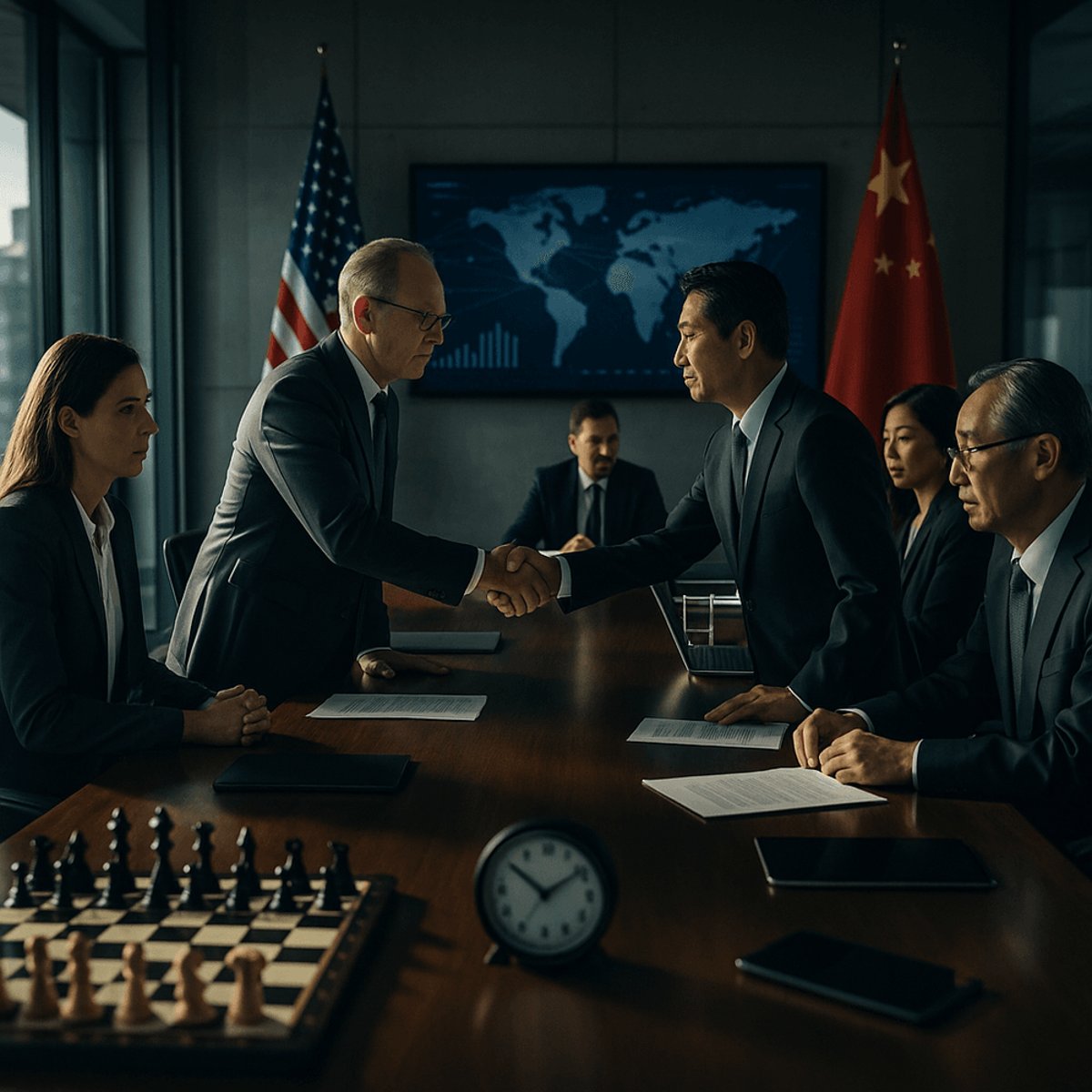
Treasury Secretary Scott Bessent just revealed the hardball tactic that broke China's resistance in TikTok negotiations. President Trump's credible threat to let the app go dark in America forced Beijing back to the bargaining table, setting up a crucial Friday call between Trump and Xi Jinping to finalize the deal that could reshape social media.
The TikTok standoff just shifted dramatically. Treasury Secretary Scott Bessent revealed Tuesday morning that President Trump's willingness to completely shut down TikTok in America is what finally forced China's hand in negotiations that had stalled since April.
"President Trump made it clear that he would have been willing to let TikTok go dark, that we were not going to give up national security in favor of the deal," Bessent told CNBC's Squawk Box. That credible threat, he said, "turned the tide" in getting Beijing back to serious talks.
The timeline Bessent laid out shows just how much geopolitics tangled up what should have been a straightforward business transaction. The commercial terms between ByteDance and potential U.S. buyers were essentially locked in by March or April. But then Trump unleashed his massive tariff announcement on April 2, and China immediately put the TikTok deal on ice.
"After Trump's massive tariff announcement, the Chinese put the deal on hold," Bessent explained. It was classic diplomatic hostage-taking - Beijing using TikTok as leverage in the broader trade war.
But Trump called their bluff. While previous administrations might have blinked, Trump's team made clear they'd rather see TikTok disappear entirely than compromise on national security. The irony? Trump's own White House launched a TikTok account last month and has nearly 1 million followers.
Now the deal is rushing toward the finish line. Trump and Chinese President Xi Jinping are scheduled to speak Friday to finalize terms, just one day before the September 17 deadline when TikTok could face a complete U.S. ban. U.S. Trade Representative Jamieson Greer hinted Monday that more time might be needed, but Bessent's comments suggest the framework is solid.
Oracle is emerging as the frontrunner to take control of TikTok's U.S. operations. CBS News reported Monday that the cloud giant is among "multiple companies" in talks, with Oracle handling the technical backbone while outside investors provide the capital. This makes sense - Oracle already manages TikTok's web infrastructure and has deep ties to the intelligence community.
The deal structure appears designed to thread a narrow needle. China gets to save face by not appearing to completely capitulate to U.S. pressure. American investors get a piece of the world's most valuable social media asset. And the U.S. government gets what it really wants - control over TikTok's data collection and algorithm updates.
"We were able to reach a series of agreements, mostly for things we will not be doing in the future that have no effect on our national security," Bessent said cryptically. Translation: China agreed to back off various tech transfer and espionage activities in exchange for keeping TikTok alive.
This isn't just about one app. The TikTok resolution could mark a turning point in U.S.-China tech relations, which have been poisoned by years of trade wars, chip restrictions, and mutual suspicion. Both sides have incentives to show they can still make deals work.
For Trump, it's a chance to demonstrate his negotiating prowess while addressing legitimate national security concerns. For Xi, it's an opportunity to show Chinese tech companies can still access global markets if they play by international rules.
Friday's Trump-Xi call will determine whether the world's most valuable social media app survives in America or becomes the biggest casualty yet of the tech cold war. Bessent's revelation that Trump's hardball tactics worked suggests we're about to see either a landmark deal that resets U.S.-China tech relations, or the most dramatic platform shutdown in internet history. Either way, the stakes couldn't be higher for the 170 million Americans who use TikTok daily.