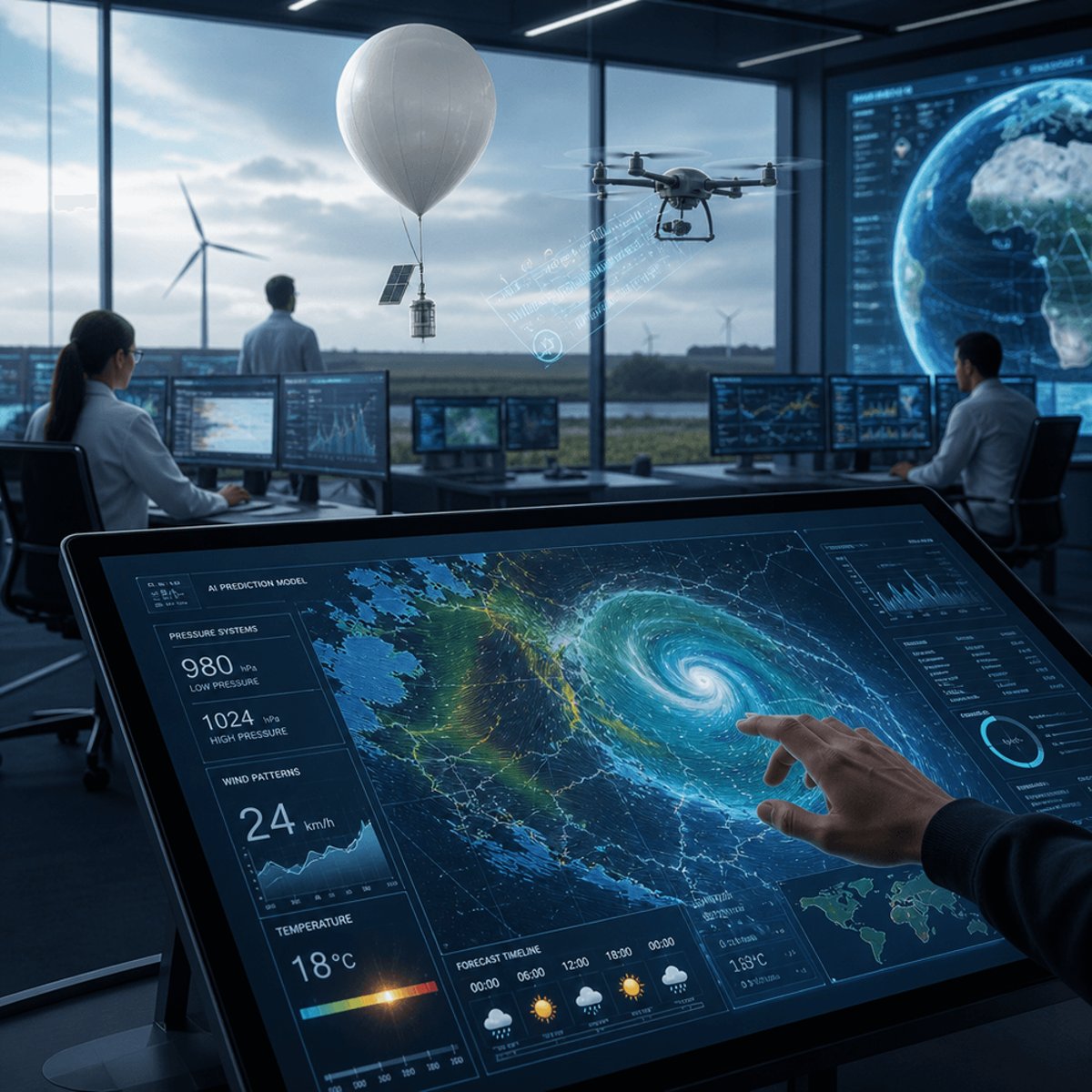
WindBorne Systems just closed a $37 million Series B to prove that AI-powered weather forecasting can be more than just accurate—it can be profitable. The startup's network of autonomous weather balloons collects atmospheric data that traditional satellites miss, feeding machine learning models that promise to outperform government forecasts. As extreme weather events multiply and industries from agriculture to energy demand better predictions, WindBorne is betting it can turn meteorology into a lucrative enterprise AI play.
WindBorne Systems is making a bold wager that the future of weather forecasting isn't just more accurate—it's a venture-backed business model. The California-based startup just secured $37 million in Series B funding to expand its fleet of autonomous weather balloons and refine the AI models that turn atmospheric data into commercial forecasts.
The timing couldn't be sharper. Climate change is making weather more volatile and unpredictable, forcing industries from agriculture to aviation to rethink how they plan operations. Traditional government weather services, while comprehensive, often lack the granularity and speed that commercial clients demand. That's where WindBorne sees its opening.
The company's approach is refreshingly analog in an age of satellites and sensors. WindBorne launches biodegradable weather balloons equipped with instruments that measure temperature, humidity, pressure, and wind patterns as they drift through the atmosphere. These balloons can reach altitudes and regions—think the middle of the Pacific Ocean or remote polar areas—where traditional data collection is sparse or nonexistent. The result is a dataset that captures atmospheric conditions conventional satellites might miss.
But hardware is only half the story. WindBorne feeds this proprietary data into machine learning models designed to generate forecasts that outperform legacy systems. The company claims its AI can predict weather patterns with greater accuracy and longer lead times than government agencies, a bold assertion in a field where incremental improvements are hard-won. If true, that edge could translate into serious revenue from clients who need to make million-dollar decisions based on whether it'll rain next Tuesday.
The Series B round, details of which weren't fully disclosed in initial reports, positions WindBorne to scale both its balloon operations and its commercial partnerships. The startup has already worked with clients in agriculture, where accurate precipitation forecasts can determine planting schedules and crop yields, and energy, where wind and solar operators need precise predictions to optimize grid contributions.
What makes this funding noteworthy isn't just the dollar figure—it's the validation of a business model that blends physical infrastructure with AI software. Climate tech has seen waves of hype and disappointment, but WindBorne represents a more pragmatic approach: solve a real problem with measurable ROI, then charge for the solution. Weather prediction affects trillions of dollars in economic activity annually, from commodity trading to disaster preparedness. Even marginal improvements in accuracy can justify premium pricing.
The competitive landscape is heating up. Tech giants like Google and Microsoft have invested heavily in AI-powered weather models, leveraging massive compute resources and existing datasets. Startups like Tomorrow.io have raised hundreds of millions to build weather intelligence platforms. WindBorne's advantage lies in its unique data collection method—those balloons generate information competitors can't easily replicate without building their own hardware networks.
Still, questions remain about scalability and economics. Launching and tracking thousands of balloons isn't cheap, and the unit economics need to pencil out against subscription or licensing revenue. WindBorne will need to prove it can deliver consistently superior forecasts at a cost structure that supports venture-scale returns. The startup hasn't disclosed customer numbers or revenue figures, leaving observers to gauge traction indirectly.
Investors are clearly betting that the convergence of climate urgency, AI capabilities, and commercial demand creates a viable market. Weather forecasting has traditionally been a public good provided by government agencies, but as industries digitize and optimize operations in real-time, they're willing to pay for better, faster, more localized predictions. WindBorne is positioning itself as the premium option in that emerging market.
The broader implications extend beyond weather apps and farming schedules. Accurate forecasting is critical infrastructure for climate adaptation. As hurricanes intensify, droughts persist, and extreme heat becomes routine, societies need better tools to anticipate and respond. If WindBorne's AI models prove superior, they could inform everything from evacuation planning to insurance underwriting. That's the kind of impact that attracts not just venture capital, but strategic partnerships with governments and multinational corporations.
What happens next will test whether specialized AI applications can carve out defensible niches against generalist tech platforms. WindBorne has raised enough capital to prove its technology at scale, but execution is everything. The company needs to demonstrate that its forecasts consistently beat alternatives, that customers renew contracts, and that the balloon network can grow without operational headaches. If those pieces fall into place, WindBorne could define a new category: AI-native infrastructure for climate intelligence.
WindBorne's $37 million raise is a referendum on whether AI can transform weather forecasting from a public utility into a profitable enterprise. The startup's combination of novel data collection and machine learning positions it to serve industries desperate for better predictions in an era of climate chaos. But capital alone won't guarantee success—WindBorne needs to prove its forecasts are worth paying for, that its balloon network can scale economically, and that it can fend off deep-pocketed competitors. If it clears those hurdles, the company could establish weather intelligence as a critical category in the enterprise AI stack, turning atmospheric uncertainty into a lucrative business opportunity.