
Newsletter
OpenAI’s Monetization Moment: $20B ARR, Cerebras Voice AI Chips Deal + Cerebras’ $1B pre-IPO Raise

The Tech Buzz
January 20, 2026
IN PARTNERSHIP WITH

Top Tech News: Strong Bank Profits; Busy 2026 M&A and IPO activity; Musk $32B OpenAI lawsuit; China's Economy Up 5%
Company Watch: OpenAI x Cerebras deal, Replit nears $400M, Runpod $120M ARR, Thinking Machines eyes $50B-$60B + space tech investment boost
Buzzy Tools: ChatGPT Go, DocuSign “Iris” Law AI, FLUX.2 image edits, BNPL Rent
Buzzy Tech: “Colossus 2” gigawatt cluster, “TimeVaults” mRNA, hydrogen Raybird
Crypto: NYSE tokenized stocks 24/7, BTC slides on tariff-war risk-off, Ethereum ATH transactions & lowest gas fees + WYDE’s $EAT End hunger token open deal
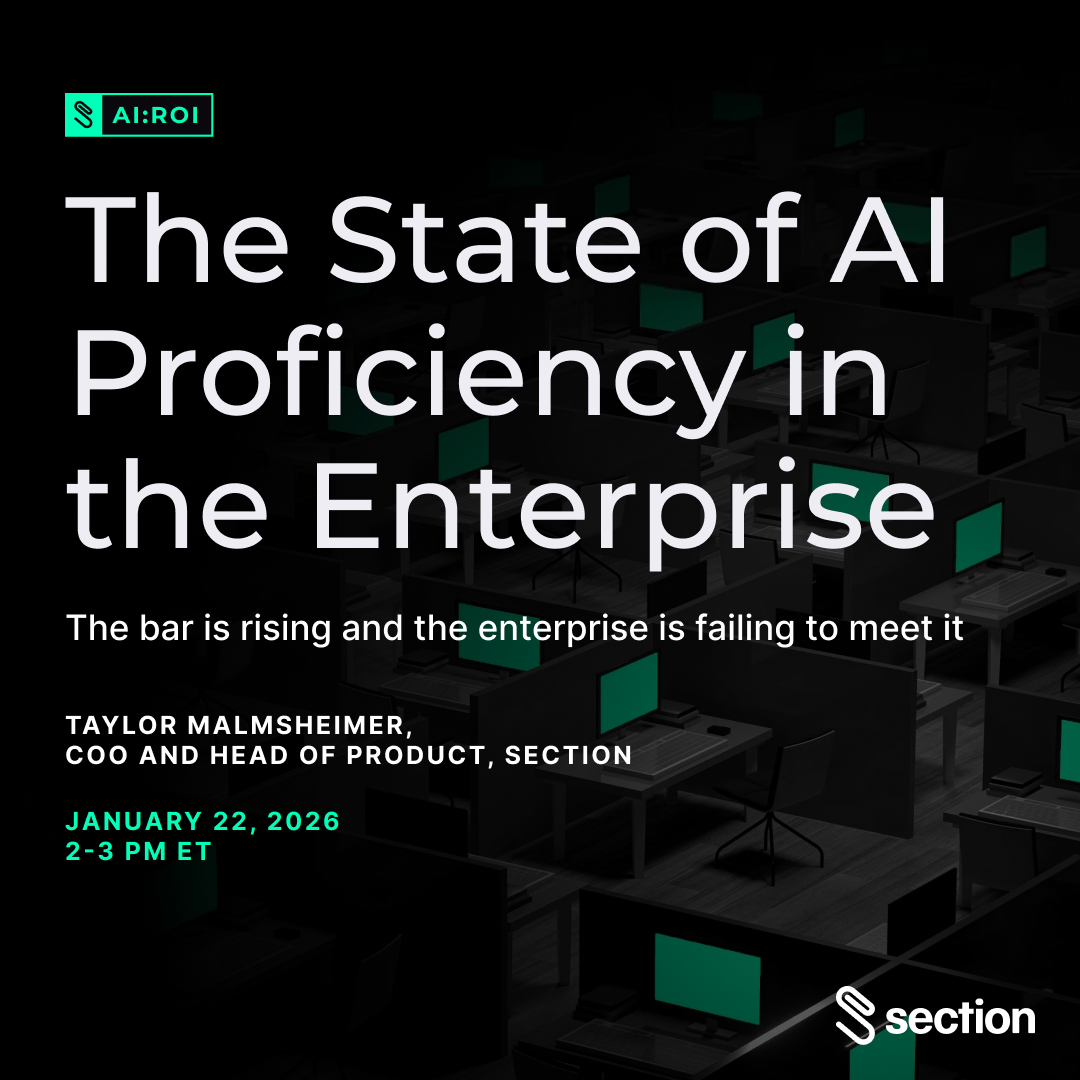
In 2026, the bar for being AI proficient has risen, but most of the workforce can barely prompt. And leadership has no idea how dire things really are.
On 1/22, join Section COO, Taylor Malmsheimer, for new data on the highest barriers to adoption, where leverage lies, and key mandates for leaders.

EU's $8T Trump Card — The EU considers financial retaliation against Trump's latest tariffs with an "anti-coercion instrument" targeting foreign investments.
Also: Deutsche Bank says US national debt is 'achilles heel' in Trump's Greenland threats. Europe holds $8T in U.S. bonds | Fortune
Stocks Surge on Strong Earnings — Goldman Sachs and Morgan Stanley report strong profits, boosting bank shares. TSMC's chip outlook lifted tech stocks Friday.
Banks Go Big — Wall Street forecasts a buzzy 2026 with strong M&A & IPO action. Morgan Stanley and JPMorgan report deals in health, industrial.
Blockchain NYSE — The NYSE is creating a blockchain-based platform for tokenized stocks, ETFs, enabling 24/7 trading & real-time stablecoins settlement.
Elon Musk reveals $134B claim, & new evidence over OpenAI’s alleged fraud regarding its nonprofit status; includes diary entries from co-founder Greg Brockman.
China's Economy grew by 5% in 2025, fueled by strong exports despite U.S. tariffs. Growth slowed to 4.5% Q4. Analysts predict further slowdown in 2026.
Tech Buzz Editorial
OpenAI just crossed $20B+ in annualized revenue, tripled year over year, and expanded its compute footprint 10x since 2023. On paper, that sounds like a company firing on all cylinders. In reality, it marks the moment OpenAI had to make a series of uncomfortable decisions that explain everything that followed this week:
Ads in ChatGPT despite Altman earlier calling it “a last resort”;
The launch of the new ChatGPT Go $8/m Tier
A deeper bets on custom chips in a major partnership (and no doubt a sizeable investment in Cerebras’ upcoming $1B fundraise);
Rumors of the new “sweetpea” AI voice assistant wearable (likely powered by cerebras “garlic” chips;
Elon’s ongoing $134B lawsuit flaring up into the next phase;
And renewed urgency around an IPO (for both OpenAI and Cerebras)
These seemingly isolated news items are all responses to the same pressure facing OpenAI and many other tech companies in January 2026. There are even signs of a resurgence in the US tech IPO markets at last, with OpenAI, Cerebras, Anthropic, SpaceX and a number of other major AI players all filing and making preparations despite borderline profit margins.
In a recent blog post, OpenAI CFO Sarah Friar confirmed OpenAI surpassed $20B in annualized revenue for 2025. Growth has been explosive. Compute usage is up 10x in two years. Weekly users now sit around 800M. The issue isn’t simply one of demand, but of conversion.
Only about 5% of those users pay at present. Subscriptions alone do not cover the cost of running one of the largest AI infrastructures on the planet. OpenAI and key rivals like Elon Musk’s xAI have committed to building and operating systems that rival national scale data centers. That reality changes the rules. At this level, even strong revenue growth can fall short.
OpenAI just announced it will begin testing targeted ads inside ChatGPT for free users and the new $8 ChatGPT Go tier in the US. The ads appear below answers as Sponsored Recommendations and are excluded from health, mental health, politics, and users under 18.
Paid tiers like Plus, Pro, Business, and Enterprise remain ad free. OpenAI says ads will not influence answers and that user conversations will not be sold to advertisers.
Still, this is a turning point. Sam Altman previously called ads in AI assistants “uniquely unsettling” and described them as a last resort. Now they are live.
That shift likely came from scale economics. When infrastructure commitments stretch into the trillion dollar range over time, stable cash flows matter more than ideals.
Timing matters. OpenAI is widely expected to target a late 2026 IPO. Public market investors will want proof that free users can be monetized without damaging trust.
That story has grown more complicated due to an ongoing lawsuit from Elon Musk, who claims OpenAI violated its original nonprofit mission and improperly aligned itself with commercial partners. While the case is still unfolding, it introduces legal uncertainty at the worst possible moment.
An IPO thrives on clarity. Lawsuits do not help valuation narratives. Ads do not either. But predictable revenue often outweighs philosophical discomfort when filings approach.
At the same time OpenAI moved on ads, it announced a major partnership with Cerebras Systems to improve real time inference. Cerebras builds massive AI chips designed for fast responses and large workloads.
The collaboration is expected to roll out in phases through 2028, with rumors from credible tech analyst sources on X yesterday also suggesting that OpenAI will utilize Cerebras chips for Codex inference and a rumored new voice mode, powered by "Garlic," which is expected to significantly improve upon the current GPT-4o offering.
This matters for two reasons. First, faster inference lowers per request costs. Second, it reduces dependence on traditional GPU supply chains dominated by Nvidia and AMD.
Cerebras itself is reportedly in talks to raise $1B at a $22B valuation and is aiming for a Q2 2026 IPO. If OpenAI is the flagship customer, and major backer of the upcoming Cerebras $1B funding round, that relationship becomes a proxy bet on OpenAI’s growth.
Last week brought reports that Jony Ive and Sam Altman are developing an AI device called Sweetpea. The concept is a behind the ear wearable that functions independently, possibly powered by a 2nm chip (Garlic peas anyone?.)
If real, this would represent OpenAI’s first serious move into consumer hardware. Voice first AI demands low latency. That aligns closely with Cerebras style inference systems.
Hardware is expensive and risky. But it also offers distribution and data advantages that software alone cannot. Apple learned that lesson early. OpenAI appears ready to test it.
OpenAI and Cerebras are not acting in isolation. The broader IPO market is warming up after years of hesitation. Confidential filings are rising. Late stage companies are quietly hiring bankers again.
At least eight U.S. venture-backed startups have filed prospectuses or started recruiting bankers. Key players include AI heavyweights like OpenAI and Anthropic, both expected to pick bankers soon with Anthropic potentially leading the way to a public listing. Discord, Strava, and Kraken have all filed confidentially for as early as H1. The most significant potential debut is SpaceX, which has signaled a listing target for H2 with a private valuation of $800B. This signals what could be a historic year for technology listings.
Across tech, the pause is ending. Capital wants liquidity again. And as usual, AI is where the biggest stories live.
OpenAI’s monetization moment is about maturity. When a company reaches this scale, every choice tightens. Infrastructure demands discipline. Public markets demand predictability. Eccentric adversarial billionaire-led Lawsuits demand extreme caution.
Ads in ChatGPT, The new ChatGPT Go Tier, Cerebras chips, wearable experiments, and IPO preparation are all parts of the same system coming into focus.
That is the sound of OpenAI accepting that the era of infinite runway based on AI hype is over (at least for now). The era of proving ROI and sustainability has begun. OpenAI may be uniquely poised at this intersection, despite losing a good deal of its market leader credibility to a resurgent Google in the latter half of 2025.
It's hard to parse what the looming IPO market really represents for the future of the markets for the average investor. “Smart-money” investors that were early on the AI wave are gearing up for what could be a historic year for technology listings. Is this wave a desperate play for suckers to provide exit liquidity before the AI bubble bursts for real, or something more sustainable?
The clearest way to understand this moment is to stop asking whether the IPO wave is “good” or “bad” and start asking what kind of market it is creating.
Private capital built the AI era quickly, but it cannot carry it indefinitely. When systems become this large, this expensive, and this embedded in everyday life, they stop behaving like venture bets and start behaving like infrastructure. Infrastructure eventually migrates to public markets not because it is failing, but because it needs permanent capital and public accountability.
That shift is uncomfortable for everyone. Insiders lose control of the narrative. Retail investors inherit the risks of scale. Regulators step closer. Growth slows and discipline replaces experimentation. That looks like a system being forced to grow up.
Some of these IPOs will underperform. Some will arrive overpriced. That is inevitable. What would be more concerning is if none of them were willing to go public at all. That would suggest the economics do not survive scrutiny.
Instead, what we are seeing is a handoff. The speculative phase is narrowing. The market is asking which AI companies can operate like utilities, price like monopolies, and survive without constant capital injections.
For investors, the opportunity is in recognizing early which businesses are transitioning from excitement to endurance.
This may not be the end of the AI cycle. But it definitely is shaping up to be a defining moment where the story starts being more about responsibility than possibility.
The first crypto 501c4 nonprofit (WYDE: END HUNGER $EAT) that has aimed to use trade fees to feed those who are hungry has recently:
Hit it’s all time high market cap following a new year surge to $14.4M FDV
Reached the milestone of funding 5000 meals through Food charities
Secured Charitable Status as Tax-exempt (the 1st U.S. exchange to do so)
Latest deals and trending companies
[Open Deal] Lambda provides AI cloud infrastructure and plans to raise at least $350M in a pre-IPO round, with Nvidia as a key partner. Despite a $175M loss, its $520M revenue shows strong growth.
OpenAI x Cerebras — OpenAI is reportedly adopting Cerebras chips for its Codex inference + new voice mode "Garlic," enhancing GPT-4o.
Also: ChatGPT Ads — Free and Go users to see targeted ads + Go Tier $8/mth
Replit Inc. — The AI coding startup is close to securing a $400M funding round led by Georgian, potentially boosting to $9B PMV.
US-Taiwan Chip Deal — A $250B agreement with Taiwan aims to boost US chip manufacturing. TSMC plans to build six fabs in Arizona.
Runpod — AI app hosting platform has reached $120M ARR. Originating from a Reddit post, Runpod serves 500,000 developers.
Moonshot AI — Chinese Alibaba-backed AI firm hit a $4.8B valuation as competitors Zhipu & MiniMax go public.
Thinking Machines Lab — Mira Murati’s AI startup is in talks to raise funding at a valuation of $50B-$60B. Tinker for fine-tuning language models is live.
Space Race — Global investment in space technology is set to rise in 2026, driven by defense satellite systems. The U.S. leads with $7.3B + a potential SpaceX IPO.
The Latest Trending Tools & Cutting Edge Technology Developments
ChatGPT Go — GPT-5.2, longer memory, file uploads for $8/mth.
DocuSign — Iris AI simplifies contracts, answers specific queries.
Black Forest — FLUX.2 [klein] high-quality 1 sec AI image edits.
Astral — AI tool for marketing tasks raises $1.2M, viral 3M view X post.
Vellum — AI agents using plain English for tasks, no hosting fees.
Affirm BNPL for Rent — Zero-interest loans for rent payment mgmt.
Colossus 2 — World's 1st gigawatt-scale AI cluster tops SF energy use.
TimeVaults — Cellular storage captures mRNA to study cancer-drug resistance.
Raybird Drone — Hydrogen-powered drone, 12-hr, quiet, minimal heat sig.
Plasma Fireballs at CERN — Stable plasma jets suggest ancient magnetic fields.
Space Race
NASA Artemis II_1st crewed lunar flight since 1972 tests for Moon, Mars missions.
China Megaconstellation — Chinese firms plan 200K satellites to rival Starlink.
The Latest News in Crypto & Blockchain
Open Deal: The first crypto 501c4 nonprofit (WYDE: END HUNGER $EAT) that has aimed to use trade fees to feed those who are hungry just hit it’s all time high ($14.4M FDV) the same day it reached the milestone of funding 5000 meals.
Blockchain NYSE — The New York Stock Exchange is creating a blockchain-based platform for tokenized stocks, ETFs, enabling 24/7 trading & real-time stablecoins settlement.
Cryptos Tumble on Trade War Fears — Bitcoin fell to $92,474 amid U.S.-EU trade war fears, liquidating over $750M in long positions.
Vitalik Buterin on DAOs — Vitalik Buterin calls for enhanced decentralized autonomous organizations (DAOs), moving beyond current token-holder voting models.
Ethereum Boom — Ethereum daily transactions hit ~2.5M, a record, with gas fees at $0.15 post-Fusaka upgrade. Stablecoins = 35-40% of transfers, staking is at ATH.
BitMine & MrBeast Partnership — BitMine Immersion Technologies invests $200M in MrBeast's Beast Industries to boost growth and explore defi.
The first crypto 501c4 nonprofit (WYDE: END HUNGER $EAT) that has aimed to use trade fees to feed those who are hungry has just hit it’s all time high ($14.4M FDV) the same day it reached the milestone of funding 5000 meals.
Coinbase Listing: $EAT
It was launched on the Wyoming Decentralized Exchange and is now tradable on Coinbase.
Tradable on Coinbase - TRADE
The first cause coin with an organizational structure behind it (DUNA 501c4 federally approved tax exempt organization).
The $EAT team is working with some of the most well-respected nonprofits in America
Every trade funds verified food banks and operators who impact their local community.
Holding $EAT provides you with governance in the organization (coming soon)
Fair launched and fully decentralized.
Meals Funded so far: 5,100 / Next Milestone: 10,000
Current number of holders: 548
Visit www.wyde.org for more information on Wyoming Decentralized Exchange
Instagram: https://www.instagram.com/thetechbuzz.ig/

| Get the daily newsletter that helps you understand the tech ecosystem sent to your inbox.
More Newsletter Posts


