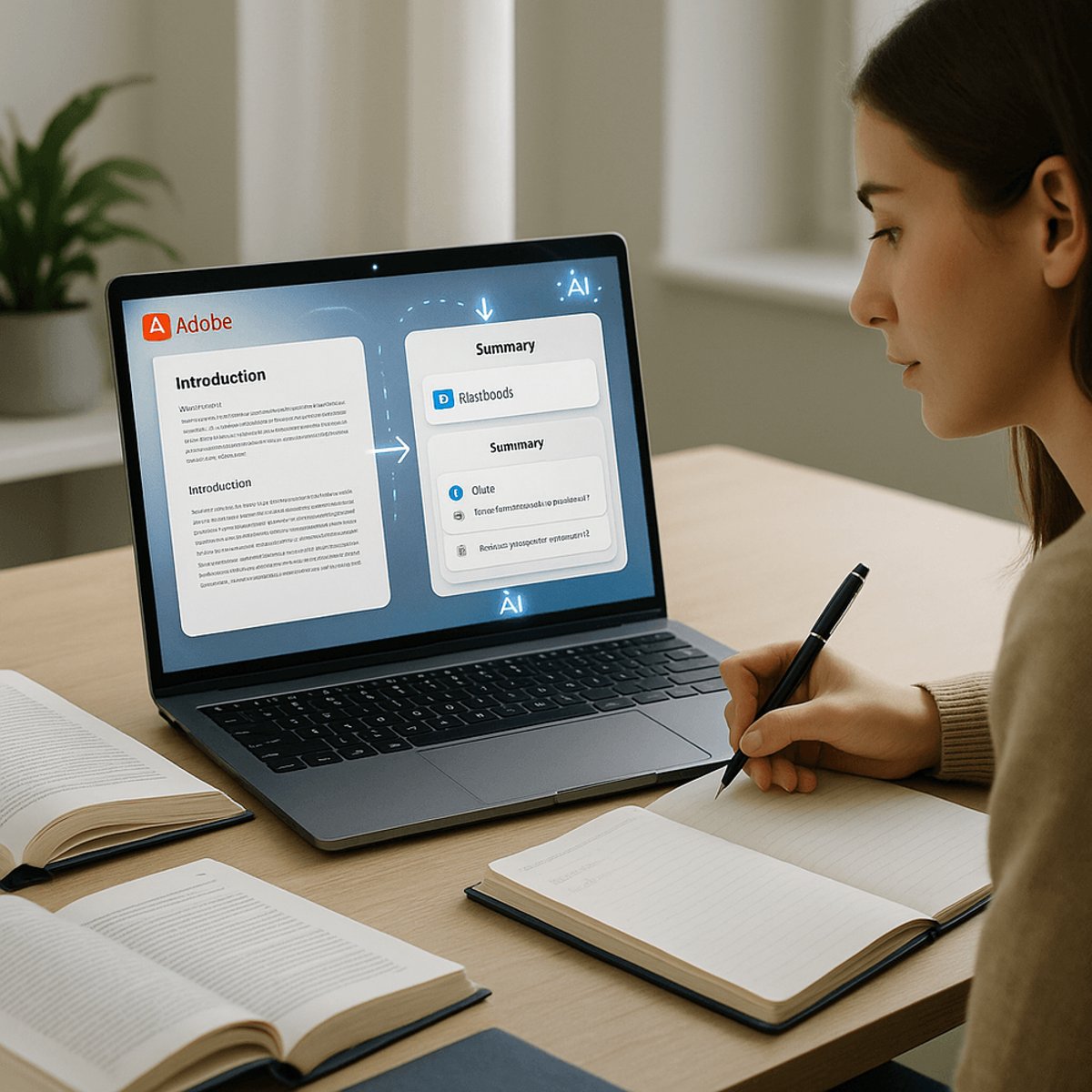
Adobe just made a play for the student market with Acrobat Spaces, a free AI-powered tool that transforms dense PDFs and documents into digestible study materials. The launch signals Adobe's push to embed AI across its product line while capturing the next generation of creative professionals before they graduate. It's also a direct challenge to emerging edtech startups banking on AI-driven learning tools.
Adobe is betting that today's students are tomorrow's enterprise users. The company unveiled Acrobat Spaces, a free AI-powered study tool that lets students upload documents and generate flashcards, summaries, quizzes, and other study materials without paying for a premium subscription. It's a strategic play that blends product development with user acquisition, capturing students early before they enter the workforce.
The timing isn't accidental. AI-powered education tools have exploded over the past year, with startups like Quizlet,Studocu, and even OpenAI's ChatGPT becoming study hall staples. Adobe's entry leverages its existing document expertise - Acrobat already processes billions of PDFs annually - while adding generative AI capabilities that feel native to how students actually work. According to TechCrunch, the tool integrates directly with Adobe's existing Acrobat infrastructure, suggesting this isn't just a standalone experiment but part of a broader AI platform strategy.
What makes Acrobat Spaces different from ChatGPT or other AI tutors? It's purpose-built for document workflows. Students can dump lecture notes, textbook chapters, or research papers into the platform and get structured outputs designed specifically for studying - not general-purpose chat responses. The AI analyzes document structure, pulls key concepts, and formats everything into study-friendly formats. For Adobe, it's also a data play: understanding how students interact with documents could inform future AI features across Creative Cloud and Document Cloud.
The education sector has become a battleground for AI companies. Google embeds AI into Classroom and Workspace, Microsoft pushes Copilot into Teams for Education, and dozens of startups are chasing venture funding with AI tutoring pitches. Adobe's advantage lies in brand recognition and existing institutional relationships - many universities already license Creative Cloud, making Acrobat Spaces an easy upsell or retention tool.
But there's a catch. While Acrobat Spaces is free, it's unclear how long Adobe will keep it that way or what premium features might emerge. The company has a history of offering free student versions of expensive software to build loyalty, then converting users to paid subscriptions once they graduate. This could follow the same playbook: hook students on AI-powered document tools, then transition them to paid Acrobat or Creative Cloud plans when they enter the job market.
The move also reflects Adobe's broader AI integration across its portfolio. The company has rolled out AI features in Photoshop, Premiere, and Firefly, its generative AI platform. Acrobat Spaces extends that momentum into a new demographic while reinforcing Adobe's positioning as an AI-first creative and productivity company. It's not just about competing with education startups - it's about staying relevant as Microsoft and Google embed AI into every corner of their ecosystems.
Competitors won't sit still. Notion recently added AI writing assistants, Canva launched AI design tools for students, and even traditional learning management systems like Canvas are experimenting with AI tutors. Adobe's challenge will be differentiating Acrobat Spaces beyond just being another AI tool. The document-centric approach helps, but students are already juggling multiple AI platforms - they'll only stick with tools that genuinely save time and improve outcomes.
For educators, Acrobat Spaces raises familiar questions about AI in the classroom. Does automating study material generation help students learn, or does it encourage surface-level engagement? Adobe hasn't published research on learning outcomes yet, and the edtech community remains divided on whether AI tools enhance or replace critical thinking. Universities will be watching closely to see if Acrobat Spaces becomes a genuine learning aid or just another shortcut.
The financial implications are subtle but significant. Adobe doesn't break out Acrobat revenue separately, but Document Cloud generated $2.9 billion in fiscal 2025, according to the company's latest earnings. Adding a free student tier could pressure short-term margins but expand the user base dramatically. If even a fraction of users convert to paid plans post-graduation, the lifetime value could justify the upfront investment. It's a classic freemium bet - lose money now to build a moat later.
What's next? Adobe will likely iterate quickly based on user feedback, adding features like collaborative study spaces, integration with learning management systems, or even AI-generated practice exams. The real test comes in six months when usage data reveals whether students actually adopt Acrobat Spaces or if it becomes another forgotten free tool. Adobe's success depends on execution - making the AI good enough to replace ChatGPT for document-heavy studying, and making the experience seamless enough that students don't churn.
Adobe's Acrobat Spaces launch is more than a free student tool - it's a calculated bet on the future of AI-powered productivity and a strategic play to capture the next generation of creative professionals. If Adobe can make the AI genuinely useful and keep students engaged through graduation, it could convert free users into enterprise revenue for decades. But the company faces fierce competition from startups and tech giants alike, all racing to own the intersection of AI and education. The real winner will be whoever builds tools students can't live without, not just another AI feature they forget to use.