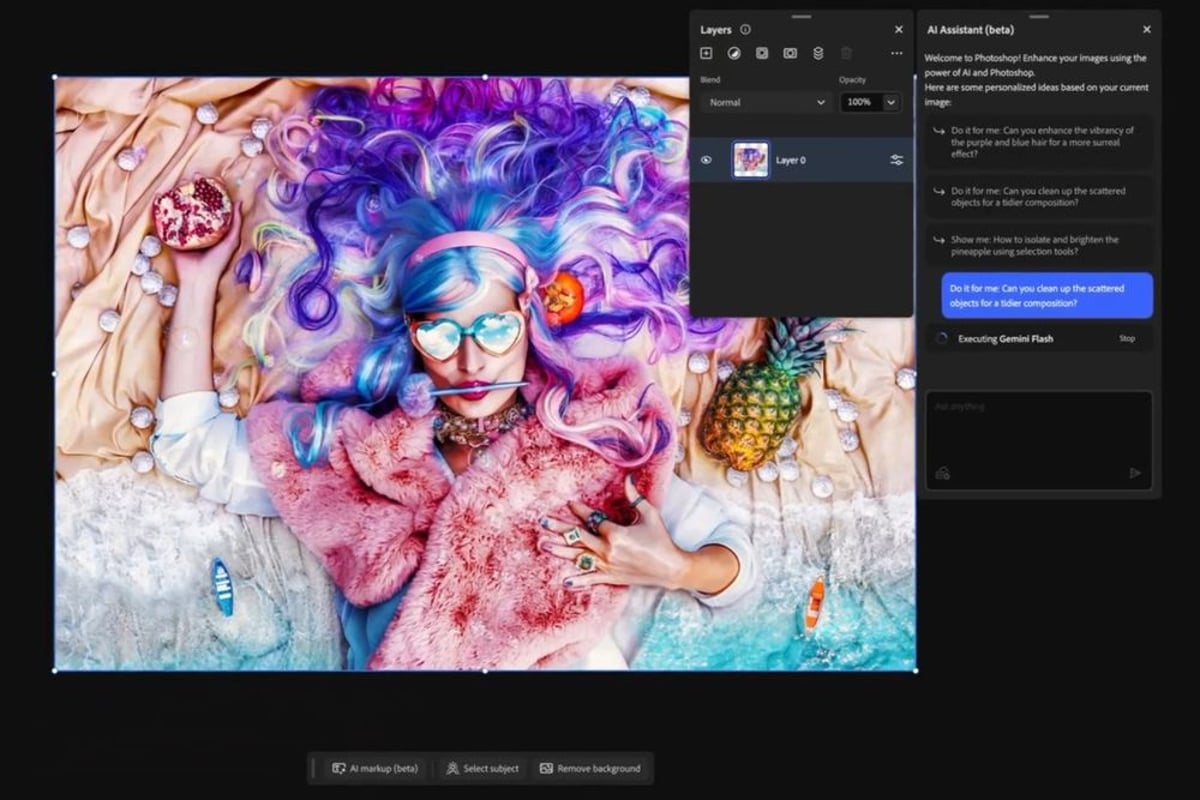
Adobe just opened the floodgates on conversational AI editing. The company's launching its AI Assistant for Photoshop web and mobile into public beta today, letting anyone describe edits like "remove the background" or "adjust the lighting" and watch the software do it automatically. It's part of a broader push into agentic AI across Creative Cloud, with Adobe apps also getting integrated directly into Microsoft's Copilot service in the coming weeks.
Adobe is betting big on conversational AI, and Photoshop just became the proving ground. The company's rolling out its AI Assistant in public beta for Photoshop web and mobile users, marking a major shift in how people interact with the industry's most iconic image editor. Instead of hunting through menus or memorizing keyboard shortcuts, users can now just ask - "change this background to a sunset" or "make the subject pop" - and the AI figures out the rest.
The feature first appeared in a private beta back in October during Adobe's MAX conference, but the public release opens it to Creative Cloud subscribers worldwide. According to Adobe's announcement, the assistant can handle everything from removing distractions and swapping backgrounds to refining lighting and adjusting color balance. It's powered by Adobe's Firefly generative AI models, which the company has positioned as commercially safe alternatives to models trained on questionable datasets.
But Photoshop is just the opening salvo. Adobe revealed this week that it's pushing agentic AI features across its entire Creative Cloud lineup, with similar assistants already deployed in Express and Acrobat. The bigger play? Getting Adobe's tools embedded directly into Microsoft Copilot, giving enterprise users one-click access to Acrobat, Express, and other Adobe services without leaving their workflow.
The timing isn't accidental. Microsoft has been aggressively bundling Copilot into its enterprise offerings, and Adobe clearly wants a piece of that distribution. For Adobe, this is about staying relevant as AI-native tools like Midjourney and Runway chip away at its creative monopoly. For Microsoft, it's another way to make Copilot indispensable - the operating system for enterprise AI.
The technology itself represents what Adobe calls "agentic AI" - software that doesn't just respond to commands but interprets intent and executes multi-step workflows. Ask to "make this photo Instagram-ready" and the assistant might adjust exposure, crop to 1:1, boost saturation, and add a subtle vignette, all without further prompting. It's a fundamentally different interaction model than Photoshop's traditional tool-based approach.
Early reactions from the private beta have been mixed. Professional designers appreciate the speed for routine tasks but worry about losing granular control. Hobbyists and content creators, though, are exactly the audience Adobe's chasing - people who want professional results without professional skills. The company's made no secret that it sees AI assistants as a way to expand its addressable market beyond the creative class.
The competitive landscape is getting crowded fast. Canva has been integrating AI features at breakneck speed, while startups like Photoroom and Remove.bg have built entire businesses around single AI-powered editing tasks. Adobe's advantage is integration - the AI Assistant lives inside the same ecosystem as advanced tools like layers, masks, and adjustment curves. Power users can let AI handle the grunt work, then fine-tune manually.
There's also the business model question. Adobe hasn't announced separate pricing for the AI Assistant, bundling it into existing Creative Cloud subscriptions for now. But the company introduced "generative credits" last year to meter AI usage, and heavy users already bump into limits. As these features move from beta to production, expect Adobe to start monetizing AI more aggressively - likely through tiered credit systems or premium AI add-ons.
The Microsoft partnership could be the real game-changer. Copilot already has 70 million daily active users according to Microsoft's recent earnings report, and most of them are enterprise workers who occasionally need to edit a PDF or create a graphic. If Adobe can make Acrobat and Express feel native inside Copilot, it's suddenly competing for workflow automation dollars, not just creative software budgets.
For now, the public beta is live for anyone with a Creative Cloud subscription who accesses Photoshop through a web browser or mobile app. The desktop version still relies on traditional AI features like Generative Fill and Remove Tool, though Adobe says a native assistant is "coming soon." Desktop users aren't thrilled about being left out of the beta, but it makes sense from Adobe's perspective - web and mobile are where new users start, and where the company needs to prove AI can lower the learning curve.
Adobe's public beta of its Photoshop AI Assistant represents more than a feature update - it's a fundamental reimagining of how creative software works. By making image editing conversational, Adobe is lowering barriers for new users while giving pros a faster way to handle routine work. The real story is the Microsoft Copilot integration coming next, which could transform Adobe from a creative suite into an enterprise AI utility. As the lines blur between specialized tools and general-purpose AI agents, Adobe's racing to prove its 35 years of imaging expertise can't be replicated by a chatbot alone.