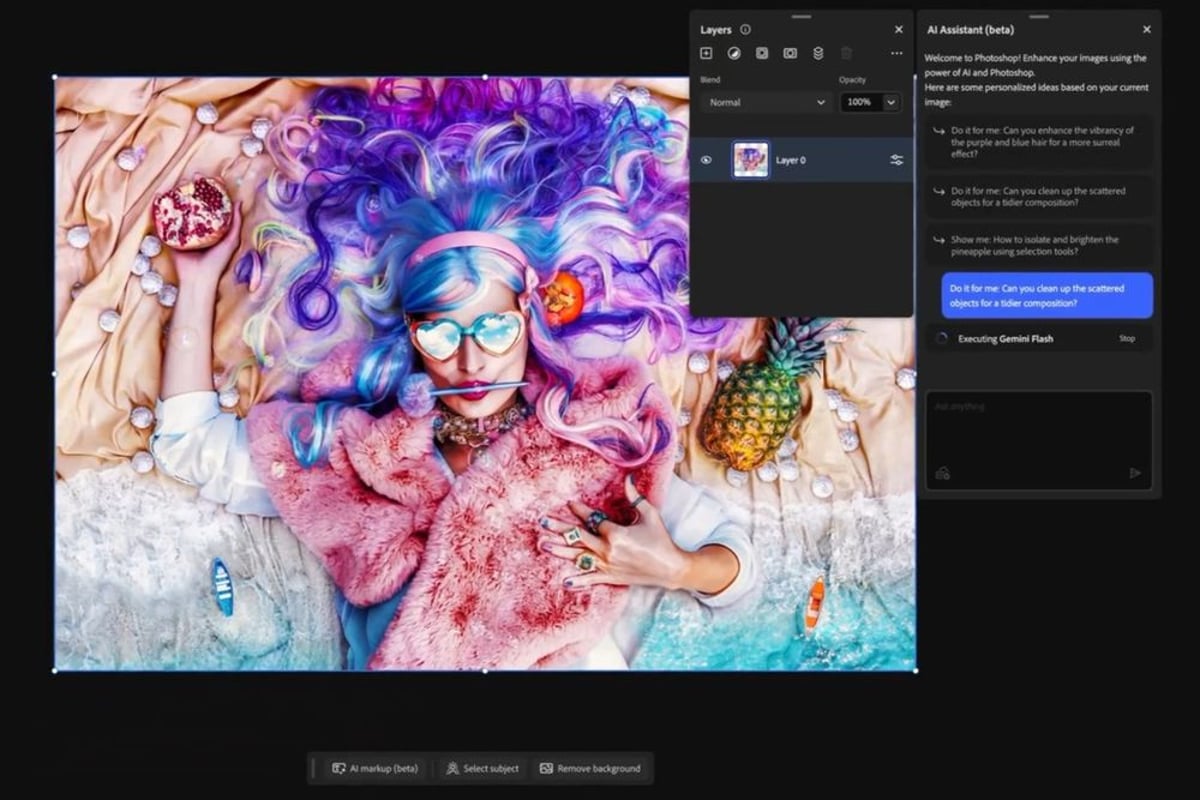
Adobe just threw open the doors to its AI-powered editing future. The company's conversational AI Assistant for Photoshop on web and mobile has officially launched in public beta, letting anyone describe edits in plain English instead of hunting through menus. It's the latest push in Adobe's race to make professional creative tools as easy as chatting with an assistant - and it's coming with a Microsoft Copilot integration that could bring Creative Cloud apps to millions more users.
Adobe is betting big that the future of creative work looks more like a conversation than a toolbar. The company just opened its AI Assistant for Photoshop web and mobile to public beta testing, according to The Verge, after months of limited private testing that began last October.
The tool works exactly how you'd expect in 2026 - you tell it what you want, and it handles the technical execution. Need to swap out a background? Remove a photobomber? Adjust the lighting to look less like a fluorescent office? Just describe it conversationally, and the AI Assistant interprets your intent and applies the appropriate Photoshop tools. It's the kind of interface that makes professional editing accessible to people who've never learned what a layer mask does.
But Adobe isn't just making Photoshop easier to use. The company announced it's weaving Creative Cloud apps directly into Microsoft Copilot, meaning users working in Microsoft's enterprise ecosystem will soon access Acrobat and Express without leaving their workflow. That's a distribution play with serious implications - Copilot already reaches millions of enterprise users, and embedding Adobe's tools there could dramatically expand the company's reach beyond its traditional creative professional base.
The timing isn't coincidental. Adobe has been racing to prove it can integrate AI without losing what made its tools industry-standard in the first place. While competitors like Canva have attracted users with AI-first simplicity, and pure AI tools like Midjourney have captured the imagination of digital artists, Adobe's been playing a more careful game - enhancing professional workflows rather than replacing them.
This approach to what Adobe calls "agentic AI" - systems that can take actions on your behalf rather than just generating content - represents a fundamental shift in how creative software works. Instead of users learning complex tools, the tools are learning to understand users. The AI Assistant doesn't just know Photoshop's capabilities; it translates human intent into technical execution.
The web and mobile focus is strategic too. Adobe's desktop apps remain the gold standard for professional work, but opening AI capabilities on more accessible platforms lowers the barrier to entry. Someone can start editing photos conversationally on their phone, get hooked on the capability, and potentially graduate to a full Creative Cloud subscription.
Adobe first teased these capabilities during its MAX conference last year, when it simultaneously announced AI assistants for Express and hinted at broader Creative Cloud integration. The company has been methodical about the rollout, likely learning from the private beta what works and what confuses users when you replace precise controls with conversational commands.
The technology raises interesting questions about Adobe's business model. If AI can handle more of the technical work, does that devalue the expertise that justified premium subscriptions? Or does it expand the addressable market enough to offset any cannibalization? Adobe seems to be betting on expansion - that making creative tools more accessible creates more customers rather than cheaper ones.
The Microsoft partnership adds another dimension. By integrating into Copilot, Adobe is essentially renting space in Microsoft's AI interface, exposing Creative Cloud capabilities to users who might never have considered downloading Photoshop. It's a recognition that in an AI-driven world, distribution happens through conversational interfaces, not app stores.
For now, the AI Assistant handles relatively straightforward edits - the kind of tasks that previously required knowing which tools to use but not necessarily advanced artistic judgment. The real test will be how far Adobe can push the capability before hitting the limits of what conversational AI can understand about creative intent.
Adobe's public beta launch marks a clear inflection point in how creative software works. By making Photoshop conversational and embedding Creative Cloud into Microsoft's enterprise ecosystem, the company is simultaneously lowering barriers for newcomers and expanding distribution to millions of potential users. The question isn't whether AI will change creative tools - it's whether Adobe can maintain its professional credibility while chasing mass-market accessibility. This beta will provide the answer, as real users test whether conversational editing can match the precision that made Photoshop the industry standard. For competitors, the clock is ticking - Adobe just made professional editing tools speak everyone's language.