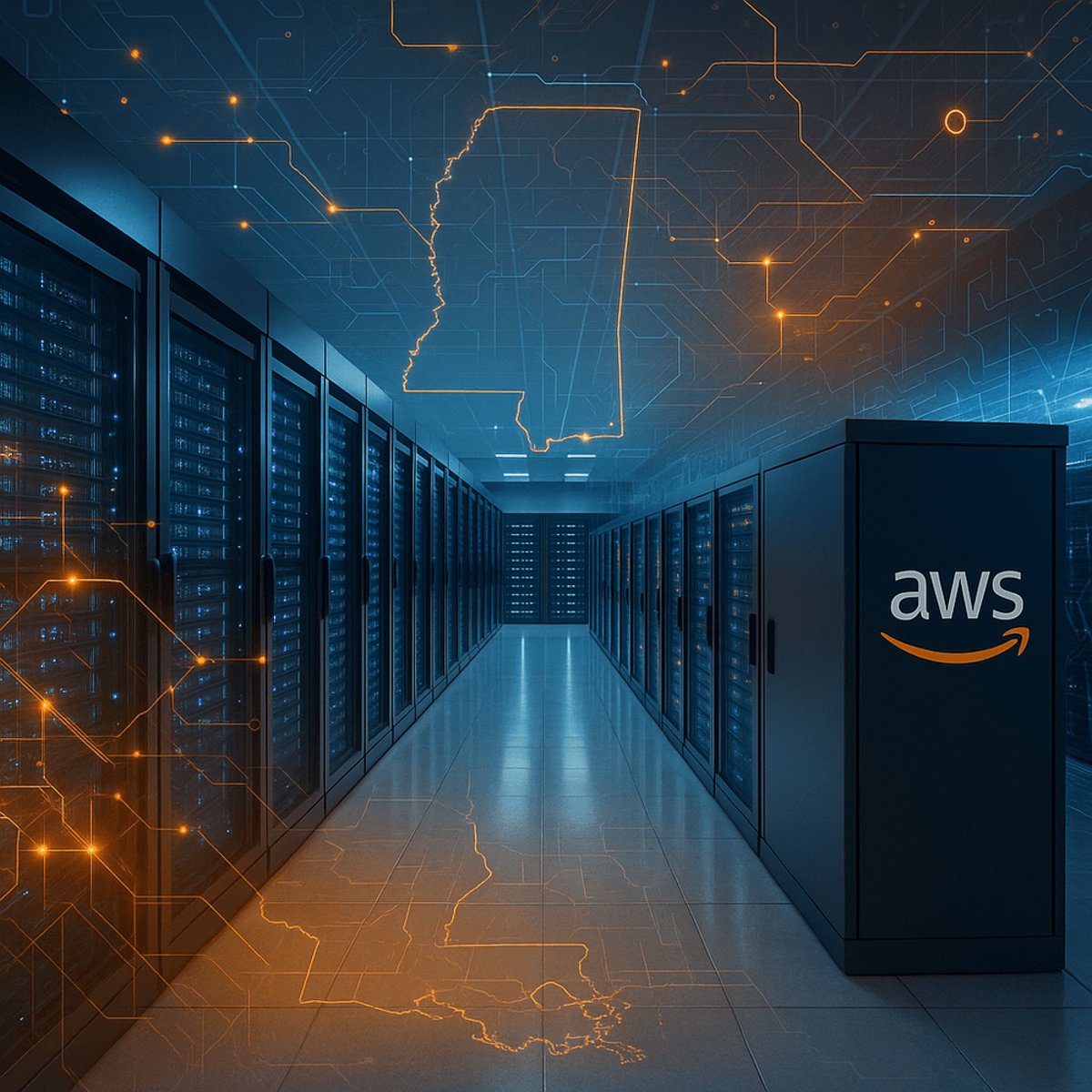
Amazon just made its biggest infrastructure bet in the Deep South. The tech giant announced a $25 billion investment to build data centers across Mississippi, creating 2,000 jobs in what marks one of the largest corporate commitments to the state in its history. The move signals Amazon's escalating race to expand cloud and AI computing capacity as demand from enterprise customers and its own AI ambitions continue to surge.
Amazon is planting a massive flag in Mississippi. The company's $25 billion commitment to build data centers across the state represents one of the largest corporate investments in Mississippi's history and underscores the frantic pace at which tech giants are building infrastructure to support AI workloads and cloud computing demands.
The investment will create 2,000 jobs, according to Amazon's official announcement. While the company didn't break out specific salary ranges, data center roles typically command salaries well above local averages, spanning everything from electrical engineers and cooling specialists to network architects and security personnel. For Mississippi, a state that's historically struggled to attract major tech employers, it's a transformational win.
But this isn't just about job creation. Amazon's move is fundamentally about capacity. The company's Amazon Web Services division is locked in an infrastructure arms race with Microsoft Azure and Google Cloud, each scrambling to build enough computing power to meet exploding demand from AI companies and enterprise customers training large language models. Data centers are the physical backbone of that competition, and whoever builds fastest gains a crucial edge.
Mississippi offers Amazon several strategic advantages. The state has abundant and relatively inexpensive electricity, a critical factor when a single large data center can consume as much power as a small city. State officials have also been aggressively courting tech infrastructure projects with tax incentives and streamlined permitting. Amazon's announcement follows similar moves by other hyperscalers exploring southern states for data center expansion, where land costs and energy rates remain lower than traditional tech hubs.
The timing isn't coincidental. Amazon has been under pressure to demonstrate concrete progress on its AI strategy. CEO Andy Jassy has repeatedly defended the company's plans to spend over $200 billion on infrastructure and technology investments, facing skepticism from some investors about returns. This Mississippi project offers tangible proof that Amazon is converting those promises into physical assets.
Data center construction also tends to move faster in states with less complex regulatory environments. While California and parts of the Northeast have become increasingly difficult places to build large-scale infrastructure due to environmental reviews and local opposition, southern states have positioned themselves as builder-friendly alternatives. Amazon appears to be betting that speed matters more than proximity to coastal tech hubs, especially when fiber networks can connect facilities anywhere.
The announcement arrives as the broader data center industry faces a capacity crunch. AI workloads require significantly more computing power and cooling capacity than traditional cloud applications. Training a single large language model can require thousands of specialized chips running for weeks, generating enormous heat and consuming massive amounts of electricity. The industry's existing infrastructure wasn't designed for this scale of demand, forcing companies to rapidly expand.
Amazon emphasized its commitment to "responsible infrastructure" in the announcement, likely a nod to growing concerns about data centers' environmental impact. The company will need to address questions about water usage for cooling systems and the carbon footprint of powering these facilities, especially in a state where renewable energy adoption has lagged behind other regions. Expect Amazon to tout renewable energy partnerships and efficiency measures as construction progresses.
For Mississippi, the deal represents economic validation but also raises questions. Will the state's workforce be ready to fill these specialized roles, or will Amazon need to import talent? How will local power grids handle the additional load? And what happens to these communities if technology shifts and Amazon's capacity needs change a decade from now? Other states that landed big data center projects have learned that the promised economic transformation doesn't always materialize as evenly as hoped.
Still, $25 billion is real money, and 2,000 jobs represent genuine opportunity in a state where the median household income sits well below the national average. Amazon's investment will likely trigger secondary development as contractors, housing, and services follow the initial construction. The question is whether Mississippi can leverage this foothold into broader tech sector growth or whether it remains primarily a location where companies park servers.
What's clear is that the cloud infrastructure buildout is far from over. If anything, Amazon's willingness to commit this level of capital suggests the company sees years of continued growth ahead, with AI serving as the primary driver. The Mississippi data centers won't come online overnight - projects of this scale typically take three to five years from announcement to operation - but they signal where Amazon believes the future of computing is headed: distributed, power-hungry, and increasingly located wherever electricity is cheap and construction is fast.
Amazon's $25 billion Mississippi commitment is about much more than southern hospitality. It's a calculated bet that the AI boom will require vastly more computing infrastructure than currently exists, and that speed and cost matter more than geographic prestige. For Mississippi, it's a chance to rewrite its economic narrative. For the broader tech industry, it's another data point showing that the infrastructure wars are just getting started. Watch how quickly Amazon can actually bring these facilities online and whether competitors respond with similar southern strategies. The cloud wars are now ground wars, and they're being fought in places that weren't on the tech map a decade ago.