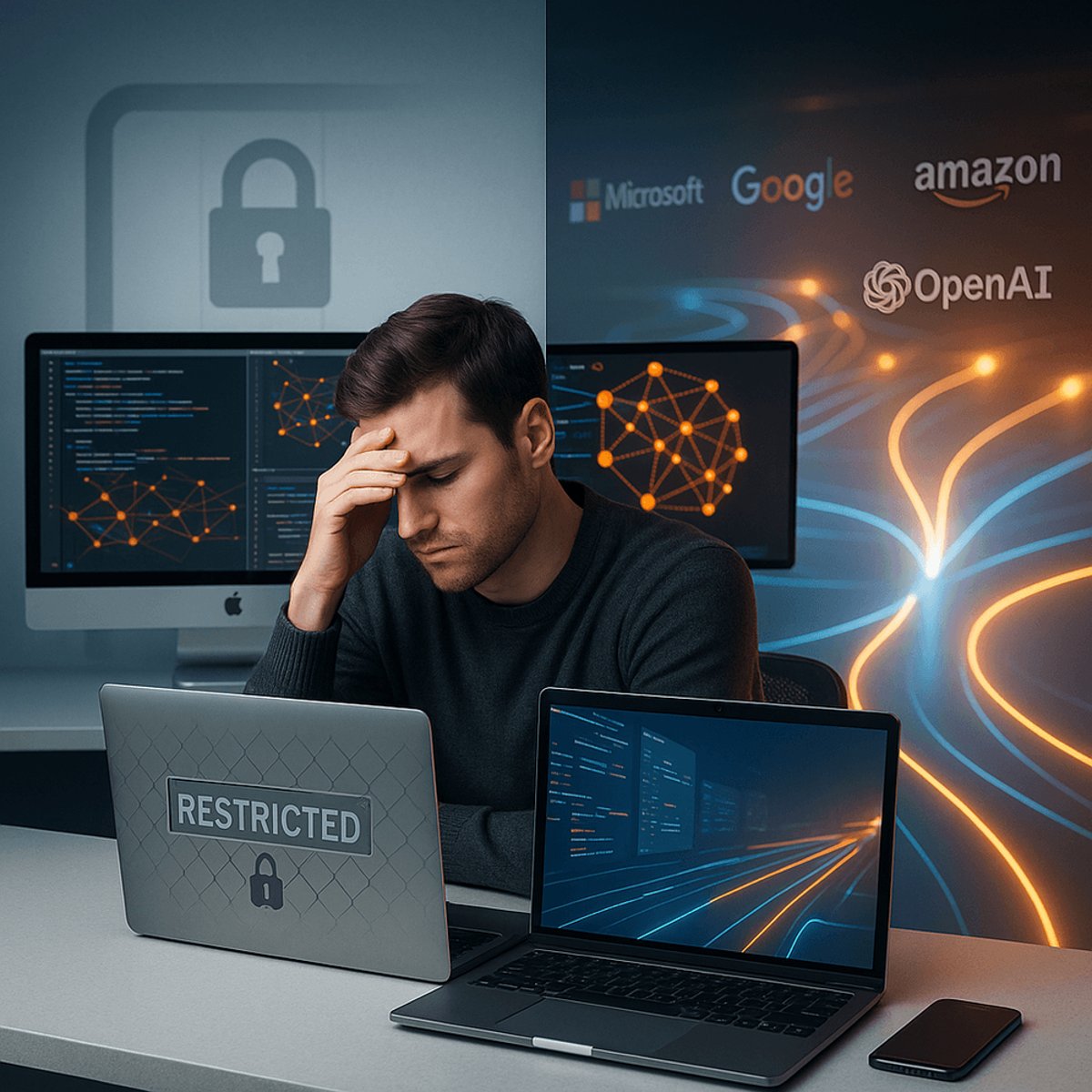
Apple is drawing fierce criticism from developers after moving to restrict AI-powered coding applications—dubbed 'vibe-coding' tools—from its App Store ecosystem. The crackdown marks a stark departure from the company's founding mission to democratize computing, putting it at odds with an emerging generation of developers who rely on AI assistants to build software. The move comes as OpenAI, Microsoft, and others race to embed AI coding capabilities into mainstream development workflows, potentially leaving Apple's platform behind.
Apple just threw a wrench into the AI coding revolution, and developers aren't happy about it. The Cupertino giant is quietly rejecting apps that enable AI-powered code generation—what the industry has started calling 'vibe-coding'—from its App Store, according to sources familiar with the policy enforcement detailed by CNBC. The move puts Apple in direct conflict with the broader tech industry's push to democratize software development through AI.
The irony isn't lost on industry observers. Fifty years ago, Steve Jobs and Steve Wozniak founded Apple with an explicit mission to put computing power into the hands of everyday people. The Apple II was revolutionary precisely because it made programming accessible to non-engineers. Now, the company is blocking the next generation of democratization tools—AI assistants that let anyone describe what they want in plain English and watch as code materializes before their eyes.
Vibe-coding apps leverage large language models from companies like OpenAI and Anthropic to translate natural language prompts into functional code. Users can say something like 'build me a recipe tracker with photo uploads' and receive working Swift or JavaScript within seconds. These tools have exploded in popularity among non-technical founders, designers, and product managers who want to prototype ideas without hiring engineering teams. But Apple apparently sees them as a threat.
The company hasn't issued a formal statement explaining the policy, but rejection notices cite vague App Store guidelines about apps that 'download or execute code.' That's the same language Apple has historically used to block JavaScript engines and game streaming services. But developers argue the comparison is disingenuous. Unlike downloadable executables that could pose security risks, AI coding tools generate code that runs in sandboxed environments—no different from apps like Swift Playgrounds that Apple itself promotes.
Meanwhile, competitors are racing ahead. Microsoft has embedded GitHub Copilot across its development tools, helping programmers write code 55% faster according to internal productivity data. Google launched Gemini Code Assist for its cloud platform, while Amazon rolled out CodeWhisperer to its massive AWS developer base. All of these tools are thriving on non-Apple platforms, creating a growing capability gap for iOS developers.
The financial stakes are enormous. Apple generated roughly $85 billion from App Store revenue in 2025, taking a 15-30% commission on digital purchases. If AI coding tools enable users to build and distribute apps outside Apple's walled garden—say, as progressive web apps—that revenue stream faces existential risk. But the crackdown might backfire. Several prominent indie developers told TechCrunch they're already exploring Android-first strategies, unwilling to invest in a platform that restricts their toolchain.
There's also a regulatory dimension. The European Union's Digital Markets Act requires Apple to allow alternative app stores and sideloading by 2026. Blocking AI coding tools while competitors embrace them could provide ammunition for antitrust regulators already scrutinizing Apple's App Store practices. The U.S. Department of Justice is watching closely after filing its landmark antitrust suit against Apple in 2024.
Some defenders argue Apple has legitimate security concerns. Generated code could theoretically contain vulnerabilities or malicious logic that slips past App Review. But critics counter that Apple already reviews all submitted apps regardless of how they were coded. If a vibe-coding app produces something dangerous, it would fail review just like any other submission. The real issue, they say, is control—Apple wants to be the gatekeeper not just for distribution but for development itself.
The developer community is mobilizing. An open letter signed by over 3,000 iOS developers calls on Apple to reverse course, arguing that 'restricting the tools we use to build software is fundamentally anti-innovation.' Some are threatening to skip iOS versions of their apps entirely, focusing instead on web-based experiences that work across platforms. That's exactly the scenario Apple has spent 15 years trying to avoid.
What happens next could define Apple's relationship with developers for the next decade. The company faces a choice: adapt to a world where AI assistance is standard for coding, or watch its platform become increasingly isolated as the rest of the industry moves forward. Steve Jobs famously said the computer is a bicycle for the mind. But if Apple keeps blocking AI coding tools, developers might just ride that bicycle somewhere else.
Apple's crackdown on AI coding apps reveals a company caught between protecting its lucrative App Store business and enabling the next wave of software development. While security concerns may be legitimate, the move looks increasingly like an attempt to maintain control over tools that threaten to bypass Apple's gatekeeping entirely. As Microsoft, Google, and others embrace AI-assisted development, Apple risks alienating the developer community that built its platform into a $85 billion-a-year business. The company that once championed putting computers in every home now finds itself restricting who gets to code—and that's a position that's tough to defend when the entire industry is moving the opposite direction.