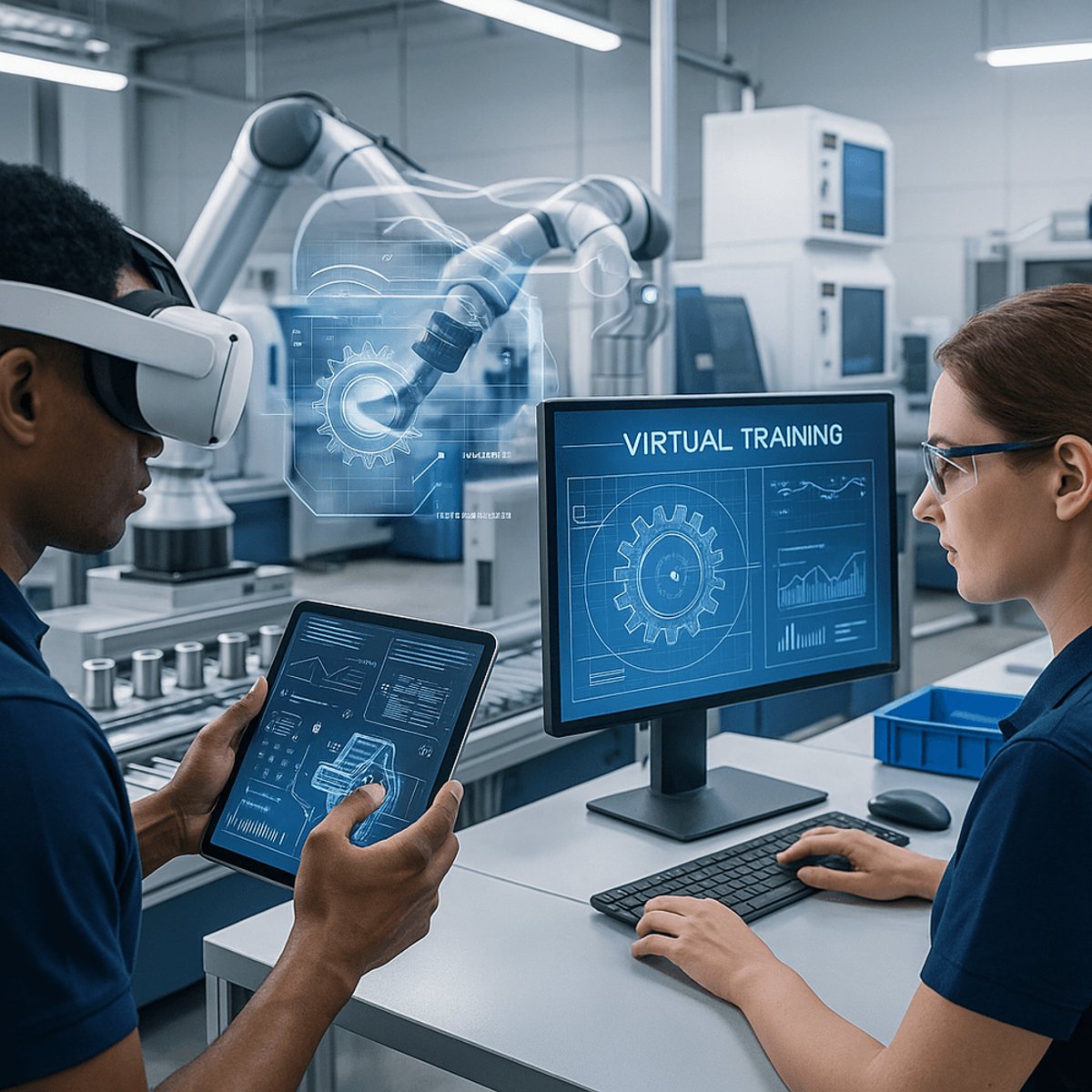
Apple just made advanced manufacturing training accessible to businesses nationwide with the launch of virtual programming for its Apple Manufacturing Academy. The move expands beyond the Detroit facility to deliver Michigan State University-developed courses covering automation, predictive maintenance, and machine learning to small- and medium-sized manufacturers across America. It's part of Apple's $600 billion U.S. investment commitment and signals how tech giants are stepping up to strengthen domestic manufacturing capabilities.
Apple is betting that virtual training can solve America's manufacturing skills gap. The company just launched online courses for its Apple Manufacturing Academy, making advanced production techniques available to small- and medium-sized businesses nationwide for the first time. The move transforms what started as a hands-on Detroit facility into a scalable digital platform that could reshape how American manufacturers learn cutting-edge techniques.
The timing isn't coincidental. As supply chain disruptions continue to highlight America's manufacturing vulnerabilities, Apple is positioning itself as both advocate and educator for domestic production. "At Apple, we believe in the power of American ingenuity, and we're proud to be delivering even more options to support small- and medium-sized companies across the country," Apple Chief Operating Officer Sabih Khan told the Apple Newsroom. The statement reflects broader tech industry efforts to rebuild American manufacturing after decades of offshore migration.
The virtual curriculum reads like a masterclass in modern production. Courses cover automation systems, predictive maintenance protocols, quality control optimization, and machine learning applications in vision systems. But Apple didn't stop at technical skills - the program includes professional development modules covering communication and presentation abilities, recognizing that manufacturing leadership requires more than just technical expertise.
Since launching in August through a partnership with Michigan State University, the Detroit facility has already trained over 80 businesses spanning Florida, Indiana, Michigan, Missouri, and Utah. That geographic spread suggests strong demand for Apple-level manufacturing knowledge, particularly from companies looking to compete with overseas production while maintaining domestic operations.
The virtual expansion comes as American manufacturing faces a critical inflection point. According to industry reports, skilled manufacturing jobs remain among the hardest to fill, with companies struggling to find workers versed in advanced automation and AI-powered systems. Apple's curriculum directly addresses these gaps, offering training in the exact technologies that separate modern manufacturing from traditional assembly line work.
What makes this significant is Apple's credibility in advanced manufacturing. The company has spent years perfecting precision manufacturing techniques for everything from iPhone components to custom silicon. That expertise now becomes available to businesses that could never afford Apple-level consultants or training programs.
The initiative fits into Apple's broader $600 billion U.S. investment commitment over the next four years. While that figure includes supplier partnerships and domestic chip production, the Manufacturing Academy represents a different approach - direct knowledge transfer rather than just capital deployment. It's manufacturing diplomacy, with Apple positioning itself as an enabler rather than competitor to smaller American manufacturers.
For participating businesses, the value proposition is clear. Free access to manufacturing techniques that typically require expensive consultants or trial-and-error development. The Michigan State University partnership adds academic credibility, while Apple's operational expertise provides real-world application.
The virtual format also solves a scale problem that physical facilities couldn't address. While the Detroit Academy can train dozens of businesses, online delivery potentially reaches thousands. That scaling matters if America seriously intends to rebuild manufacturing capabilities across multiple industries and regions.
What remains unclear is how this positions Apple relative to other tech giants pursuing manufacturing strategies. While companies like Tesla focus on vertical integration and Amazon builds fulfillment automation, Apple is sharing expertise horizontally across industries. It's an interesting bet that strengthening the entire manufacturing ecosystem benefits Apple more than hoarding competitive advantages.
The program launches as manufacturing policy becomes increasingly bipartisan, with both political parties supporting domestic production initiatives. Apple's approach - providing skills rather than just requesting subsidies - could influence how other tech companies engage with manufacturing policy discussions.
Apple's virtual Manufacturing Academy expansion represents more than corporate training - it's industrial policy through private sector expertise. By making advanced manufacturing techniques freely available nationwide, Apple is essentially democratizing production knowledge that traditionally required significant investment to access. Whether this approach can meaningfully impact America's manufacturing competitiveness remains to be seen, but it establishes Apple as a key player in domestic manufacturing renaissance efforts while potentially creating a pipeline of suppliers versed in Apple-standard production techniques.