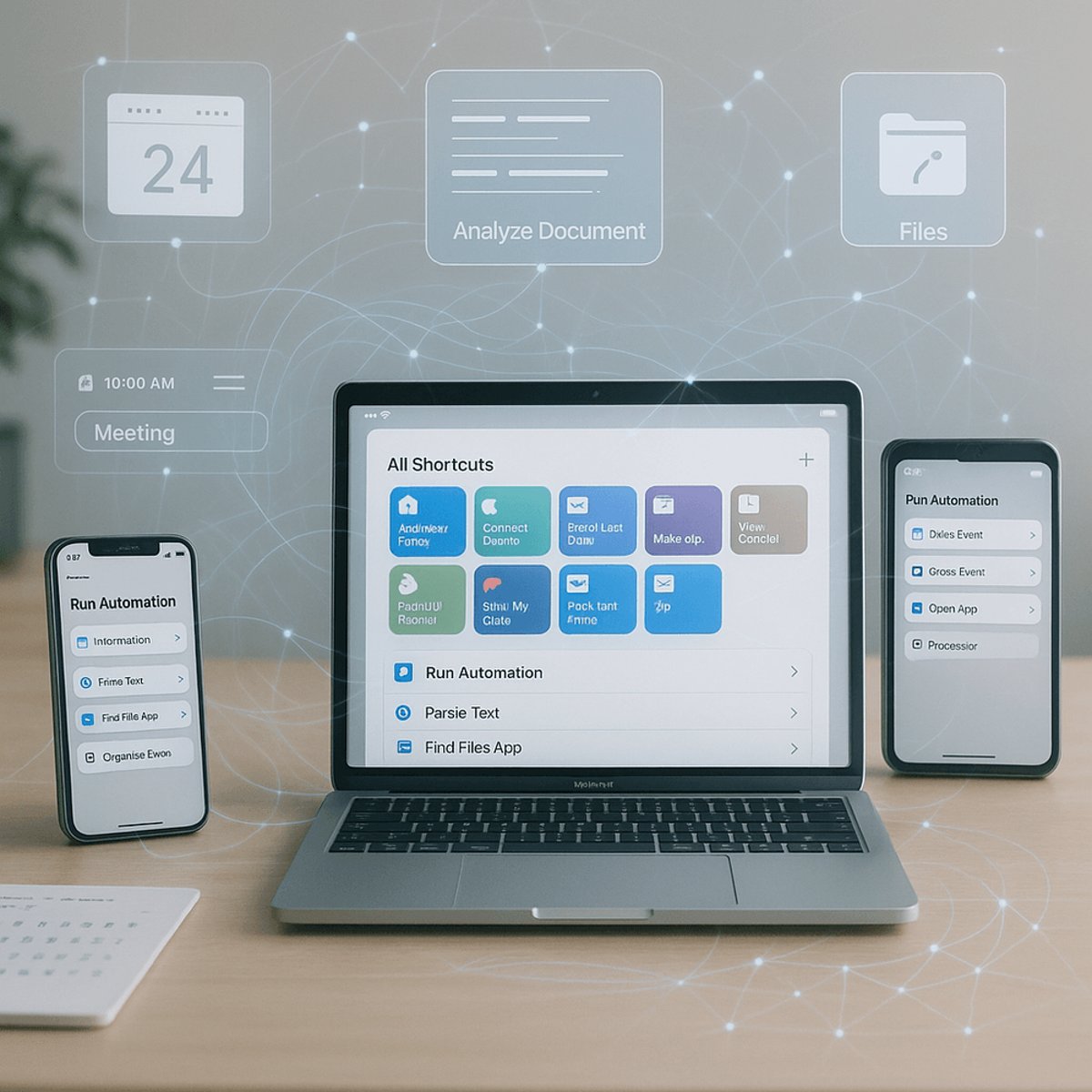
Apple just turned its most underrated productivity app into an AI powerhouse. The company's latest macOS update quietly integrates Apple Intelligence directly into Shortcuts, letting users create custom automations that can parse unstructured text, extract calendar events from messages, and build smart workflows that actually understand context. While everyone's focused on flashy AI chatbots, Apple's betting on something more practical - AI that works invisibly in the background to make your daily tasks smoother.
Apple just made one of its most overlooked apps significantly more powerful, and hardly anyone noticed. The integration of Apple Intelligence into the Shortcuts app represents a fundamentally different approach to AI - one that embeds machine learning directly into user workflows rather than forcing everything through a chatbot interface.
The update, buried in macOS 26's feature list, adds Apple Intelligence as a native application within Shortcuts. Users can now access AI-powered actions for proofreading, summarizing, and generating images directly within their automation workflows. But the real game-changer is the "Use Model" action, which offers unprecedented flexibility in how people can leverage AI for personal productivity.
This action gives users three distinct options: Apple's completely offline and private on-device model, a server-based version using the same Apple models, or direct ChatGPT integration without requiring a subscription or API key. It's a surprisingly open approach from a company known for tightly controlled ecosystems.
The practical applications become immediately clear when you consider how most people actually interact with digital information. Take calendar management - traditionally, adding an event from a text message or email requires multiple manual steps: reading the message, opening Calendar, creating a new event, and manually entering details like time, location, and title. With AI-powered Shortcuts, users can create automations that parse unstructured text and automatically populate calendar events with the extracted information.
Wired's Justin Pot, who extensively tested these capabilities, describes creating shortcuts that grab clipboard text and use multiple AI model steps to extract specific details like event titles, start times, and locations. While the system isn't perfect - it requires fine-tuning and occasional manual review - it demonstrates a more practical approach to AI integration than most consumer applications.
The approach aligns with Apple's broader Apple Intelligence strategy of making AI a feature rather than a product. Instead of forcing users to learn new interfaces or change their existing workflows, Apple Intelligence enhances tools people already use. This philosophy extends beyond Shortcuts to other areas where Apple has quietly integrated AI capabilities without making them the primary selling point.
The timing is particularly interesting given the current AI landscape. While competitors focus on increasingly powerful chatbots and multimodal AI assistants, Apple continues betting on invisible AI that solves specific problems within existing workflows. The Shortcuts integration represents this philosophy taken to its logical conclusion - users can literally program AI to work exactly how they want it to work.
For productivity enthusiasts, this opens up possibilities that go far beyond simple text manipulation. Users can create shortcuts that intelligently categorize emails, extract action items from meeting notes, or automatically organize photos based on content analysis. The AI can handle the complex pattern recognition while the Shortcuts framework provides the structural logic for automation.
The broader implications extend to how we'll actually use AI in coming years. Rather than replacing human decision-making, tools like AI-powered Shortcuts augment existing processes by handling the tedious parsing and organization tasks that consume so much daily mental energy. It's a more sustainable approach to AI adoption - one that doesn't require users to completely reimagine how they work.
Apple's bet is that most people don't want to chat with AI - they want AI to quietly make their existing tools better. The Shortcuts integration proves this vision works in practice, turning a relatively niche automation app into a surprisingly powerful platform for personal AI deployment. As more users discover these capabilities, expect to see increasingly sophisticated automation workflows that leverage AI for everything from smart home management to complex data analysis.
Apple's integration of AI into Shortcuts represents a fundamentally different vision for how we'll actually use artificial intelligence in daily life. Rather than forcing users to adapt to new chatbot interfaces, Apple is making existing productivity tools smarter and more capable. This approach - AI as an invisible enhancement rather than a replacement - may prove more sustainable and practical than the current obsession with conversational AI. For users willing to invest time in building custom automations, the enhanced Shortcuts app offers a glimpse of a future where AI works quietly in the background, handling tedious tasks and freeing up mental energy for more important decisions.