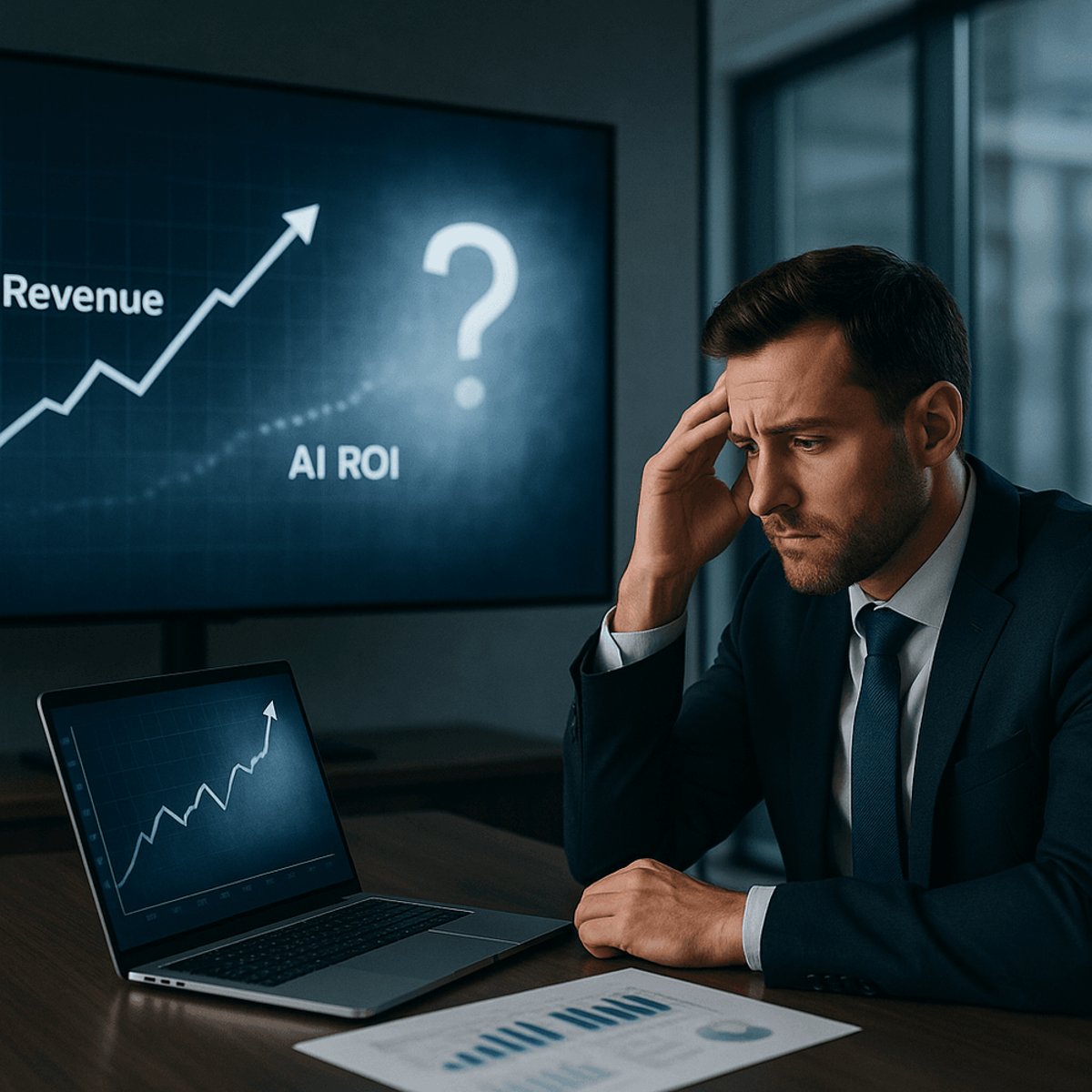
Apple just posted a blockbuster quarter with $143.8 billion in revenue, but CEO Tim Cook stumbled when Morgan Stanley analyst Erik Woodring asked the question everyone's been avoiding: how exactly does Apple plan to make money from its massive AI investments? Cook's answer - a word salad about 'great value' and 'opportunities' - reveals what might be tech's most uncomfortable truth. While the industry pours billions into AI development, the path to profitability remains as clear as mud.
Apple CEO Tim Cook was riding high during Thursday's earnings call. The company had just crushed expectations with $143.8 billion in quarterly revenue, marking a 16% jump from the previous year according to Apple's official report. Analysts lobbed softball questions. Cook batted them away with practiced ease.
Then Morgan Stanley's Erik Woodring stepped up to the plate with a fastball nobody saw coming.
'When I think about your AI initiatives, you know, it's clear there are added costs associated with that,' Woodring started, his voice carrying what might have been a tremor of nervousness. 'Many of your competitors have already integrated AI into their devices, and it's just not clear yet what incremental monetization they're seeing because of AI.'
The pause that followed must have felt eternal. Then came the question that's been lurking in the darkest corners of every investor's mind: 'So, how do you monetize AI?'
It's a fair question. Apple's been pouring resources into what it calls Apple Intelligence, rolling out AI features across iOS and integrating large language models into Siri and system-wide functions. The compute costs alone are staggering - running inference on device and in the cloud burns through both silicon and cash. But unlike subscription services or hardware sales, the revenue line item for AI remains conspicuously absent.
Cook's response was a masterclass in saying absolutely nothing. 'Well, let me just say that we're bringing intelligence to more of what people love, and we're integrating it across the operating system in a personal and private way, and I think that by doing so, it creates great value, and that opens up a range of opportunities across our products and services,' he told the call according to TechCrunch's coverage.
Great value. Range of opportunities. Products and services. It's corporate speak bingo, and every square is filled with nothing.
But here's the thing - Apple's not alone in this expensive fog. The entire tech industry has embraced what can only be described as a vibes-driven approach to AI investment. Take OpenAI, the poster child for the AI boom. Despite ChatGPT becoming a household name and embedding itself into cultural consciousness, the company isn't planning to see profitability until 2030 according to analysts at HBSC. And that's if everything goes perfectly - which requires securing another $207 billion in funding.
The math doesn't math. Microsoft has sunk tens of billions into OpenAI and its own AI infrastructure. Google is racing to compete with Gemini while watching search ad revenue potentially cannibalized by AI-generated answers. Meta is giving away Llama models for free while spending billions on compute. Everyone's pouring champagne, but nobody's checking if there's actually a celebration to attend.
Apple's situation is particularly interesting because the company has historically been ruthlessly disciplined about return on investment. This is a company that killed the iPod at its peak, that charges $999 for a monitor stand, that extracts 30% from every App Store transaction. Apple doesn't do charity.
Yet when it comes to AI, Cook is asking investors to trust that 'great value' will somehow translate into revenue. Maybe Apple Intelligence drives iPhone upgrades - the company's bread and butter. Maybe it creates stickiness that keeps users locked into the ecosystem. Maybe premium AI features eventually become part of iCloud+ subscriptions. But Cook didn't say any of that. He couldn't, because Apple apparently hasn't figured it out yet.
The silence is deafening across Silicon Valley. Ask any exec how they're planning to recoup their AI investments and you'll get the verbal equivalent of a shrug emoji. The assumption seems to be that if you build it - and spend enough billions - the money will come. Eventually. Somehow.
Nvidia is making money hand over fist selling the shovels for this gold rush. But for the companies actually building AI products? The business model remains stubbornly theoretical. You can't IPO on vibes forever, and even Big Tech's war chests aren't infinite.
Woodring's question exposed the emperor's new clothes moment the industry has been avoiding. Apple posted $143.8 billion in quarterly revenue, yes, but how much of that came from AI? Zero dollars that anyone can point to. How much did AI cost to develop and deploy? Nobody's saying, but it's not cheap.
The most telling part of Cook's non-answer was what he didn't say. He didn't mention subscription revenue from AI features. He didn't cite increased device sales driven by Apple Intelligence. He didn't point to cost savings from AI-powered automation. He just gestured vaguely at 'value' and 'opportunities' like a fortune teller reading tea leaves.
For a company that usually speaks the language of precision - units sold, average selling price, services growth percentage - the lack of concrete AI metrics is glaring. Either Apple genuinely hasn't figured out how to monetize its AI investments, or the answer is so underwhelming that Cook would rather deploy meaningless platitudes than admit it.
Woodring's question wasn't just about Apple - it was about the entire industry's collective delusion that AI investments will magically pay for themselves. Cook's fumble reveals that even the most valuable company in the world is winging it when it comes to AI economics. As billions continue flowing into development and deployment, the uncomfortable truth is that nobody - not Apple, not OpenAI, not the rest of Big Tech - can articulate a clear path from AI spending to AI profit. The vibes are immaculate, but the spreadsheets tell a different story. Until someone can answer Woodring's question with actual numbers instead of corporate poetry, investors might want to ask it more often.