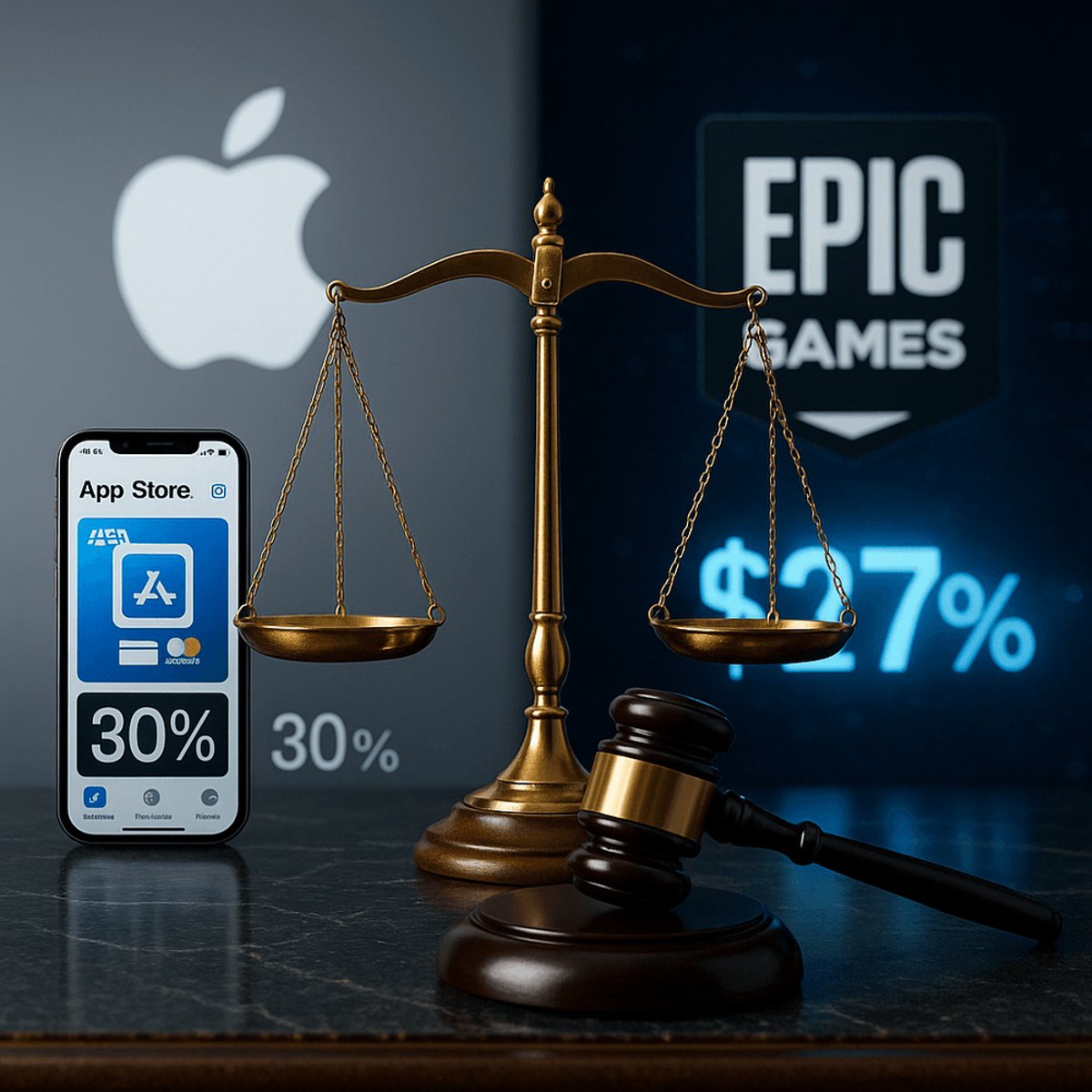
Apple is heading back to the Supreme Court - again - in its high-stakes battle with Epic Games over App Store commission fees. The tech giant plans to challenge a lower court ruling that restricts its ability to charge developers fees on external payment systems, marking the latest escalation in a legal war that's already reshaped how platforms monetize their ecosystems. The move comes as developers and regulators worldwide watch closely, knowing the outcome could fundamentally alter the economics of app distribution.
Apple just escalated its legal war with Epic Games to the highest court in the land. The iPhone maker plans to ask the Supreme Court to review a ruling that struck at the heart of its App Store business model - the ability to collect fees even when developers use external payment systems.
The decision to appeal comes after a lower court sided with Epic on a key point: Apple can't force developers to use its in-app purchase system exclusively, and more importantly, it can't automatically charge its standard 15-30% commission on transactions that happen outside the App Store entirely. For Apple, that ruling threatened to punch a massive hole in the roughly $85 billion services business it's built around the App Store.
This isn't Apple's first trip to the Supreme Court over this fight. The company previously asked the justices to review aspects of the original 2021 ruling, but the court declined to hear that appeal. Epic Games also petitioned the Supreme Court at the time, seeking to overturn parts of the decision that went against it - including the finding that Apple's App Store doesn't constitute an illegal monopoly. The court passed on that request too, leaving both companies unsatisfied.
But Apple's trying again, and the stakes have only gotten higher. Since the original ruling, the company has implemented what it calls a "link-out" system, allowing developers to include external payment links in their apps. The catch? Apple still charges a 27% commission on purchases made within seven days of a user clicking that external link - only 3 percentage points less than its standard 30% cut. Developers have called it a compliance strategy that violates the spirit of the court's order.
The legal maneuvering comes as Apple faces mounting pressure on multiple fronts. The European Union's Digital Markets Act has already forced the company to allow alternative app stores and payment systems in Europe, while regulatory investigations in the UK, Japan, and South Korea are examining similar App Store practices. Epic CEO Tim Sweeney has become one of Apple's most vocal critics, characterizing the company's fee structures as an unfair tax on the entire app economy.
For developers, the Supreme Court decision could be transformative. If Apple wins, it cements the company's ability to extract fees across the entire customer relationship, even for transactions that never touch Apple's servers. If the court upholds the lower ruling - or declines to hear the case - it could open the floodgates to alternative monetization models that bypass Apple's cut entirely.
The business implications extend far beyond mobile apps. Microsoft, Google, and other platform operators are watching closely, knowing that precedent set in the Apple-Epic case could reshape how they operate their own app stores and developer ecosystems. Game console makers like Sony and Nintendo also rely on similar commission structures for their digital storefronts.
Apple has consistently argued that its commission fees are justified by the value it provides - App Store infrastructure, payment processing, fraud prevention, and access to over 1 billion iPhone users. The company maintains that allowing developers to bypass its payment system without compensation would let them free-ride on Apple's investments while still benefiting from the iOS ecosystem.
Epic, meanwhile, has framed the fight as a battle for the future of digital commerce. The company argues that Apple's control over iOS app distribution gives it monopoly power that it abuses to extract excessive fees, stifling innovation and raising prices for consumers. Sweeney has pointed to the Epic Games Store on PC, where the company charges just 12% commission, as proof that lower fees are economically viable.
The Supreme Court now faces a decision about whether to take up the case at all. Legal experts say the court typically looks for cases that resolve conflicting interpretations of law across different circuits, or that address questions of major national importance. Apple will likely argue this case meets both criteria, given the scale of the app economy and conflicting approaches to platform regulation emerging globally.
Timing could prove critical. The court's current term runs through June 2027, but it hasn't yet announced whether it will grant Apple's petition for review. If accepted, oral arguments wouldn't likely happen until late 2027, with a decision potentially coming in 2028 - nearly seven years after the original Epic v. Apple trial began.
Apple's decision to appeal to the Supreme Court again signals the company views this fight as existential to its services business model. Whether the justices agree to hear the case will determine if the tech industry gets a definitive answer on platform fee structures, or if the current patchwork of regulations and lower court rulings continues to define how app stores operate. For developers, the uncertainty continues - but the possibility of real change to the App Store's economics has never been more tangible. Watch for the Supreme Court's decision on whether to grant review in the coming months.