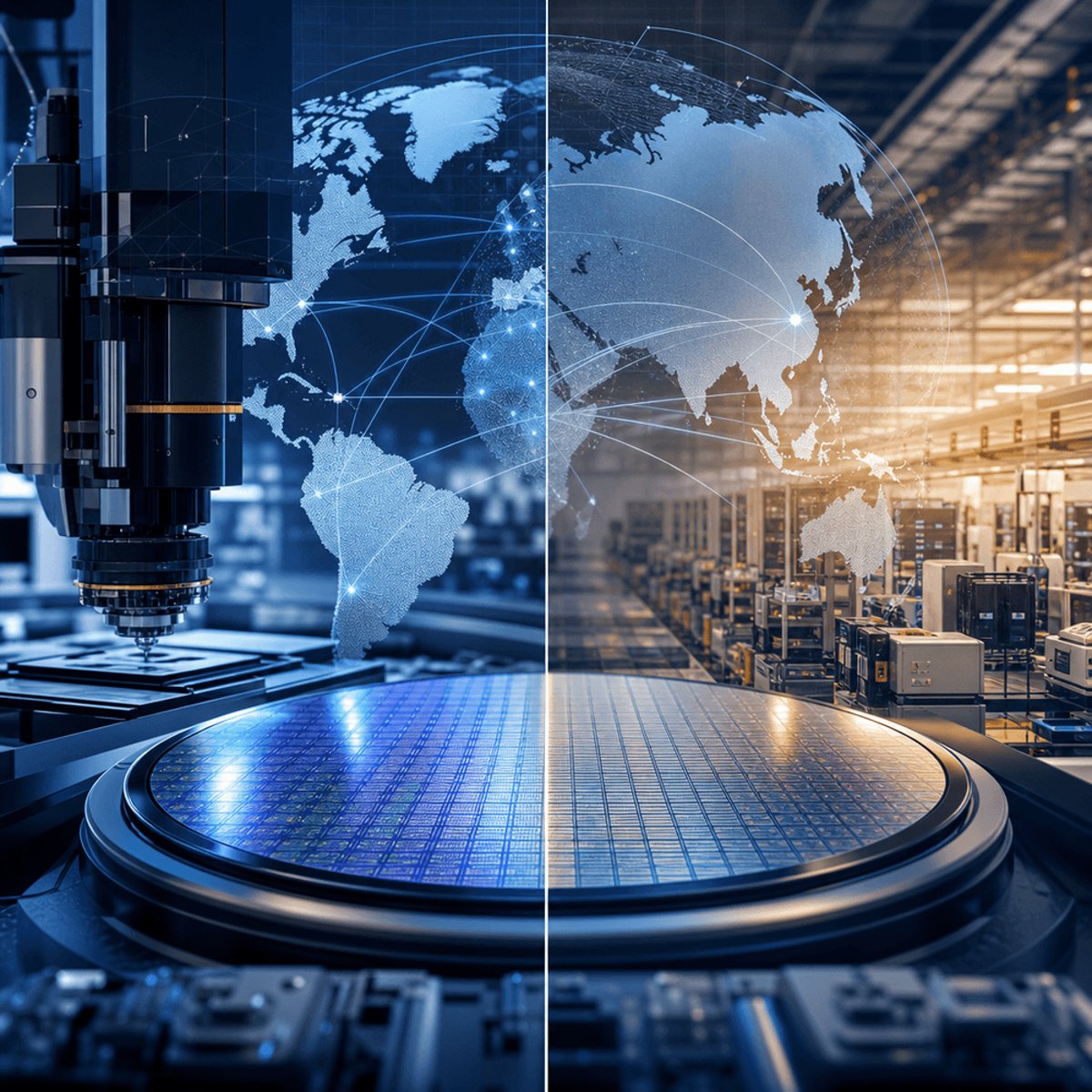
ASML, the Dutch semiconductor equipment giant that controls the global chip manufacturing supply chain, is walking a geopolitical tightrope as roughly 20% of its 2026 net sales come from China - just as U.S.-China tensions over AI technology reach new heights. The company's position highlights how the escalating tech cold war is forcing European suppliers to choose sides, even as Beijing remains one of their most lucrative markets.
ASML finds itself caught in the crossfire of the U.S.-China technology war, with the company's substantial revenue dependence on Chinese customers colliding head-on with Washington's increasingly aggressive export control regime. The Veldhoven-based company projects that China will represent around 20% of its 2026 net sales, a significant exposure that underscores the delicate balancing act facing European tech suppliers.
The situation has grown more precarious as the Biden administration and its successors have systematically tightened restrictions on advanced semiconductor manufacturing equipment flowing to China. ASML's most sophisticated systems - the extreme ultraviolet lithography machines that cost upward of $200 million each and are essential for producing cutting-edge AI chips - have been effectively blocked from Chinese customers since 2019. These EUV systems are the only tools capable of manufacturing the sub-7-nanometer chips that power Nvidia's AI accelerators and similar advanced processors.
But it's the restrictions on ASML's older deep ultraviolet (DUV) systems that could really sting the company's bottom line. Dutch authorities, under pressure from Washington, have progressively limited ASML's ability to ship these less-advanced but still crucial machines to China. While DUV equipment can't produce the most cutting-edge chips, Chinese foundries like SMIC have been stockpiling the systems to maintain and expand their manufacturing capacity for mature-node semiconductors.
The geopolitical pressure creates an almost impossible situation for ASML. On one side, the U.S. and its allies view the company's technology as a strategic chokepoint - the Netherlands is the only country that produces EUV systems, giving Western governments unprecedented leverage over global chip production. On the other, China represents not just current revenue but future growth potential as Beijing pours hundreds of billions into domestic semiconductor manufacturing.
Chinese chipmakers have responded to the restrictions by front-loading orders for whatever ASML equipment they can still legally purchase, creating temporary revenue spikes that mask underlying business uncertainty. This buying pattern makes ASML's financial forecasting treacherous - is that 20% China revenue sustainable, or are customers simply stockpiling before the next round of restrictions hits?
The AI boom has only intensified these tensions. As OpenAI, Google, and other U.S. tech giants race to build ever-larger language models requiring enormous compute resources, Washington views advanced chip manufacturing as a national security imperative. The logic is straightforward - controlling access to chipmaking equipment means controlling who can build AI systems capable of everything from autonomous weapons to sophisticated cyberattacks.
For ASML, the strategic calculus extends beyond just counting revenue. The company's research and development pipeline depends on close collaboration with leading-edge chipmakers like TSMC in Taiwan and Intel in the U.S. Alienating Western governments could jeopardize those partnerships, even as losing China market access would immediately impact financial performance.
Industry analysts point out that ASML's predicament reflects a broader reconfiguration of global technology supply chains. The era of frictionless international tech commerce is over, replaced by a landscape where companies must navigate competing geopolitical demands. European firms, in particular, face pressure from both Washington and Brussels to align technology policy with broader strategic competition against China.
The situation gets more complex when you consider that many of ASML's own suppliers are based in the U.S., including Nvidia which provides computational lithography software, and various optics manufacturers. This creates multiple pressure points where American export controls could potentially impact ASML's operations, even for sales to non-Chinese customers.
Meanwhile, China isn't standing still. Beijing has launched multiple initiatives to develop domestic alternatives to ASML's technology, though experts believe indigenous Chinese EUV capabilities remain years if not decades away. The more immediate Chinese strategy focuses on maximizing yield and performance from older manufacturing processes - essentially doing more with less advanced equipment. Some Chinese chipmakers have demonstrated surprising capability in this approach, producing 7nm-class chips using DUV equipment through multiple patterning techniques, though at lower yields and higher costs than EUV-enabled processes.
ASML's exposure to China revenue crystallizes the fundamental tension reshaping the global technology industry - the collision between commercial incentives and geopolitical imperatives. As the U.S.-China AI competition intensifies, companies like ASML face increasingly binary choices about market prioritization. That 20% China revenue figure isn't just a financial metric; it's a measure of strategic vulnerability in an era where semiconductor technology has become as much about national security as business. The Dutch chipmaker's ability to navigate these pressures while maintaining technological leadership will likely determine not just its own future, but the broader trajectory of how democracies and authoritarian states compete for AI supremacy. For now, ASML continues walking the tightrope, but the rope keeps getting thinner.