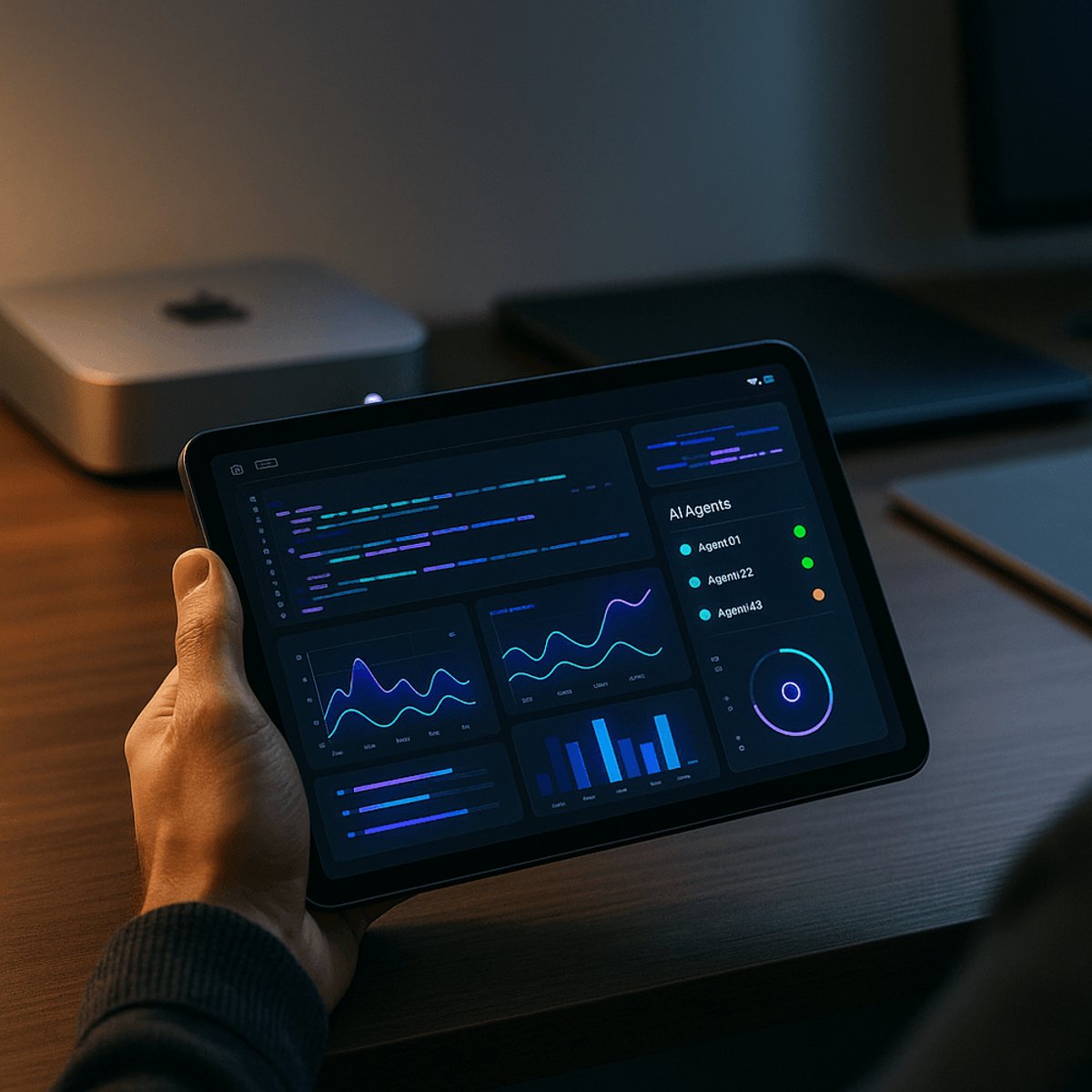
Remote desktop software just got an AI-era makeover. Astropad, the company known for turning iPads into drawing tablets, is launching Workbench - a tool designed specifically for monitoring and controlling AI agents running on Mac Minis from an iPhone or iPad. While traditional remote desktop software was built for IT support and occasional file access, Workbench addresses a new problem: keeping tabs on autonomous AI agents doing real work on remote machines. The launch signals how AI infrastructure is forcing developers to rethink tools that haven't fundamentally changed in decades.
Astropad is betting that the future of remote desktop software isn't about helping your parents fix their computer - it's about babysitting AI agents. The company's new Workbench app, announced today via TechCrunch, lets users remotely monitor and control AI agents running on Mac Minis from their iPhone or iPad, bringing low-latency streaming technology to a problem that didn't exist until recently.
The timing makes sense. As AI agents become more capable of handling complex, multi-step tasks autonomously, companies are increasingly running them on dedicated hardware - often Mac Minis tucked away in server racks or home offices. But unlike traditional server processes that either work or don't, AI agents exist in a gray area where they need supervision without constant hand-holding. You want to know what they're doing, step in when they go off-rails, but not hover over them like a micromanager.
That's where Workbench comes in. The app leverages Astropad's experience in low-latency streaming - the same technology that made their iPad drawing tablet apps feel responsive enough for professional artists. According to the TechCrunch report, this infrastructure now enables mobile access to AI agents with minimal lag, letting users check in on agent progress or take control when needed, all from a device that fits in their pocket.
The focus on Mac Minis is strategic. Apple's compact desktop has become surprisingly popular for AI workflows, offering a balance of performance, energy efficiency, and macOS compatibility that appeals to developers running agents that need to interact with consumer applications. While cloud-based AI platforms dominate enterprise deployments, local hardware gives developers more control over costs, privacy, and the ability to test agents in real-world environments.
Traditional remote desktop tools like TeamViewer, Chrome Remote Desktop, or even Apple's built-in Screen Sharing weren't designed for this use case. They assume a human is driving both ends of the connection - someone needs help, someone provides it, then everyone logs off. AI agent monitoring requires different assumptions: frequent check-ins, low-friction access, mobile-first design, and the ability to quickly switch from passive observation to active intervention.
Astropad's pivot from creative tools to AI infrastructure reflects broader market shifts. The company built its reputation helping digital artists use iPads as Wacom tablet alternatives, establishing expertise in real-time streaming and mobile-desktop integration. Now they're applying that technical foundation to what they see as a larger opportunity: the emerging stack of tools needed to deploy, manage, and monitor AI agents at scale.
The market for AI agent infrastructure is still nascent, but activity is accelerating. Companies are building orchestration layers, monitoring dashboards, safety guardrails, and now remote access tools specifically for agent workflows. It's reminiscent of how DevOps tools emerged in the 2010s - taking concepts from traditional IT operations and reimagining them for cloud-native architectures and continuous deployment.
Workbench also highlights an interesting architectural choice in AI deployment. While much attention focuses on massive cloud clusters training frontier models, practical AI agent deployment often happens on modest hardware running inference locally. A Mac Mini running a fine-tuned model can handle tasks like email triage, research synthesis, or automated testing without the latency and cost of API calls to cloud services.
The mobile-first approach matters too. If AI agents are supposed to work autonomously, the whole point is that humans don't need to be chained to desks watching them. Being able to check agent progress from an iPhone while grabbing coffee, or intervene from an iPad during a commute, aligns with the promise of automation - it should give you time back, not create a new category of surveillance work.
For Astropad, Workbench represents both product evolution and market validation. The company is betting that the same customers who valued their creative tools will also need AI infrastructure - developers, designers, and knowledge workers who increasingly rely on agents to handle routine tasks. Whether that bet pays off depends on how quickly AI agents move from experimental to essential, and whether dedicated monitoring tools gain traction over makeshift solutions.
The launch also raises questions about what AI agent infrastructure will look like as the space matures. Will monitoring remain a separate tool category, or get absorbed into broader AI platforms? Will local deployment stay relevant as cloud providers optimize for agent workloads? And will mobile access become table stakes, or remain a niche feature for early adopters?
Astropad's Workbench signals how AI is forcing software categories to evolve or risk irrelevance. Remote desktop tools spent decades serving IT support and occasional remote work, but AI agents introduce fundamentally different requirements - continuous lightweight monitoring, mobile access, and quick intervention when automation goes sideways. Whether Workbench becomes the standard for AI agent oversight or just an early experiment, it's a reminder that as AI agents move from demos to production, the infrastructure around them needs to catch up. For developers running agents on local hardware, the ability to check in from anywhere without the friction of traditional remote desktop tools might be the difference between trusting automation and constantly second-guessing it.