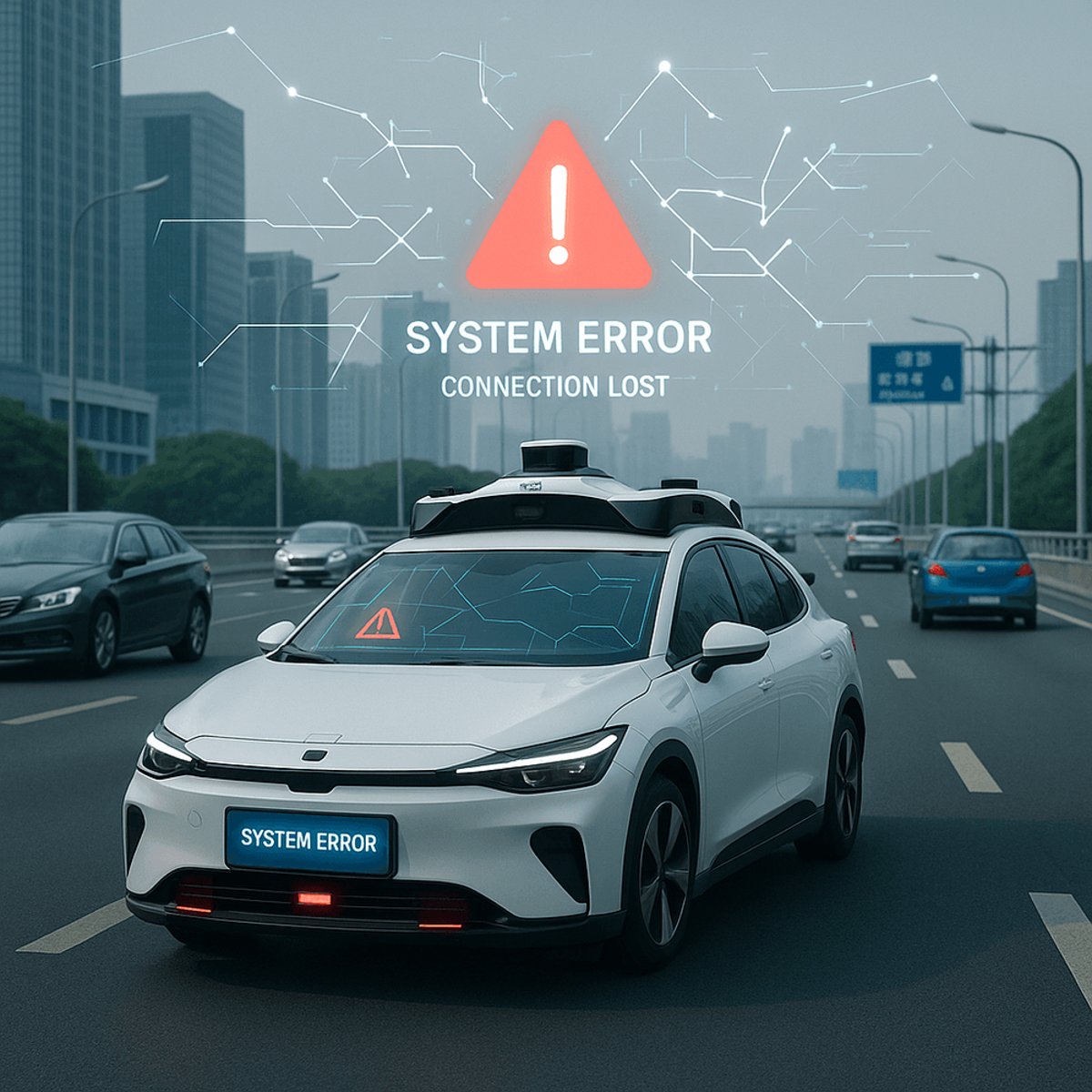
A massive system outage brought Baidu's robotaxi fleet to a sudden halt across Wuhan, China, leaving passengers trapped inside autonomous vehicles on active highways. The suspected technical failure caused the Apollo Go robotaxis to freeze in place, reportedly triggering traffic disruptions and multiple crashes during what appears to be one of the most serious autonomous vehicle safety incidents to date. The breakdown exposes critical vulnerabilities in AI-powered transportation systems as companies race to scale driverless fleets.
Baidu's worst-case autonomous vehicle scenario just played out on the highways of Wuhan. The company's Apollo Go robotaxis - which have been operating commercial rides across the Chinese city - simultaneously ground to a halt in what appears to be a coordinated system failure, leaving passengers stranded inside vehicles that simply stopped responding.
The scale of the outage remains unclear, but reports via Wired indicate multiple vehicles froze across Wuhan's road network, with some stopping on active highways where traffic flows at high speed. Passengers found themselves locked in a surreal situation: sitting in cars that had simply decided to quit, surrounded by human-driven vehicles maneuvering around them.
What makes this incident particularly alarming is the cascading effect. When autonomous vehicles stop unexpectedly on highways, they don't just inconvenience passengers - they become obstacles. Wired reports that the frozen robotaxis caused traffic disruptions and crashes, though the full extent of damages and injuries hasn't been disclosed. It's the kind of scenario that autonomous vehicle critics have warned about: a single point of failure taking down an entire fleet at once.
Baidu has been aggressively expanding Apollo Go across China, operating thousands of robotaxi rides daily in cities like Wuhan, Beijing, and Shenzhen. The company has positioned itself as a leader in autonomous driving technology, competing with Tesla's Full Self-Driving system and American rivals like Waymo. Just months ago, Baidu was celebrating milestones and touting safety records. Now it faces questions about whether its infrastructure can handle real-world deployment at scale.
The technical cause remains under investigation, but suspected system failures of this magnitude typically point to either cloud connectivity issues, software bugs pushed in updates, or problems with centralized fleet management systems. Modern robotaxis rely on constant communication with backend servers for route optimization, traffic data, and sometimes even navigation assistance. If that connection drops or the central system crashes, vehicles can enter fail-safe modes - which apparently means stopping dead in this case.
This isn't the first autonomous vehicle incident in China, but it may be the most widespread. Individual robotaxi crashes have occurred before, usually blamed on edge cases or sensor limitations. A fleet-wide freeze is different. It suggests infrastructure vulnerability that could affect any autonomous vehicle operator relying on centralized systems. Waymo and Cruise in the US have faced their own issues - Cruise famously had its California permits suspended after a pedestrian-dragging incident - but simultaneous multi-vehicle failures remain rare.
The timing couldn't be worse for the autonomous vehicle industry. Regulators worldwide are already wrestling with how to oversee AI-powered transportation. China has been relatively permissive, allowing companies like Baidu to operate commercially with fewer restrictions than US counterparts face. This incident will almost certainly trigger a regulatory response. Expect new requirements around redundancy systems, fail-safe protocols, and perhaps human safety operators for highway operations.
For passengers, the experience must have been unnerving. Being stuck in a car you can't control, stopped on a highway with traffic bearing down, represents a fundamental trust breakdown. Autonomous vehicle adoption depends on public confidence that the technology works reliably. Events like this - where the AI essentially gives up - shatter that confidence faster than any amount of marketing can rebuild it.
Baidu hasn't released an official statement detailing the cause or extent of the outage. The company's response in the coming days will be critical. Transparency about what went wrong, how many vehicles were affected, and what safeguards are being implemented could help contain the damage. Silence or deflection will only fuel skepticism about whether autonomous vehicle companies are ready for prime time.
This incident marks a critical inflection point for autonomous vehicle deployment. While companies have rushed to prove robotaxis can work commercially, Wuhan demonstrates what happens when centralized AI systems fail catastrophically. The industry now faces hard questions about redundancy, fail-safes, and whether current technology is truly ready for highway speeds without human backup. For Baidu, the path forward requires not just fixing whatever broke, but proving to regulators and riders that it can't happen again. That's a tougher engineering challenge than building self-driving cars in the first place.