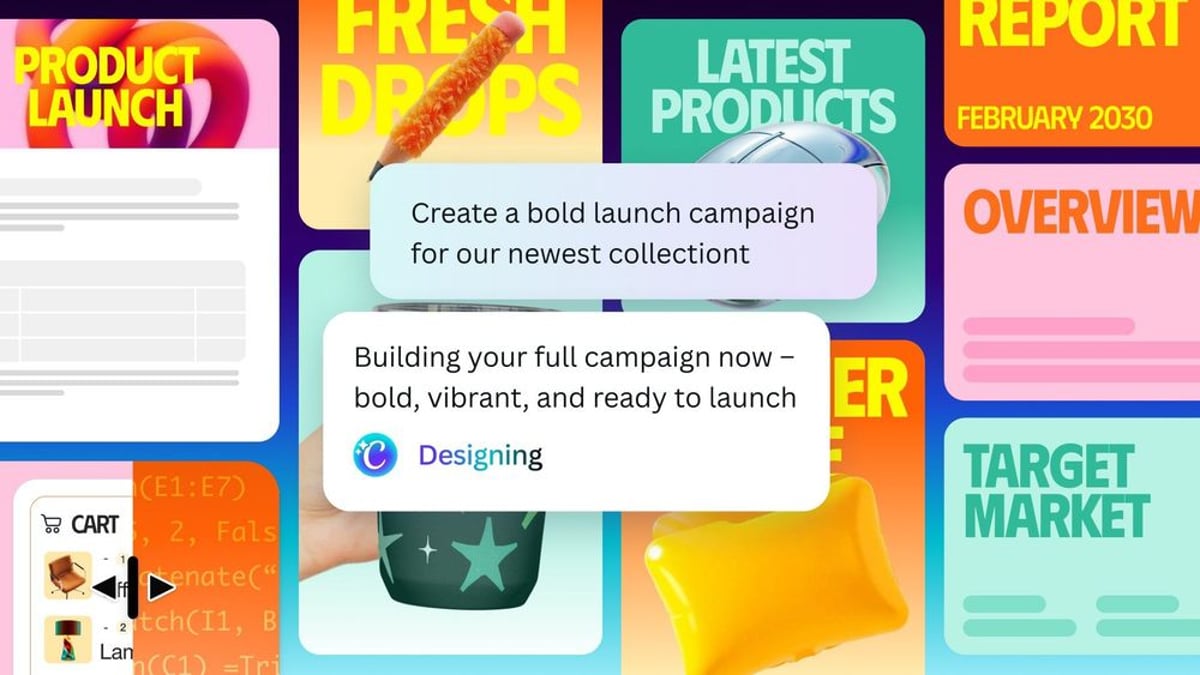
Canva just dropped its biggest AI overhaul yet, and it's going after the entire creative workflow. The design platform announced Canva AI 2.0 today, introducing a conversational interface that lets its 200 million users create and edit designs by simply describing what they want in plain English. Instead of clicking through menus, designers can now tell Canva's AI assistant to "create a social media campaign" or "adjust the color palette to match our brand" - and watch it execute across the entire suite.
Canva is rewriting the rules of design software with a bet that natural language will replace traditional interfaces. The company's AI 2.0 update, announced today, introduces what it calls an "orchestration layer" - essentially a brain that sits on top of all of Canva's existing AI models and lets users control everything through conversation.
The shift is massive for a platform that's already serving over 200 million users globally. Instead of hunting through toolbars or learning keyboard shortcuts, designers can now type requests like "create a presentation deck based on our Q2 results" or "redesign this flyer for Instagram" and watch the AI execute in real-time, according to The Verge's coverage.
What makes this different from other AI design tools is the scope. Canva isn't just adding a chatbot - it's rebuilding how users interact with the entire platform. The new interface can access everything from template libraries to brand kits, photo editing tools to video creation features, all through that single conversational prompt. It's the kind of ambitious integration that Adobe and Figma have been working toward but haven't fully delivered.
The timing isn't accidental. Canva's been quietly building its AI capabilities for months while competitors scrambled to bolt generative AI onto existing products. This orchestration approach suggests the company's been thinking about the infrastructure problem - how to make multiple AI models work together seamlessly - while others focused on individual features.
For marketers and creative teams, the implications are immediate. A social media manager can now ask Canva to "generate five variations of this ad for different demographics" without manually duplicating templates or adjusting elements. A startup founder can describe their brand vision and get a complete visual identity system. The platform becomes less of a tool and more of a creative partner.
But there's a competitive angle here that's worth watching. Canva's been eating into Adobe's territory for years by offering simpler, cheaper alternatives to professional design software. AI 2.0 accelerates that threat. If natural language interfaces work as promised, the learning curve that kept casual users paying Adobe subscription fees basically disappears.
The update also signals where the broader SaaS market is heading. Every software company is racing to add conversational AI, but most implementations feel tacked on - a chatbot in the corner that can answer questions but can't actually do much. Canva's building the interface around the conversation, which is either visionary or a massive gamble depending on how well the AI actually performs.
Early signals suggest Canva's serious about the execution. The company's been testing these features with select enterprise customers for weeks, refining the prompt understanding and output quality. That's a different approach than the "launch fast and fix later" mentality dominating AI releases lately.
The rollout starts today for paid subscribers, with free tier access coming later. That's strategic - Canva's using AI 2.0 as a premium feature to drive conversions while gathering feedback from power users who'll push the system hardest. Expect iterations and improvements as real-world usage exposes edge cases the testing phase missed.
What's less clear is how this affects Canva's long-term positioning. The company's valued at $40 billion and has been rumored as an IPO candidate. This update positions them squarely in the AI infrastructure space rather than just design tools - a narrative that plays better with investors but comes with higher expectations. They're not just competing with design software anymore; they're going after the entire creative workflow stack.
The broader question is whether conversational interfaces actually deliver on the promise. We've seen plenty of AI demos that look magical in controlled settings but frustrate users in practice. Canva's betting its future on the idea that describing what you want will always be faster than learning how to make it yourself. If they're right, this is the beginning of a major platform shift. If not, they've just added complexity to a product that succeeded because it was simple.
Canva's AI 2.0 represents a genuine shift in how design software might work - not just adding AI features, but rebuilding the entire interaction model around conversation. Whether it succeeds depends on execution, but the ambition is clear: Canva wants to own the full creative workflow by making professional design accessible through plain English. For the 200 million users already on the platform, it's a massive upgrade. For Adobe and Figma, it's a warning shot that the design software wars just entered a new phase where natural language might matter more than feature lists.