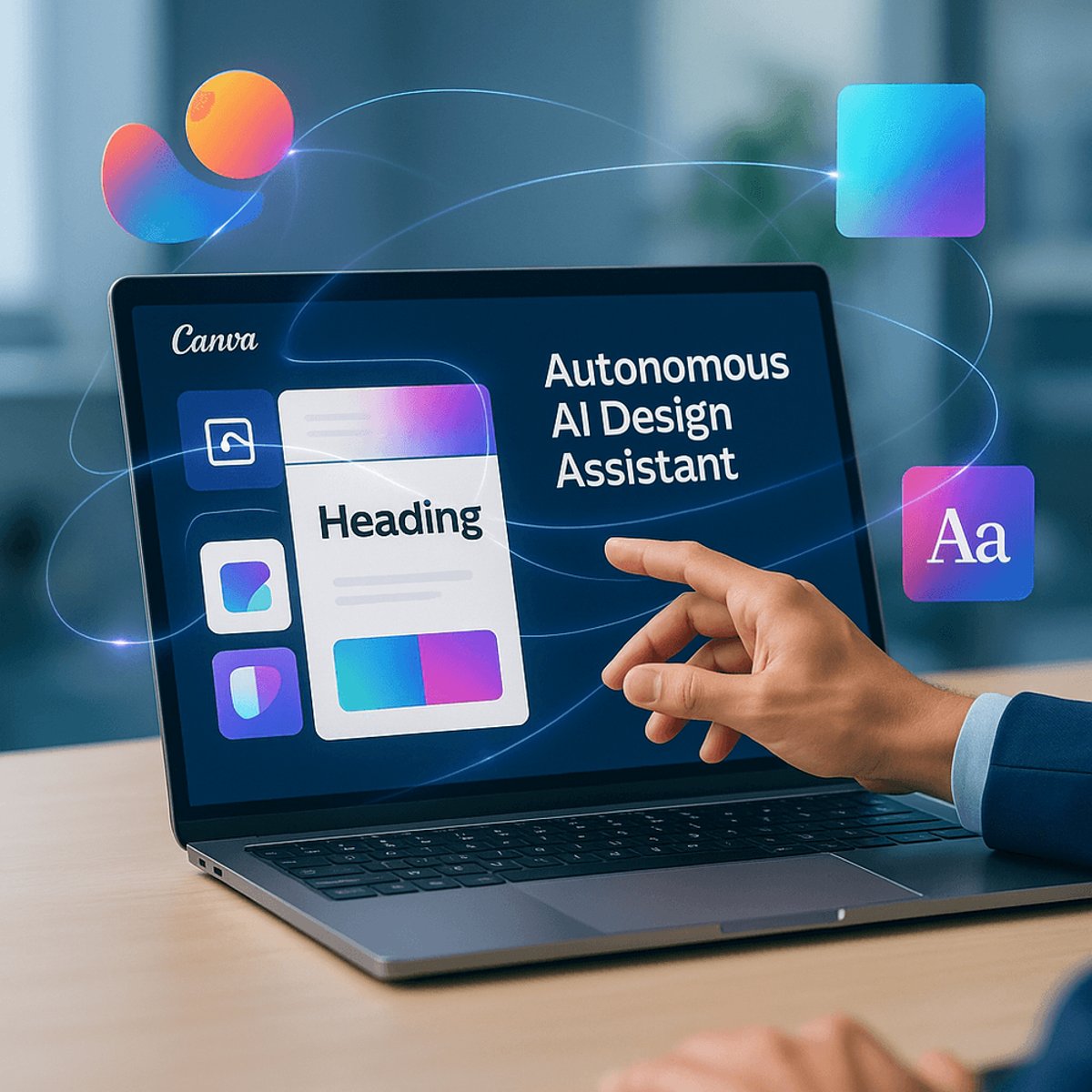
Canva just turned its AI assistant into an autonomous design agent. The platform's latest update lets users generate fully editable designs through natural language prompts, with the AI calling various design tools on its own to assemble layouts, graphics, and text elements. It's a direct shot at Adobe's creative dominance and signals how AI is reshaping the $50 billion design software market from prompt-to-production workflows.
Canva is betting that designers don't want to just chat with AI - they want it to do the actual work. The company's revamped AI assistant can now autonomously select and execute design tools based on user prompts, creating fully editable designs without requiring users to manually pick fonts, arrange elements, or hunt for graphics.
Instead of simply suggesting next steps, the AI assistant interprets requests like "create a product launch announcement for our Q2 release" and automatically calls the appropriate tools - pulling templates, generating text, selecting color schemes, and positioning design elements. Users get back a working design they can tweak, not just inspiration or placeholder content.
This is agentic AI coming to the creative workspace. While Adobe has embedded generative AI into Photoshop and Illustrator for image creation and editing, Canva's approach focuses on orchestrating entire workflows. The difference matters for the 170 million monthly users who rely on Canva for quick-turnaround marketing materials, social posts, and presentations.
The timing isn't coincidental. Adobe has spent the past year rolling out Firefly-powered features across Creative Cloud, but those tools still require designers to know which application to open and which feature to invoke. Canva's assistant sidesteps that friction entirely by making design intent - not tool mastery - the primary interface.
Under the hood, the AI assistant uses what the industry calls tool-calling or function-calling, where large language models decide which specific capabilities to invoke based on user goals. OpenAI popularized this approach with ChatGPT plugins, and now it's spreading to vertical software like design platforms. The AI doesn't just generate a design from scratch - it's conducting Canva's existing arsenal of templates, stock libraries, and layout engines.
For enterprise teams, this changes the economics of design production. Marketing departments that previously needed dedicated designers for every social post or email header can now brief the AI and get production-ready assets in seconds. That's why Canva has been aggressively courting enterprise customers, with teams pricing starting at $30 per person annually - a fraction of Adobe Creative Cloud's $600-plus annual subscriptions.
The competitive pressure is real. Adobe dominates professional creative work, but Canva has captured the massive market of non-designers who need good-enough graphics fast. By adding autonomous AI capabilities, Canva is moving upmarket without abandoning its accessibility advantage. You don't need to know what kerning is if the AI handles typography decisions automatically.
But there's a catch. Fully autonomous design generation only works when the AI correctly interprets creative intent - something even humans struggle with. Early agentic AI tools in other domains have shown that automation breaks down when tasks require subjective judgment or brand-specific nuance. Canva will need to prove its AI can handle the ambiguity inherent in "make this look professional" or "give it more energy."
The broader implication is that creative software is splitting into two camps. Tools like Adobe's suite remain focused on giving experts maximum control through AI-enhanced capabilities. Platforms like Canva are building AI that takes control, making decisions on behalf of users who want results over creative exploration. Both approaches use generative AI, but they serve fundamentally different workflows.
What's clear is that the design software wars are no longer just about features - they're about how much autonomy users are willing to hand to AI. Canva is making a bold bet that most people designing Instagram stories or pitch decks would rather delegate than deliberate. If they're right, Adobe will need to rethink more than just its AI strategy.
Canva's autonomous AI assistant represents a fundamental shift in how creative software works - from tools that require human orchestration to agents that handle entire workflows independently. For the millions of marketers, small business owners, and teams who need designs faster than they need creative control, this could be the tipping point where AI moves from helpful suggestion engine to actual production partner. The question isn't whether agentic AI will reshape design software, but whether Adobe and other incumbents will adapt their expert-focused tools before Canva's accessibility-first approach captures the bulk of the market. The design software wars just went from feature competition to philosophy clash.