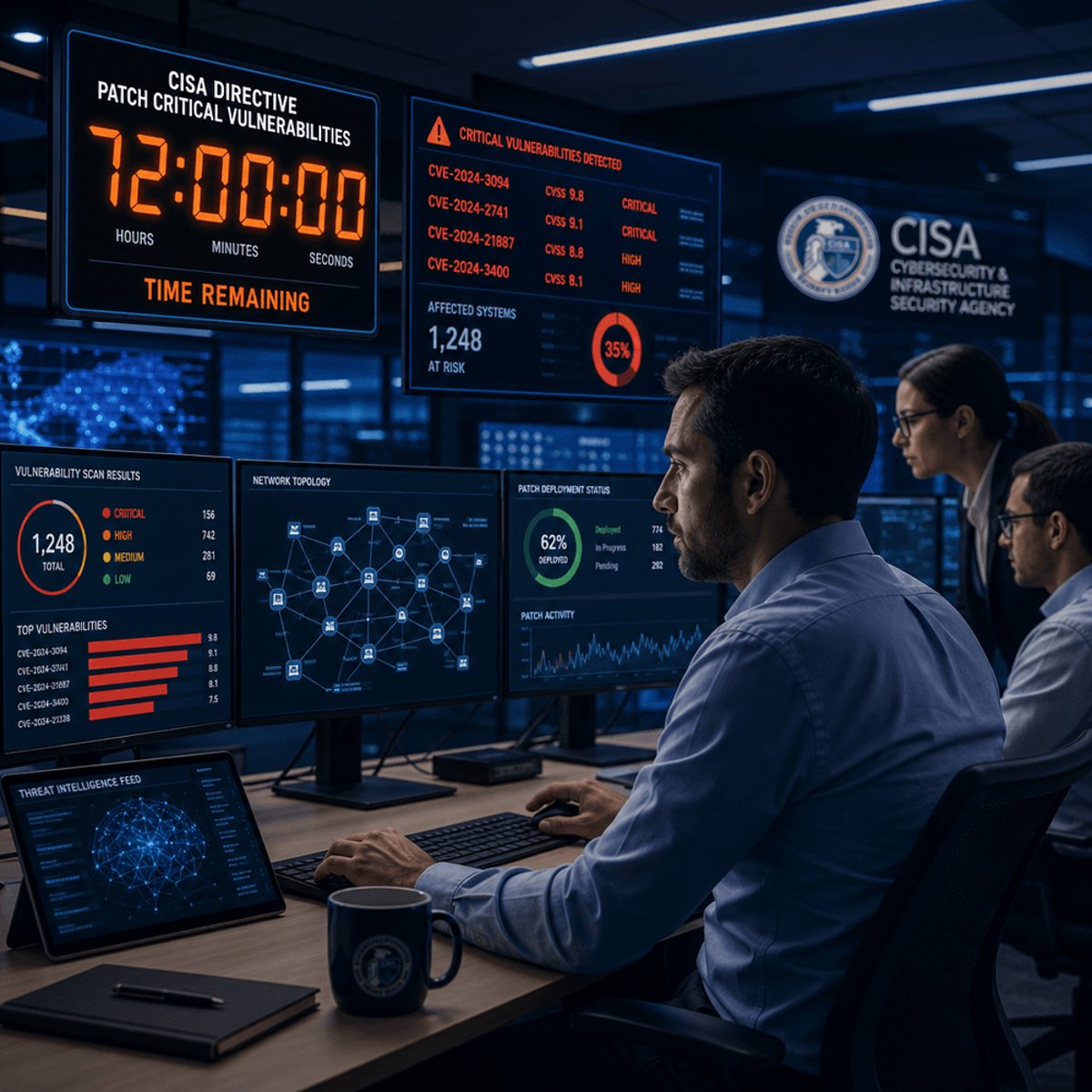
The federal government just put agencies on a three-day clock. The Cybersecurity and Infrastructure Security Agency issued an emergency directive Wednesday slashing vulnerability patching windows to as little as 72 hours, a dramatic acceleration driven by AI-powered exploit development that's turning discovered bugs into active weapons in record time. The move marks the government's most aggressive response yet to what security officials describe as an AI arms race that's fundamentally broken traditional patch timelines.
CISA just rewrote the rules of cybersecurity response. The agency's new binding operational directive, announced Wednesday, compresses patching timelines for federal systems to three days for critical vulnerabilities and seven days for high-severity flaws. It's the shortest mandatory window the agency has ever imposed, and the reason is clear: AI is handing attackers an unprecedented speed advantage.
"Defenders cannot afford to take weeks to patch," a CISA official told reporters during a hastily arranged briefing, according to Wired's reporting. The stark language reflects growing alarm inside government security circles about how artificial intelligence is collapsing the window between vulnerability disclosure and active exploitation.
Traditionally, security teams operated on a comfortable if flawed assumption: they had weeks, sometimes months, to test and deploy patches after a vulnerability became public. Attackers needed time to reverse-engineer fixes, write exploit code, and build attack infrastructure. That math no longer works.
AI-powered security research tools can now analyze patches within hours of release, automatically identify the underlying vulnerability, and generate working exploit code before most IT departments have even opened their morning email. What used to take skilled hackers days or weeks of painstaking work now happens in the time it takes to run a script. OpenAI, Google, and other AI labs have all documented this capability, though they've tried to limit access to the most dangerous applications.
The directive arrives as federal agencies are still recovering from a series of high-profile breaches that exploited known vulnerabilities. Recent incidents involving Microsoft Exchange servers and various VPN appliances followed a familiar pattern: patches were available, but organizations hadn't applied them before attackers struck. Now CISA is betting that mandatory speed can outpace AI-assisted attackers.
But the three-day window presents enormous operational challenges. Enterprise patching isn't just about clicking an update button. It requires testing for compatibility issues, coordinating maintenance windows, backing up systems, and having rollback plans ready. Compressed timelines mean less testing, higher risk of breaking critical systems, and security teams working around the clock.
"This is going to be brutal for agencies running legacy systems," said one federal IT official who requested anonymity because they weren't authorized to speak publicly. Many government systems still run on decades-old infrastructure that can't be patched quickly without extensive testing. The directive doesn't exempt these systems, which means agencies face an impossible choice: rush patches and risk system failures, or miss deadlines and face CISA enforcement.
The private sector is watching nervously. While the directive only applies to federal agencies, it sets a precedent that will ripple through enterprise security. Cyber insurance providers are already discussing whether to require similar patching speeds as a condition of coverage. Compliance frameworks will likely follow CISA's lead. And corporate boards, increasingly focused on cybersecurity after years of costly breaches, will start asking their CISOs why they can't match government timelines.
Some security experts question whether speed alone solves the problem. AI doesn't just accelerate exploitation; it also enables more sophisticated attacks that bypass patches entirely. And the directive may inadvertently create new vulnerabilities if rushed patches introduce bugs or compatibility issues. Several organizations have already reported that emergency patching caused system outages that proved more disruptive than potential attacks.
The timing is significant. The directive comes as the US government ramps up its response to AI-driven cybersecurity threats. Earlier this year, Microsoft and Google both disclosed that state-sponsored hacking groups were using AI tools to accelerate reconnaissance and exploit development. China, Russia, Iran, and North Korea have all invested heavily in AI-powered offensive cyber capabilities, according to intelligence assessments.
CISA is also expanding its Known Exploited Vulnerabilities catalog, the authoritative list of security flaws that attackers are actively using. The catalog has grown by more than 40% in the past year, with AI-assisted discovery accelerating the pace. Every addition triggers the new patching clock for federal agencies.
What happens to agencies that can't meet the deadline remains unclear. CISA has enforcement authority, but the agency has historically focused on collaboration rather than punishment. The directive includes provisions for agencies to request extensions in extraordinary circumstances, but CISA made clear those will be rare exceptions, not routine practice.
The directive also requires agencies to maintain comprehensive asset inventories and vulnerability scanning programs, closing a gap that's plagued federal cybersecurity for years. You can't patch what you don't know you have, and many agencies still lack complete visibility into their IT environments. CISA is betting that the tight deadlines will force agencies to finally implement proper asset management.
For security vendors, the directive represents both opportunity and challenge. Automated patch management tools will see increased demand as organizations scramble to compress their response cycles. But vendors will also face pressure to improve patch quality and reduce the testing burden, since customers no longer have time for extensive validation.
CISA's three-day mandate isn't just a policy shift—it's an acknowledgment that AI has permanently altered the cybersecurity equation. Federal agencies now face the same reality that's kept private sector security teams up at night: the old playbook doesn't work anymore when attackers have AI on their side. Whether organizations can actually meet these compressed timelines without breaking critical systems remains an open question, but the directive makes one thing clear—the grace period for leisurely patching is over. Every organization, federal or otherwise, needs to start thinking about security response in hours and days, not weeks and months. The AI threat won't wait.