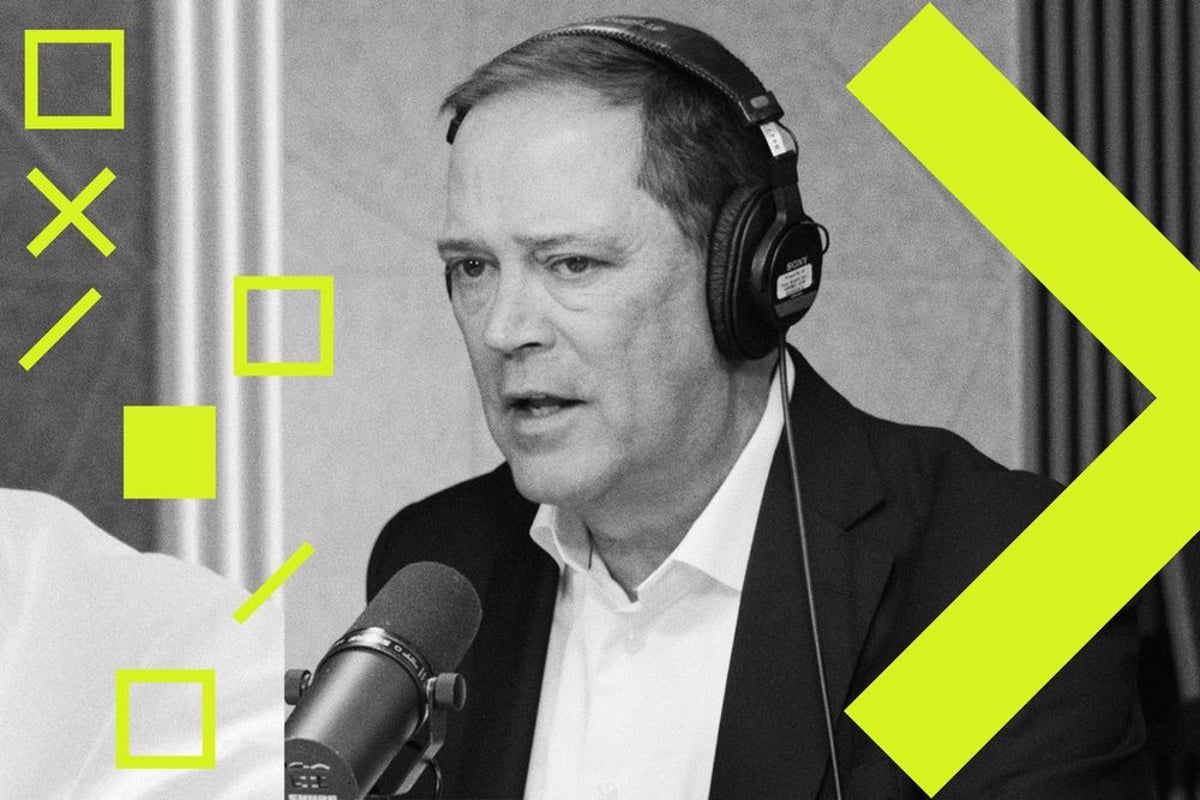
Cisco CEO Chuck Robbins just declared the networking giant is preparing for orbital data centers, siding with Elon Musk over Sam Altman in tech's newest infrastructure debate. In a wide-ranging interview, Robbins revealed his teams started planning space-ready networking equipment three months ago, acknowledging AI's explosive growth is hitting hard limits on Earth. But he also admitted what few executives will say out loud: this is a bubble, and he's seen this movie before when Cisco briefly became the world's most valuable company during the dot-com era.
When Cisco CEO Chuck Robbins sat down for an interview, he didn't hesitate on the question that's splitting Silicon Valley: Should we build data centers in space? "Absolutely," he answered. "And we will."
It's a striking declaration from the leader of a company that powers much of the internet's physical infrastructure. Robbins revealed his product teams approached him just three months ago about preparing for orbital deployment, initially thinking the idea was "crazy." Now Cisco is actively designing networking equipment to handle the vacuum of space, extreme temperatures, and the challenge of launching hardware into orbit.
The rationale comes down to escaping Earth's limits. "Right now we're dealing with lots of power constraints, and up there you don't have that," Robbins explained. He's backing Elon Musk's plan to launch a million satellites as data center infrastructure over Sam Altman's dismissal of orbital facilities as a "pipe dream." When pressed on who to believe, Robbins was blunt: "I wouldn't bet against Elon."
But the space ambitions mask a more immediate crisis - growing public opposition to data center construction on Earth. AI infrastructure faces bipartisan pushback across the United States, with communities rejecting facilities that spike electricity costs and consume massive amounts of water. An Alabama state senator even proposed blocking solar projects specifically to discourage data centers.
Robbins acknowledged the challenge but sees it differently. "I don't think it's politics so much as it is the physical limitations, the community," he said. "People don't want these things in their backyards, and I get that." The solution, in his view, might literally be looking up.
The pressure to keep building is existential for Cisco. After years of minimal business with hyperscalers like Amazon and Microsoft, the company will do billions in revenue this year supplying networking gear for AI data centers. The turnaround traces to a 2016 stroke of luck: acquiring Israeli chip firm Leaba, which gave Cisco one of the few silicon architectures capable of connecting GPUs at the speeds AI training demands.
"If we didn't have that silicon today, we would not be participating in this phase," Robbins admitted. "Otherwise I'd be buying merchant silicon like all my competitors, and I'd be just like everybody else."
That puts Cisco in direct competition with Nvidia, whose networking business hit $31 billion last fiscal year - larger than Cisco's $20 billion. Robbins described it as "coopetition," noting hyperscalers want vendor diversity while enterprises stick with Cisco's 40 years of embedded knowledge. But Cisco has a unique edge: its security business. As AI agents proliferate across networks, Robbins argued only Cisco can deliver security at the network layer with the low latency agentic workloads require.
He's even eyeing a partnership with Okta, whose CEO recently pitched agent "kill switches" on the same podcast. "That kill switch might be implemented at the network layer because we may see something happening that it won't see at the upper layers," Robbins suggested.
Yet for all the growth, Robbins delivered a message few executives will state plainly: this is a bubble. When asked if AI infrastructure spending might not pay off, he drew direct parallels to the dot-com era when Cisco briefly became the world's most valuable company.
"Did the dot-com bust or did the winners emerge, the losers failed, and now we have what we have?" he said. "I think you're going to see the same thing here. There are certainly going to be companies that will cease to exist. They're going to go away."
The comparison isn't just historical. Robbins sees similar dynamics: massive capital deployed on uncertain returns, circular financing through neoclouds, and FOMO driving C-suite decision-making faster than information can be gathered. Cisco is being "super conservative" about which customers it finances, having learned painful lessons in 2000.
But there's a key difference from fiber networks left dark after the dot-com crash. "Unlike that fiber, these data centers are being used day one at full capacity," Robbins insisted. Whether they'll stay full depends on consumer applications that don't yet exist - a problem Robbins acknowledged but couldn't solve.
"I don't have any great examples yet," he said of consumer AI breakthroughs. Enterprise use cases like coding and customer service are clear, but without a Netflix-scale application, communities won't tolerate data centers driving up their utility bills.
The infrastructure challenges extend beyond public opposition. Cisco is navigating memory shortages so severe that consumer laptop makers told the same podcast they might not ship products this year. Robbins confirmed Cisco faces an 18-month crunch securing components, forcing more frequent price increases passed through to customers who understand "everybody's in the same boat."
Then there's the organizational upheaval. Robbins revealed that next year, 70% of Cisco's code will be AI-written, with five or six products already 100% AI-generated. It raises unprecedented reliability questions for a company whose failures can cascade catastrophically across the internet.
"Our stuff has to work," Robbins emphasized, contrasting Cisco with OpenAI's philosophy of shipping products that work "10 percent of the time just to get to use them." The company is converting decades-old C++ code to modern languages via AI - a move Robbins immediately questioned: "You better test that like crazy before you put it in a customer environment."
The geopolitical landscape adds another layer of complexity. Countries increasingly demand data sovereignty and "sovereign control over any technology they're using," Robbins explained. They don't want the US - or any nation - holding kill switches over critical infrastructure.
This is forcing Cisco to redesign products historically built as global cloud instances that could be partitioned. Now they're architecting systems to run entirely within single countries, fragmenting what was once envisioned as a borderless internet.
"The internet in California looks different than the internet in Texas today," Robbins observed, describing a future that's "going to be more fragmented for sure." Crisis scenarios might see countries isolating their networks entirely, though day-to-day functionality should remain largely unchanged.
For the next three to five years, Robbins said Cisco will focus every resource on "secure connectivity in this agentic era." But he acknowledged the pace of change makes longer-term planning nearly impossible. The 85,000-person company has consolidated all products under a single leader for the first time, streamlining decision-making as uncertainty mounts.
"If speed and change makes you uncomfortable, you're going to be uncomfortable," Robbins told employees at a recent all-hands. "It is a world where companies can get seriously damaged in a very short period of time."
Which brings the conversation full circle to orbital data centers. If Earth-based infrastructure faces mounting opposition, memory shortages, geopolitical fragmentation, and an uncertain consumer payoff, why not look to space?
Robbins framed it as eliminating challenges rather than running from politics. Unlimited solar power, no community complaints, no utility rate spikes. Just the minor details of cooling in a vacuum, radiation hardening, and launching equipment at scale.
"We'll build them in space faster, I guess," he said with a laugh when asked what happens if public opposition blocks terrestrial construction. But underlying the joke is a serious bet that Elon Musk's vision might solve problems that are proving intractable on Earth.
Chuck Robbins is making billion-dollar bets in a moment of extraordinary uncertainty. He's preparing for orbital data centers that may never launch, building AI infrastructure for consumer applications that don't exist, and redesigning products for a fragmenting internet while competitors like Nvidia expand into his core business. Most remarkably, he's doing it while openly calling the AI boom a bubble. Whether his 2016 chip acquisition proves as lucky as it seems, or whether Cisco gets caught when the bubble pops like it nearly did in 2000, will define his legacy. For now, he's betting that when communities won't accept data centers on Earth, the answer might literally be written in the stars.