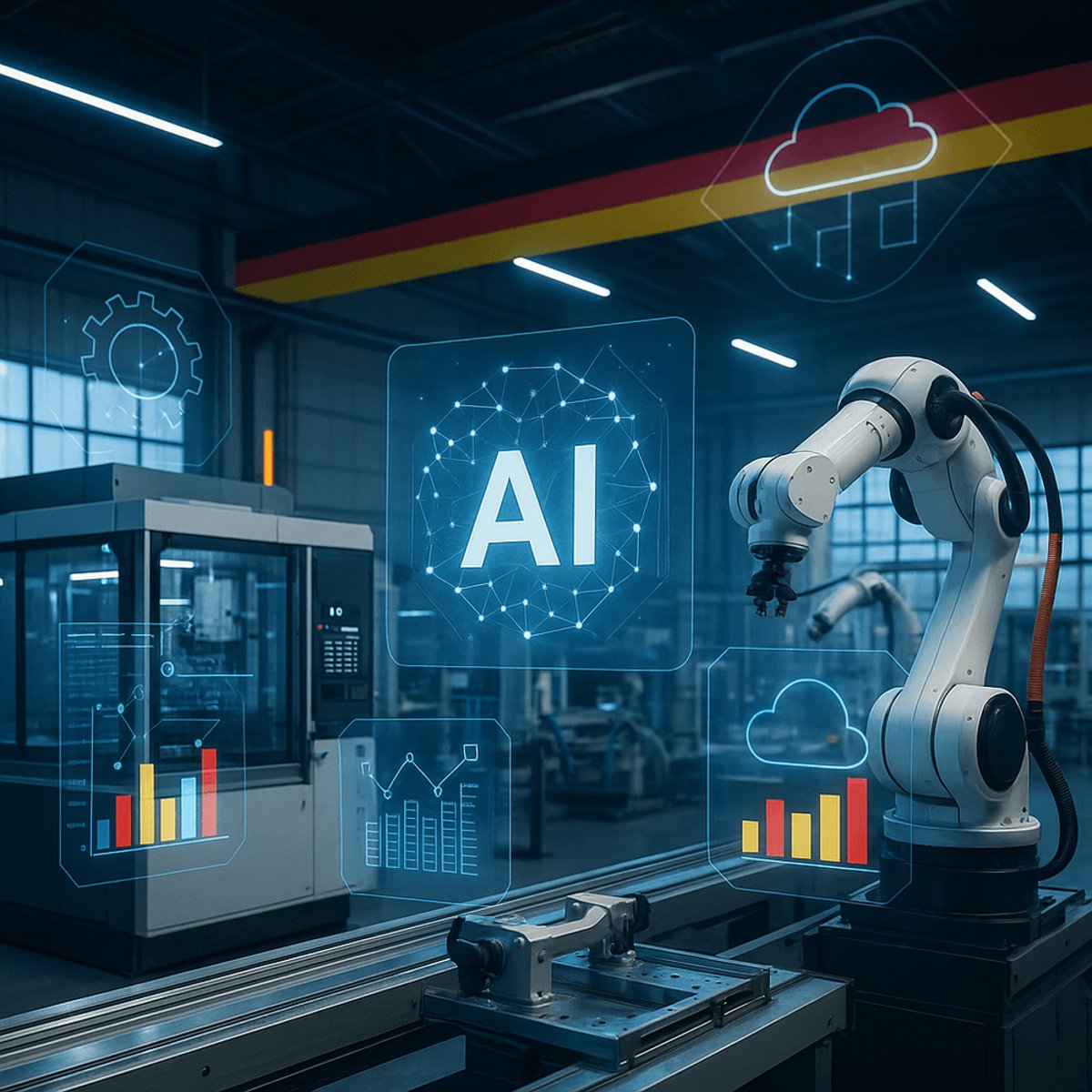
Deutsche Telekom and NVIDIA just dropped a bombshell in Berlin, unveiling the world's first Industrial AI Cloud - a sovereign, enterprise-grade platform set to transform Germany's manufacturing landscape starting early 2026. This isn't just another cloud service; it's Europe's answer to AI sovereignty, combining Deutsche Telekom's trusted infrastructure with NVIDIA's cutting-edge AI and Omniverse digital twin platforms.
The tech world just witnessed something unprecedented in Berlin. Deutsche Telekom and NVIDIA didn't just announce another cloud partnership - they unveiled what they're calling the world's first Industrial AI Cloud, and it's about to reshape how Europe thinks about AI sovereignty.
"We have to build a stack here in Germany which is enabling our industry to participate in this next-generation evolution of industrialization," Deutsche Telekom CEO Tim Höttges told the packed audience at Berlin's historic Gasometer. The message was clear: Europe isn't just watching the AI revolution from the sidelines anymore.
This isn't your typical cloud infrastructure play. The Industrial AI Cloud represents a fundamental shift in how European manufacturers will approach digital transformation. Built entirely in German data centers and powered by up to 10,000 NVIDIA GPUs, the platform promises something that's been missing from the European tech landscape - true AI sovereignty without compromising on performance.
NVIDIA CEO Jensen Huang made the stakes crystal clear during Tuesday's announcement. "These computers are the modern versions of factories," he said. "These are factories, just like factories of cars and all the industrial factories of Germany, these are factories of intelligence." It's a bold vision that positions AI infrastructure as critical as traditional manufacturing.
The technical specs are impressive. The platform harnesses state-of-the-art NVIDIA hardware, including DGX B200 systems and RTX PRO Servers, fully integrated with NVIDIA AI Enterprise and Omniverse software. But what makes this different is the sovereignty angle - everything runs on German soil, under German data protection laws, giving European enterprises the AI firepower they need without regulatory headaches.
Starting in early 2026, enterprises will get early access to GPU capacity at scale, with contracts designed for speed and flexibility. The platform will enable industry-specific AI solutions spanning digital twins, robotics, predictive maintenance, and molecular simulation. Companies can even train next-generation foundation models using their real production data - something that's been a regulatory nightmare for European firms using US-based cloud services.
The ecosystem is already taking shape faster than anyone expected. SAP CEO Christian Klein positioned his company as "the bridge between technology and industry," with SAP's Business Technology Platform serving as the software backbone for secure, scalable application development. Federal ministers Karsten Wildberger and Dorothee Bär framed the announcement as the first tangible outcome of Germany's "Made for Germany" initiative.
But it's the industrial partnerships that really show this platform's potential. Siemens will use the cloud to accelerate industrial AI adoption and offer AI-powered solutions to customers. German automakers Mercedes-Benz and BMW plan to run complex simulations with AI-driven digital twins, potentially cutting vehicle development times dramatically.
The live demos painted a picture of AI-powered factories that seemed straight out of science fiction. Agile Robots showcased their H10-W system, while Wandelbots demonstrated AI-powered robotics already working on factory floors. These aren't concept demos - they're production-ready systems that will run on the Industrial AI Cloud.
"In the future, in industry 4.0, with AI, every company that's a manufacturing company will have two factories, the factory for the car, and the factory for the AI that drives the car," Huang explained. The implications are staggering - every manufacturer becomes an AI company by necessity, not choice.
The timing couldn't be better for European industrial policy. As US-China tensions continue to reshape global tech supply chains, Europe's been scrambling to establish technological independence. The Industrial AI Cloud gives European manufacturers a credible alternative to US cloud giants while maintaining the performance standards that Industry 4.0 demands.
Christian Sewing, co-initiator of the "Made for Germany" initiative, emphasized the platform's role in reshaping European manufacturing. This represents one of the first flagship projects to emerge from the initiative announced earlier this year, signaling that German industrial policy is moving from rhetoric to reality.
The competitive implications are massive. European manufacturers have struggled to match the AI capabilities of their US and Chinese counterparts, often citing regulatory compliance and data sovereignty concerns. The Industrial AI Cloud removes those excuses while providing enterprise-grade performance that rivals anything available globally.
"This is the next industrial revolution in combination with your industries," Huang declared. "It will turbocharge Industry 4.0. It's going to be enormously important, and I think it's going to be the beginning of a new phase of growth and innovation for Germany."
The Industrial AI Cloud isn't just another enterprise software announcement - it's Europe's declaration of AI independence. By combining sovereignty with performance, Deutsche Telekom and NVIDIA have created something that could fundamentally shift how global manufacturers approach AI adoption. With major German industrial players already committed and a 2026 launch timeline, this platform could determine whether Europe remains competitive in the AI-driven economy or gets left behind. For European manufacturers, the question isn't whether to adopt AI anymore - it's whether they'll do it on European terms or someone else's.