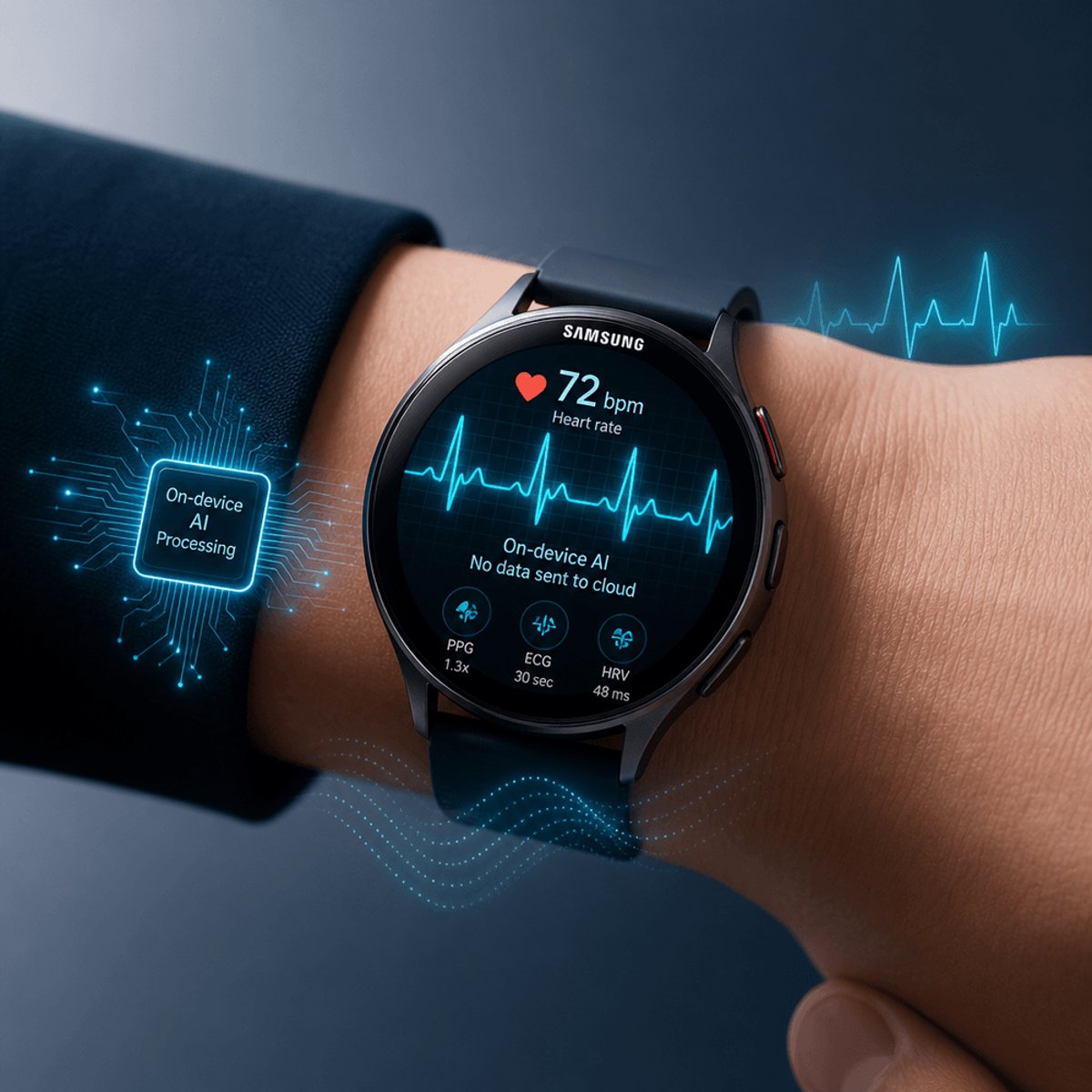
Samsung Research America is pushing health AI to the edge. The company's Digital Health Team just unveiled two foundation models - xMAE and HiMAE - that can analyze biosignals from smartwatches in real time, without cloud servers. The breakthrough: HiMAE processes health data in less than one millisecond on a smartwatch CPU, while xMAE learns to predict heart health from continuously measured signals. Both models earned acceptance to ICML and ICLR, the industry's top AI conferences.
Samsung just made a serious play in the race to put AI-powered health monitoring directly on your wrist. While competitors push cloud-based analysis, the company's research arm is betting on something different: foundation models small enough to run locally on a smartwatch, fast enough to deliver insights in real time.
The Digital Health Team at Samsung Research America unveiled two AI models - xMAE and HiMAE - that represent a fundamental shift in how wearables understand your body. Instead of sending data to remote servers, these models process biosignals right on the device. HiMAE does it in under one millisecond on a smartwatch CPU, according to research published at ICLR 2026.
"We're moving from reactive treatment toward preventive, personalized, and connected experiences," Samsung explained during the Health Forum at Galaxy Unpacked July 2026. The foundation models are the technical backbone making that vision possible.
xMAE tackles a problem that's plagued wearable makers for years. ECG measurements are incredibly accurate for heart monitoring but require users to stop and actively take a reading. PPG sensors, which measure blood flow through light, run continuously but lack ECG's precision. The two signals come from the same cardiac activity - they just arrive with a time delay, like thunder after lightning.
Samsung's solution: teach an AI model to reconstruct masked portions of ECG data using the continuously available PPG signal. The xMAE framework learns the temporal relationship between both biosignals, effectively translating passive measurements into cardiac insights that previously required active user intervention.
The researchers pretrained xMAE on roughly 9,400 hours of paired ECG and PPG data. The model then beat both single-signal models and existing multimodal approaches in 15 of 19 evaluation tasks, spanning cardiovascular disease prediction, abnormal test results, and sleep classification. More importantly, the learned features transferred across different sensor types, body positions, and data collection environments.
But xMAE still needs decent compute power. That's where HiMAE comes in.
Health data reveals different patterns depending on the timescale you examine. Short segments capture heartbeats. Longer windows show sleep cycles or activity trends. It's like zooming in and out on an image - you see different information at each level.
HiMAE uses multiple encoders to analyze biosignals across these varying time scales simultaneously. During self-supervised training, the model reconstructs masked data segments, learning to identify meaningful patterns even with limited labeled examples. A single pretrained HiMAE model handles classification tasks, numerical predictions, and data generation.
The efficiency gains are striking. Samsung achieved high performance while shrinking model size compared to existing architectures. Computational demands dropped so far that a smartwatch-class CPU can run inference in less than one millisecond. That's fast enough for real-time analysis without draining battery or waiting for cloud responses.
"HiMAE demonstrates the potential of on-device health foundation models for the first time," the researchers noted. It's analyzing raw health signals locally, in real time, without server dependency.
The timing matters. Apple continues refining health features across its Watch lineup. Google's Fitbit integration pushes deeper into Wear OS. Amazon's Halo stumbled and shut down, but the industry's direction is clear: health monitoring is becoming a core smartwatch battleground.
Samsung's bet on edge AI could prove decisive. Privacy-conscious users don't want biosignals leaving their wrist. Battery life suffers when devices constantly ping servers. Latency kills real-time interventions. On-device processing solves all three problems - if the models are good enough.
Both xMAE and HiMAE use self-supervised learning on unlabeled biosignal data, then fine-tune for specific health tasks. It's the same foundation model approach that transformed language AI, now applied to the body's electrical and optical signals. After pretraining on large-scale health data, the models generalize across biosignal analysis, biomarker development, and health prediction tasks.
The research credentials add weight. ICML and ICLR acceptances mean Samsung's work passed peer review at the industry's most competitive AI conferences. That's validation beyond corporate press releases - these models represent genuine technical advances in understanding physiological relationships and temporal structure in biosignals.
Samsung's Connected Care vision, outlined at the recent Unpacked event, relies on exactly this kind of continuous, personalized health insight. The company talks about moving from episodic measurements to ongoing awareness, from generic advice to individualized guidance. Foundation models that run locally, understand context across timescales, and bridge different sensor types are the infrastructure that makes it possible.
The researchers from Samsung Research America's Digital Health Team are continuing development on AI technologies that "continuously understand a person's health state from biosignals, generate health insights, and offer appropriate health guidance." Translation: expect these models to ship in future Galaxy Watch devices, probably sooner than later.
Competitors will watch closely. On-device health AI that actually works - fast, accurate, power-efficient - changes what's possible in wearables. Samsung just showed it's feasible. Now the race is on to ship it.
Samsung's xMAE and HiMAE models mark a genuine technical leap in wearable health AI - peer-reviewed, on-device, and fast enough for real-time use. While the industry debates cloud versus edge, Samsung's shipping the answer: foundation models that understand your body's signals without ever leaving your wrist. As Connected Care moves from concept to product, these AI models become the difference between another fitness tracker and a device that actually knows what's happening inside you. The question now isn't whether on-device health AI is possible - Samsung just proved it is. The question is who ships it to consumers first.