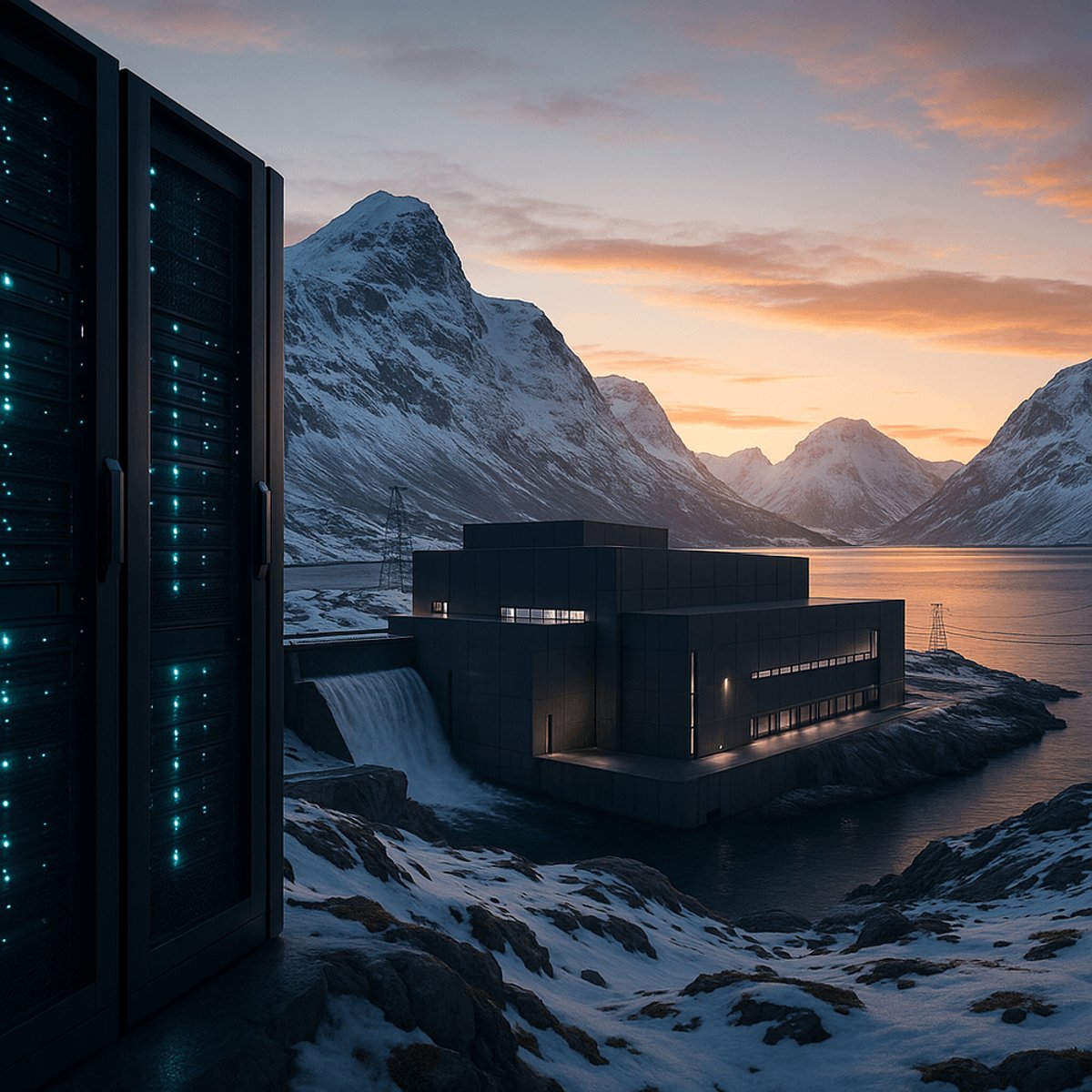
A former Trump administration official is plotting a multi-billion-dollar Arctic data center that would become one of the world's largest AI infrastructure facilities. Drew Horn, CEO of GreenMet and former senior aide to Vice President Mike Pence, told CNBC the Greenland project aims to hit 300 megawatts by mid-2027 before scaling to 1.5 gigawatts by late 2028. But the venture faces a gauntlet of challenges - from securing local permits to navigating the diplomatic minefield created by President Trump's renewed push to acquire the Danish territory.
A massive data center project in one of the world's most remote locations just became the latest flashpoint in the AI infrastructure arms race. Drew Horn, former senior aide to Vice President Mike Pence and CEO of strategic advisory firm GreenMet, is leading a multi-billion-dollar effort to build a 1.5-gigawatt facility on Greenland's southwest coast - a project that would rank among the largest data centers on the planet if completed.
The plan calls for the facility to go live at 300 megawatts by mid-2027, then expand to 1.5 gigawatts by the end of 2028. That's several times larger than any currently operational data center globally, though the target aligns with the wave of gigawatt-scale projects that Meta, Microsoft, Google, Amazon Web Services, and OpenAI are racing to build as AI workloads devour exponentially more computing power.
Horn told CNBC the venture has locked in binding financial commitments - split between debt and equity - to cover half the initial phase and half the final buildout. But those funds are contingent on clearing critical milestones, including securing land rights and permits from Greenland's local government. Construction hasn't started yet, and the project still lacks formal approvals from authorities in Kangerlussuaq, the small settlement at the end of a fjord where the facility would sit.
The timing couldn't be more complicated. Greenland has been thrust into a geopolitical firestorm after President Donald Trump doubled down on his interest in acquiring the semi-autonomous Danish territory. While Trump recently backed off threats to impose tariffs on European nations over the issue, the diplomatic tensions have created an uncertain backdrop for private ventures seeking government cooperation.
"The issue is not so much on the private side, it's on the diplomatic," Horn said in the interview. "Our effort, which is purely private, it succeeds only if we have the buy-in from the relevant affected parties and countries."
Horn - who also served as a senior advisor to the Energy and Intelligence departments toward the end of Trump's first term - has been cultivating relationships with officials in Nuuk and Copenhagen. He met Danish Ambassador to the U.S. Jesper Møller Sørensen on Wednesday to discuss the project as part of what he called a "continuing dialogue."
GreenMet, which helps companies navigate government funding and strategic partnerships, has ties to other former Trump orbit figures. George Sorial, who was executive vice president and chief compliance counsel at the Trump Organization until 2019, and Keith Schiller, Trump's longtime bodyguard and former director of Oval Office operations, helped establish the company in 2021 and remain shareholders. Sorial told CNBC he and Schiller are "passive minority shareholders" with no management role.
The project's power strategy highlights both the opportunity and the challenge of building in the Arctic. For the initial 300MW phase, the venture plans to use specialized barges carrying liquefied natural gas to the Kangerlussuaq fjord. The second phase would be powered by a new hydroelectric facility - critical infrastructure that still requires permits from Greenland's government, where 70% of electricity already comes from hydro.
"We've spent about a year putting together everything from the power to the technology components, and we have a Greenlandic partner on the ground," Horn said. "Right now we're waiting on approvals from the Greenlandic side."
Analysts see clear advantages to Greenland's resource profile. "The biggest value sits in its resource profile, specifically in hydro for electricity generation and a 'free cooling' proposition given the lower ambient temperature," Noah Ramos, strategist at Alpine Macro, told CNBC. Data centers generate enormous heat from servers, and Arctic temperatures dramatically reduce cooling costs - one of the largest operational expenses for facilities.
But the same environment creates engineering nightmares. "Building in the Arctic is capital intensive; construction seasons are short, and the heat from the servers can melt the very ground the building sits on... specialized engineering is needed," Ramos said.
There's also a technology wildcard. Nvidia is pushing new chip generations that require less cooling, potentially undermining the Arctic advantage. "It's early days, but if future generations of chips are even more efficient in this regard, it could negate the need for expensive data centre build outs in places like Greenland," Michael Field, chief equity strategist at Morningstar, told CNBC.
The project fits into a broader land grab for data center capacity. Deals in the sector hit a record $61 billion in 2025 as hyperscalers scrambled to lock down sites and power. Major tech companies are evaluating unconventional locations worldwide, from nuclear-powered facilities to offshore platforms, as traditional markets like Northern Virginia run short on available electricity.
Horn said "larger corporate entities" will lead the actual construction and operation, but declined to name them since partnerships aren't public yet. GreenMet will continue advising as the project pursues government investment from the U.S., Greenland, Denmark, and other NATO countries.
The venture's success hinges on threading a diplomatic needle - advancing a commercial project while governments negotiate over Greenland's future relationship with the United States. For now, the data center remains a bet that Greenland's combination of renewable energy, natural cooling, and strategic location can overcome the immense logistical and political hurdles of building at the edge of the Arctic.
The Greenland data center represents both the ambition and uncertainty defining AI infrastructure's next chapter. If Horn and his partners can navigate the permitting maze and diplomatic crosscurrents, they'll have pulled off one of the most audacious data center builds in history - harnessing Arctic conditions to power the AI boom. But the project's fate depends less on engineering prowess than on political winds swirling around Greenland's relationship with Washington and Copenhagen. For an industry desperate for gigawatt-scale capacity, this remote Arctic settlement has become an unlikely proving ground for whether the world's appetite for AI can overcome geography, geopolitics, and the challenges of building on permafrost.