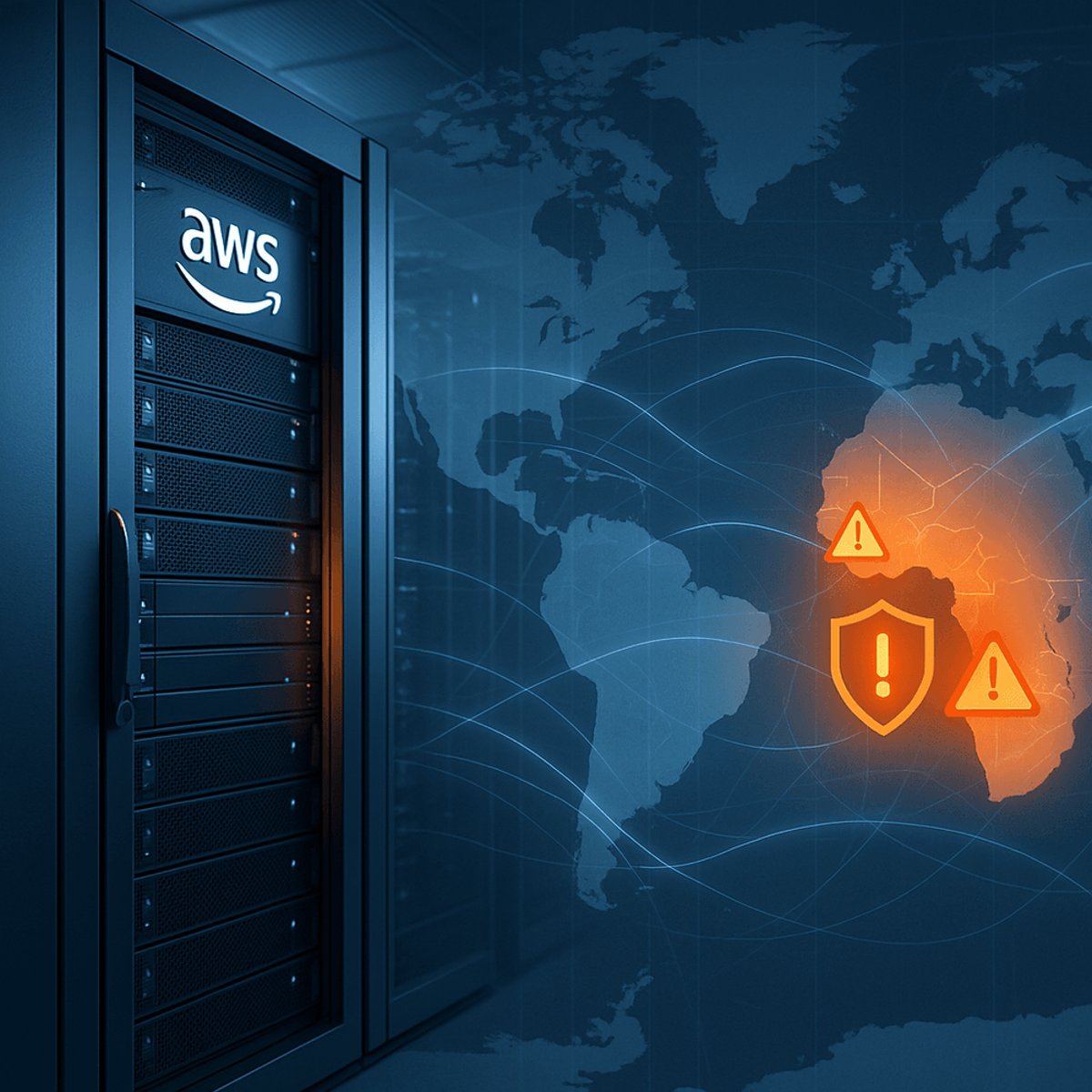
Amazon confirmed Wednesday that three of its AWS data centers in the Middle East sustained damage from Iranian drone strikes, marking the first time a major cloud provider's physical infrastructure has been targeted in a military conflict. The Bahrain facility suffered collateral damage from a nearby strike, while two UAE data centers took direct hits. Iranian state media claims the attacks targeted infrastructure supporting U.S. military operations, raising urgent questions about the vulnerability of global cloud services that power everything from enterprise applications to AI workloads.
Amazon Web Services is scrambling to assess the damage after confirming that Iranian military drones struck three of its Middle Eastern data centers on Wednesday, according to a statement reported by CNBC. The Bahrain facility took collateral damage from a drone strike that hit nearby, while two data centers in the United Arab Emirates were directly targeted.
Iranian state media quickly claimed responsibility, framing the strikes as retaliation against infrastructure they allege supports U.S. military operations in the Gulf region. The accusation, whether accurate or not, demonstrates how cloud providers have become entangled in geopolitical tensions despite positioning themselves as neutral infrastructure operators. Amazon has long maintained that AWS serves commercial customers and complies with all applicable laws regarding government contracts.
The physical damage to AWS facilities represents a watershed moment for the cloud industry. While cyberattacks on cloud infrastructure have become routine, kinetic military strikes on data centers cross a threshold that most security planners hadn't seriously contemplated. AWS operates 33 geographic regions globally with 105 availability zones, but this incident exposes the vulnerability of concentrated infrastructure in politically volatile regions.
Amazon hasn't disclosed the extent of service disruptions or which customer workloads might be affected. The company's Middle East (Bahrain) region, launched in 2019, serves customers across the Gulf Cooperation Council countries. The UAE regions handle growing demand from enterprises expanding into the Middle East and companies seeking data residency compliance with local regulations. Any prolonged outage would ripple through financial services, oil and gas operations, and the growing number of AI startups that have flocked to the region.
The timing couldn't be worse for AWS, which has been aggressively courting enterprise customers with promises of 99.99% uptime and geographic redundancy. The company's revenue grew 19% year-over-year to $105 billion in 2025, with international expansion driving much of that growth. Now CIOs at major enterprises face uncomfortable board-level questions about whether their multi-cloud strategies adequately account for geopolitical risk, not just technical failure modes.
Competitors are watching closely. Microsoft Azure operates data centers in the UAE and Qatar, while Google Cloud has been expanding its Middle Eastern footprint. If AWS's facilities prove vulnerable to military action, every cloud provider with infrastructure in contested regions faces heightened scrutiny. The incident could accelerate the already-growing trend of data sovereignty requirements, with governments demanding that critical workloads run on domestic soil.
Defense analysts note that targeting civilian infrastructure, even infrastructure with alleged military connections, raises serious questions under international law. But the precedent is now set - cloud data centers, once considered off-limits civilian infrastructure, have become legitimate targets in the eyes of some military planners. That calculus changes everything for an industry built on the assumption that bits and bytes exist somehow apart from geopolitics.
For AWS customers running production workloads in the affected regions, the immediate concern is failover and recovery. The company's architecture typically includes multiple availability zones within each region, designed to isolate failures. But drone strikes aren't the kind of failure mode those systems were built to handle. If all availability zones in a region sustained damage, customers without cross-region replication would face data loss and extended downtime.
The incident also highlights the concentrated risk in submarine cable infrastructure. The Middle East serves as a critical nexus for fiber optic cables connecting Europe, Asia, and Africa. Physical attacks on data centers could easily extend to the cable landing stations that connect those facilities to the global internet, creating cascading failures far beyond the immediate strike zone.
Amazon's stock showed little movement in after-hours trading, suggesting investors view this as a isolated incident rather than a systematic threat to AWS's business model. But that sanguine response might be premature. If enterprise customers begin demanding pricing concessions or contractual protections related to geopolitical risk, AWS's industry-leading margins could face pressure. The company's ability to charge premium prices has always rested on its reputation for reliability.
The Iranian strikes on AWS facilities mark a dangerous new chapter in the intersection of cloud computing and geopolitics. What was once theoretical risk modeling is now very real - physical infrastructure that powers global digital services can become collateral damage or direct targets in military conflicts. Enterprise customers and governments will need to rethink their cloud strategies with geopolitical risk weighted as heavily as technical architecture decisions. For AWS and its competitors, the era of cloud providers as neutral infrastructure operators may be ending, replaced by a harder reality where data centers are strategic assets in a fractured world.