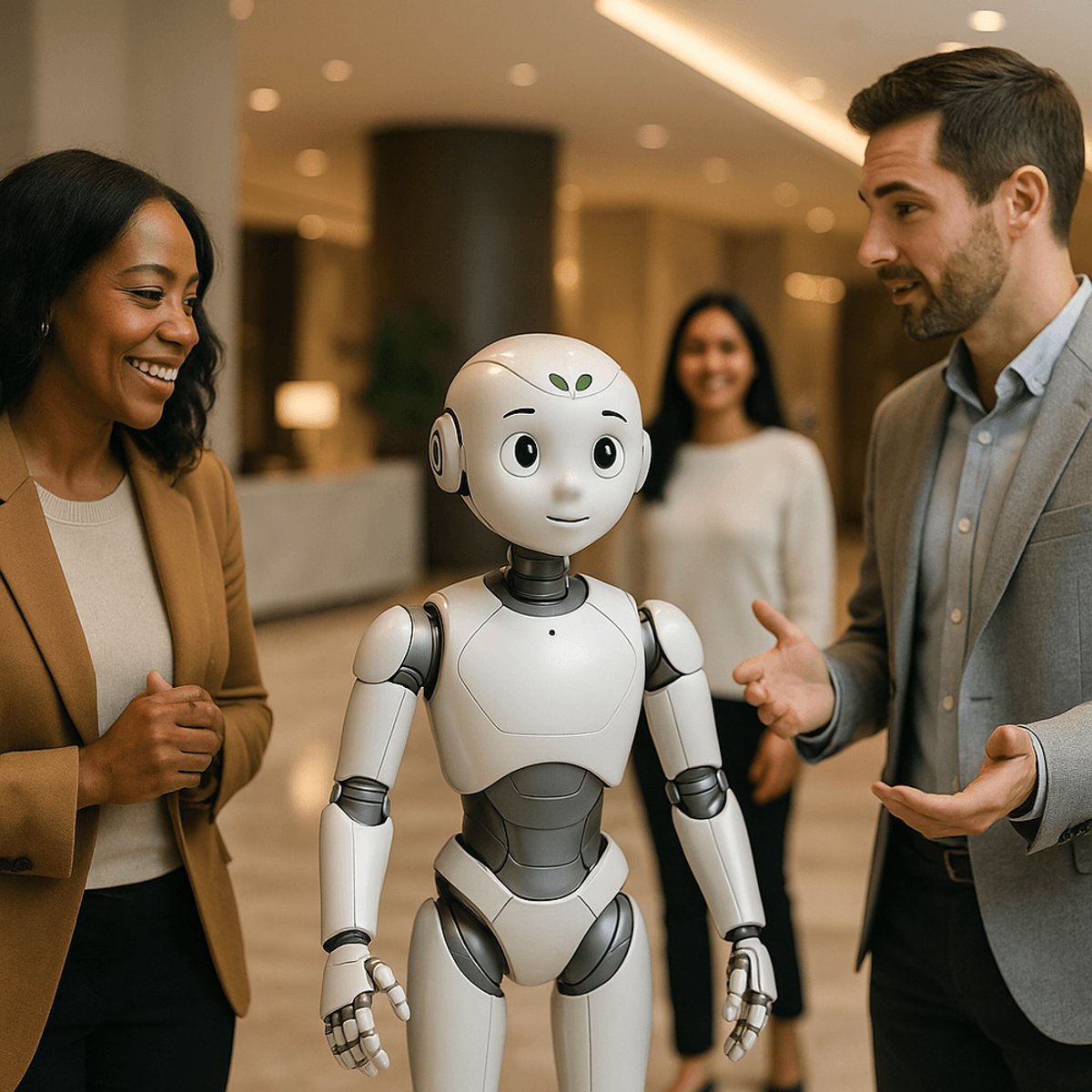
A new humanoid robot is betting against the warehouse hype. Fauna, a startup founded by former Meta and Google engineers, just launched Sprout - a child-sized humanoid designed to fetch toothbrushes in hotels rather than stack shelves in factories. At $50,000, the robot aims to crack hospitality and research markets that bigger competitors have largely ignored, with Disney and Boston Dynamics already signed as early customers.
Fauna just placed a contrarian bet in the humanoid robot race. While competitors chase factory floors and warehouse contracts, the startup's launching Sprout - a 9-year-old-sized humanoid designed to bring you a toothbrush.
The robot goes on sale today for $50,000, and CEO Robert Cochran says hotels are already lining up. "We said, 'What if we could build something lightweight, engaging, and safe to be around, and capable enough to do some exciting things?'" Cochran told Wired in an exclusive demo.
It's a sharp departure from the prevailing wisdom. More than a dozen US companies are pouring resources into humanoids built for industrial work. Boston Dynamics recently signed a deal to integrate Google's AI into its robots. Tesla is developing Optimus for manufacturing. Startups like Agility Robotics, Figure AI, and 1X are all targeting factories and logistics.
But Fauna's thesis is different. The founding team - which includes veterans from Meta and Google - believes hospitality and entertainment will crack first. And they've already landed customers that suggest they might be right. Disney, which operates robots at theme parks, signed on as an early buyer. So did Boston Dynamics itself, which makes larger, stronger humanoids but apparently sees value in Sprout's approach.
The robot's design reflects its mission. Sprout comes with mechanical eyebrows that convey interest, surprise, or confusion - features you don't need in a warehouse but become crucial when interacting with hotel guests. It can scan environments, walk autonomously, and tap into language models out of the box. During a demo, Cochran asked Sprout to check what was in the fridge. The robot interpreted the command using an LLM, walked over "in a manner not unlike a truculent 9-year-old," peered through the glass door, and reported back about several sodas.
That kind of capability matters for Fauna's target market. Scientists at New York University are already using Sprout to research robotic manipulation and human interaction. The startup built software libraries that make the robot easy to program, and it can be teleoperated for training purposes. Fauna claims it's developed proprietary tech to help Sprout regain balance if it stumbles - critical when you're navigating crowded hotel lobbies.
The pricing puts Sprout in interesting territory. Chinese robotics firm Unitree has found success selling humanoids for entertainment and research at under $20,000, though fully equipped versions with sensors and computers cost about the same as Sprout. Fauna's positioning suggests it's aiming higher than hobbyists but lower than industrial buyers willing to pay six figures for manufacturing-grade machines.
Cochran's background at Meta gives him insight into technologies that could accelerate humanoid adoption. He notes that AI systems identifying objects - like those being developed for smart glasses - translate directly to robots navigating human environments. "You can kind of get a 'Hello World' example of a robot where you can talk to and autonomously map and navigate its environment effectively," he says. "And from there, the world's your oyster."
The launch comes as the humanoid industry grapples with a fundamental question: where will these machines actually work? Factory trials are underway at automakers, but practical deployment remains limited. Fauna's wagering that service industries hungry for labor and willing to experiment will move faster than manufacturing giants with established processes.
It's a gamble that depends on hotels, restaurants, and entertainment venues seeing value in robot staff that can fetch items, guide guests, and handle simple tasks. Sprout's $50,000 price point means it needs to justify itself quickly - roughly equivalent to a year's salary for human workers in many hospitality roles, but without the ongoing wage costs.
The robotics industry is watching whether service applications can finally deliver on decades of promises. Previous generations of service robots largely failed to gain traction outside controlled environments like hospitals and airports. But advances in AI, particularly language models and computer vision, give Sprout capabilities earlier machines lacked. Whether that's enough to crack hospitality at scale is the bet Fauna's making.
Fauna's launching Sprout into a crowded humanoid market with a contrarian strategy that could either carve out a lucrative niche or prove the industry's warehouse obsession was right all along. With Disney and Boston Dynamics as early believers and hotels already in discussions, the startup's betting that friendly, affordable, and safe beats strong and industrial when it comes to working alongside humans. The next 12 months will show whether hospitality customers are ready to hand robot butlers the room service cart - or if humanoids still need more time in the lab before they're ready for the lobby.