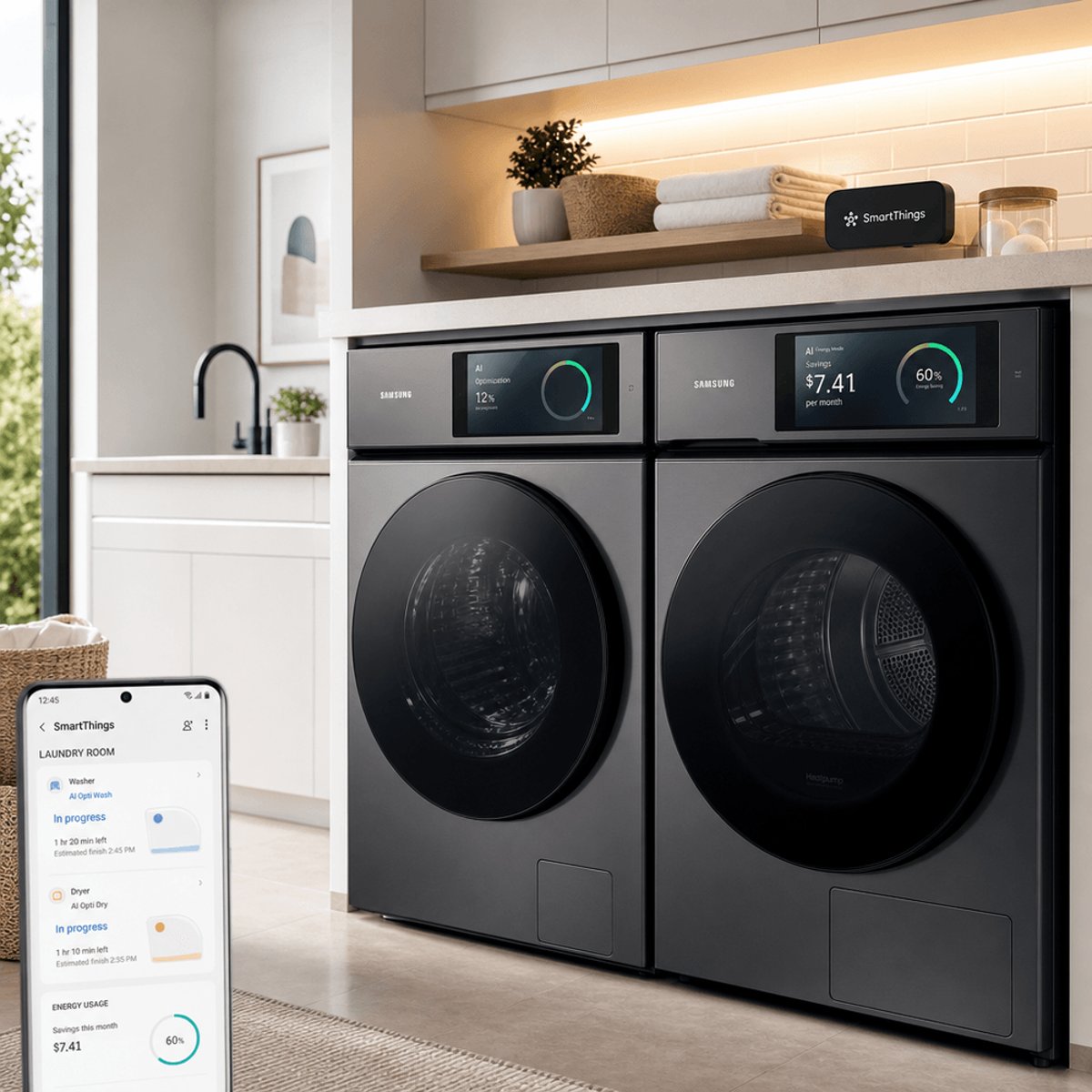
Samsung just launched its Bespoke AI Washer and Dryer lineup, pushing AI deeper into the home appliance market with fabric-sensing technology and voice-controlled operation. The new lineup, rolling out globally starting July 2026, promises up to 70% energy savings through AI-optimized wash cycles and SmartThings integration. It's Samsung's latest move to apply the AI playbook beyond smartphones and TVs, betting consumers will pay premium prices for smarter laundry rooms.
Samsung is bringing AI to your laundry room. The company unveiled its new Bespoke AI Washer and Dryer lineup today, marking another front in the race to embed artificial intelligence across every corner of the smart home. With fabric-sensing algorithms, voice-activated controls, and energy monitoring that promises to slash utility bills, Samsung's betting that consumers care as much about intelligent laundry as they do about AI-powered phones.
The washers pack AI Wash+ technology that recognizes five fabric types - cotton, delicates, towels, denim, and outdoor wear - for loads up to 2kg, according to Samsung's announcement. Multiple sensors detect weight and fabric composition, then automatically adjust water, detergent, and cycle time based on soil levels throughout the wash. The dryers get similar treatment with AI Dry+, which analyzes moisture and temperature while identifying four fabric types to optimize the heat pump compressor and heat exchanger performance.
"As consumers increasingly seek appliances that adapt intelligently to their daily routines, Samsung continues to expand the role of AI across the home," Hyoung Min Park, VP and Head of Customer Experience for Samsung's Digital Appliances division, told press. "The new Bespoke AI Washer and Dryer lineup delivers a more personalized and convenient laundry experience."
The real headline is energy savings. Samsung claims AI Energy Mode can cut washer power consumption by up to 70% by washing at lower temperatures using the company's Ecobubble technology and extending cycle times. For dryers, the AI optimization reduces energy use by 20% compared to standard cycles, based on internal testing. Those numbers matter as household energy costs continue climbing globally, and appliance makers race to tout sustainability credentials.
But Samsung's also making a play for convenience. Each machine features a 7-inch LCD Smart Screen that serves as both control panel and usage dashboard, learning habits and suggesting cycles through the SmartThings app. After each load, users get detailed reports on energy and water consumption. The lineup integrates Samsung's upgraded Bixby voice assistant, letting users start cycles, adjust settings, or check wash time remaining through voice commands - no need to touch the screen with wet hands.
The SmartThings integration is key to Samsung's broader smart home strategy. Through the app, users can monitor daily, weekly, and monthly energy consumption with estimated electricity costs. When AI Energy Mode is activated on compatible cycles, the system intelligently balances cleaning performance against power usage. It's the kind of connected ecosystem approach that's becoming table stakes for premium appliances as Google, Amazon, and Apple all push deeper into the smart home.
Samsung's timing is strategic. The global smart home appliance market is exploding, driven by rising energy costs and consumer appetite for IoT-connected devices. By embedding AI algorithms that continuously optimize performance, Samsung's positioning these appliances as upgrades worth paying for - not just replacing old machines when they break. The company's already applied this playbook successfully with premium refrigerators and ovens.
The new Bespoke AI lineup offers washer capacities from 10.5kg to 13kg in a 24-inch standard-depth design, with matching dryers from 9kg to 13kg capacity. Availability starts in select markets this July, though Samsung hasn't disclosed pricing. That's typical for the company's Bespoke line, which targets premium buyers willing to pay extra for customization and smart features.
What's notable is how Samsung's fabric recognition works. The AI algorithm can only identify fabrics for loads up to 2kg - anything heavier and you're relying on broader weight and soil sensors. Mixed fabric loads may also reduce detection accuracy, according to the fine print. It's a reminder that AI in appliances still has practical limits, even as marketing emphasizes the intelligence.
Still, the voice control and energy monitoring represent meaningful conveniences. Being able to ask Bixby to explain screen information or add an extra rinse cycle without stopping mid-task addresses real friction points in daily laundry routines. And the energy tracking through SmartThings gives users visibility into actual usage patterns - valuable data as utility rates fluctuate.
Samsung's not alone in the AI appliance race. LG has been pushing its ThinQ AI platform across washers and dryers, while startups are experimenting with retrofit smart home solutions. But Samsung's ecosystem advantage - spanning phones, TVs, appliances, and the SmartThings hub - gives it a path to deeper integration that standalone appliance makers can't match.
Samsung's Bespoke AI lineup shows how AI is creeping into every appliance category, not just the obvious candidates like thermostats and security cameras. The fabric sensing and voice control are genuinely useful features, while the energy monitoring addresses real consumer concerns about utility costs. But the proof will be in real-world performance - whether the AI algorithms actually deliver meaningful energy savings and convenience, or just add complexity to machines that need to run reliably for a decade. As the July launch approaches, Samsung's betting consumers will pay premium prices for laundry rooms that think for themselves.