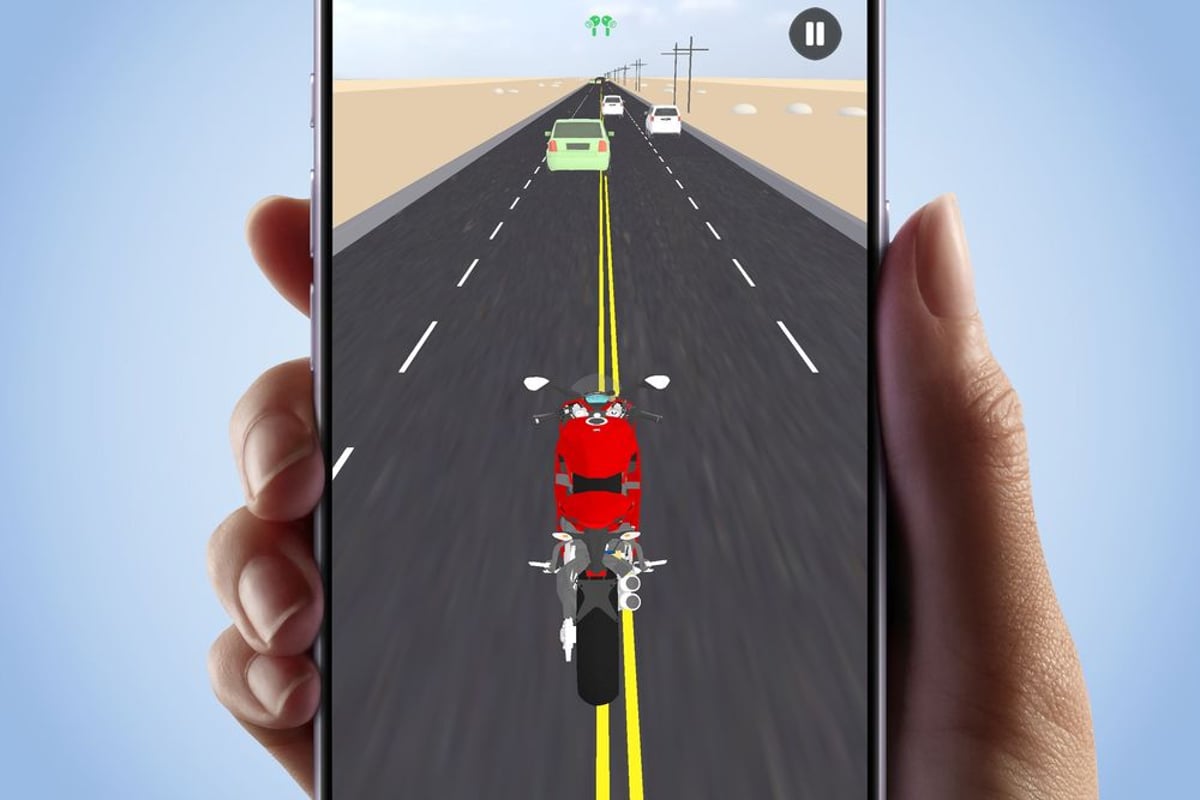
Developer Ali Tanis just launched RidePods, the first iPhone game that turns Apple's AirPods into a wearable motion controller. Instead of tapping screens, players steer a motorcycle through traffic by simply tilting their heads while wearing compatible AirPods. The free game represents a fascinating glimpse into hands-free mobile gaming, even if the execution feels more like a proof of concept than a polished experience.
The gaming industry just got its first taste of truly hands-free mobile controls, and it's coming from an unexpected source. Apple's AirPods have quietly become motion controllers thanks to developer Ali Tanis, who reverse-engineered the Spatial Audio feature to create something entirely new for iOS gaming.
RidePods - Race with Head launched this week as a free download, requiring nothing more than compatible AirPods and subtle head movements to play. The concept is deceptively simple: steer a motorcycle through endless traffic by tilting your head left and right. But the technical execution reveals how Apple's hardware ecosystem is quietly enabling new interaction paradigms.
The game works exclusively with AirPods that support Spatial Audio - including AirPods Pro, AirPods Max, and third and fourth-generation regular AirPods. These models pack accelerometers and gyroscopes that normally track head position for immersive audio experiences. Tanis tapped into this sensor data to create responsive gaming controls that feel surprisingly natural.
"I had to reverse engineer the Spatial Audio feature to make this work," Tanis announced on Y Combinator, though Apple does provide official developer access to headphone motion data for fitness and accessibility applications.
The gaming experience itself remains fairly basic. Players navigate a motorcycle down what appears to be an endless straight highway, dodging oncoming traffic with head tilts. There's no steering wheel physics or complex track layouts - just pure reaction-based gameplay that responds to your neck movements. The graphics occasionally glitch, with roads disappearing mid-game, and the motorcycle seems locked to a perfectly straight path.
But here's where it gets interesting: the controls actually work remarkably well. Testing with both AirPods Pro and AirPods Max revealed surprisingly nuanced responsiveness to even subtle head movements. The bike responds to micro-adjustments, and you can even play with just a single AirPod earbud for an added challenge. Advanced users can disable Automatic Head Detection in their AirPods settings to use the earbuds as handheld controllers, though this requires much more precise movements.
The game includes additional features like forward and backward head tilts for acceleration and braking (though these controls seem inconsistent), toggleable first-person and third-person camera views, and a recording function that captures both gameplay footage and a selfie video of you playing. It's clearly designed for social sharing - imagine the TikTok videos of people apparently controlling games with their thoughts.
What makes RidePods significant isn't its current gameplay quality, but what it represents for the future of mobile interfaces. Apple's investment in spatial computing through Vision Pro and advanced AirPods sensors is creating unexpected opportunities for developers to reimagine how we interact with devices.
The accessibility implications alone are enormous. Motion-controlled gaming could open new possibilities for users with limited hand mobility, while the hands-free nature removes barriers that traditional touch interfaces create. Imagine controlling a complex strategy game like Civilization or navigating through productivity apps using nothing but head gestures.
For Apple, RidePods demonstrates the untapped potential in their existing hardware ecosystem. The company has invested heavily in sensor technology across AirPods, Apple Watch, and iPhone, but most developers stick to conventional interaction methods. Games like RidePods prove there's room for innovation using tools already in users' pockets and ears.
The mobile gaming industry, worth over $100 billion annually, is constantly seeking new ways to differentiate experiences on increasingly similar hardware. Motion controls offer a path toward more immersive and physically engaging gameplay that doesn't require additional accessories or expensive AR/VR headsets.
RidePods feels rough around the edges, but it's exactly the kind of experimental project that often leads to breakthrough interfaces. The App Store is filled with polished games that follow established patterns, but real innovation happens when developers like Tanis push hardware beyond its intended use cases.
RidePods won't replace traditional mobile games anytime soon, but it's opened a door that other developers will inevitably walk through. The combination of Apple's advanced sensor hardware and creative developer experimentation is creating entirely new categories of interaction. As spatial computing becomes more mainstream and accessibility concerns drive innovation, head-controlled interfaces may evolve from novelty to necessity. For now, RidePods serves as an intriguing proof of concept that your next game controller might already be sitting in your ears.