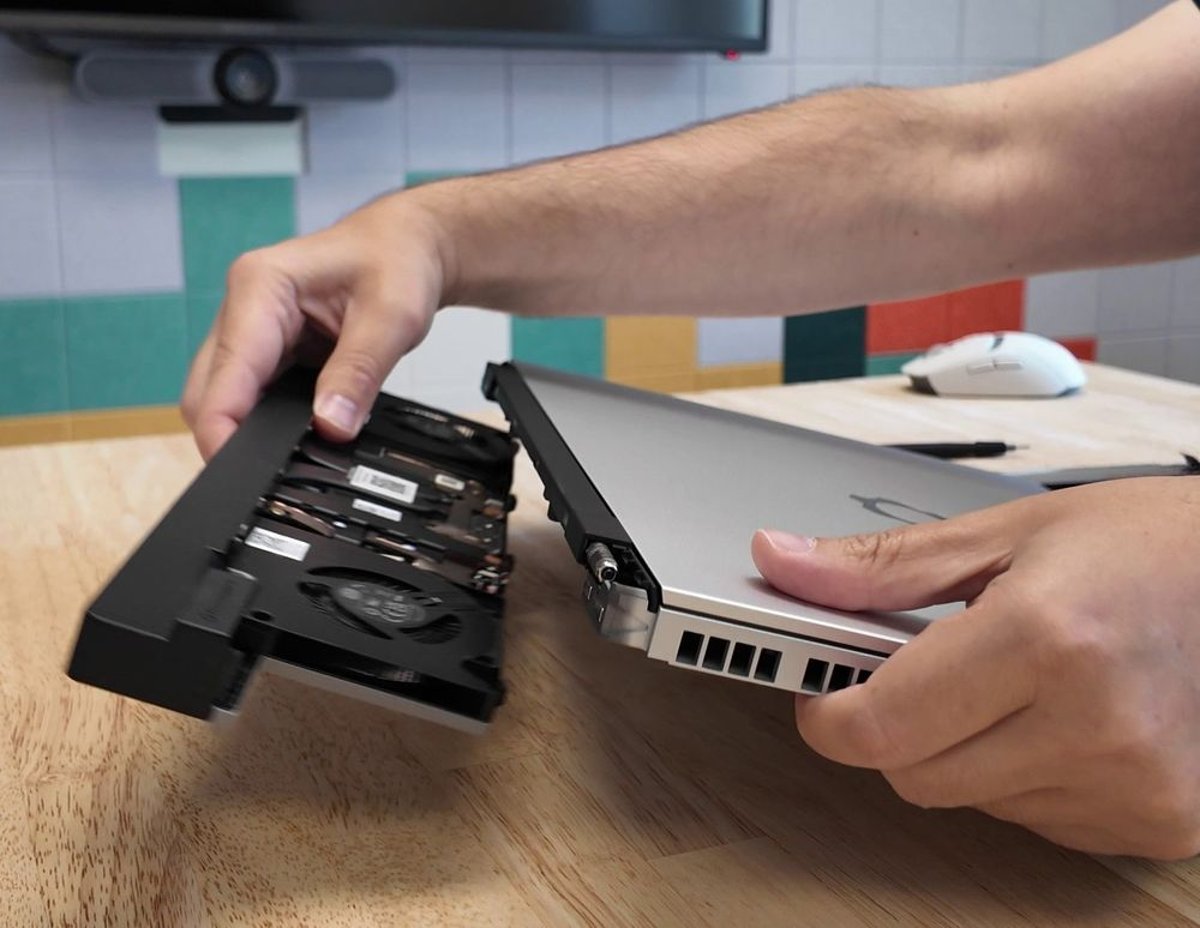
Framework just delivered on tech's most elusive promise — a laptop where you can actually swap the graphics card at home. The Verge's Sean Hollister became the first journalist to physically upgrade a Framework Laptop 16's GPU in three minutes flat, yanking out an AMD RX 7700S and plugging in Nvidia's new mobile RTX 5070 with just six screws.
Framework just shattered the laptop industry's biggest lie. For years, companies have promised "upgradeable" gaming laptops, only to abandon users with obsolete hardware and broken promises. Today, that changes — Framework's modular GPU system actually works, and The Verge's Sean Hollister proved it by swapping an entire graphics card in three minutes.
The demonstration took place at Framework's San Francisco headquarters, where Hollister became the first journalist to physically upgrade a laptop GPU from AMD RX 7700S to Nvidia RTX 5070. The swap required just six screws and Framework's included pen-shaped screwdriver — simpler than traditional MXM modules that required technical expertise.
"This is the proof point we've been waiting for," Hollister wrote in The Verge's exclusive coverage. "It's one thing to build a laptop that can swap its graphics card, and another thing entirely to actually get both Nvidia and AMD to deliver upgrades that fit."
The breakthrough arrives with painful historical context. Alienware promised identical functionality with its Area-51m laptop in 2019, marketing upgradeable graphics as the future of gaming. But Dell's gaming division never delivered a single upgrade module, eventually facing customer lawsuits and settling in arbitration after stranding early adopters with non-upgradeable systems.
Framework's success stems from securing actual hardware partnerships. Unlike Alienware's vaporware promises, Framework obtained Nvidia's blessing and engineering support to create modules that physically fit and functionally work in existing laptops. The RTX 5070 upgrade delivers 30-40% performance improvement over the baseline AMD configuration, running games smoothly at 1440p high settings during live testing.
CEO Nirav Patel acknowledged current limitations during Hollister's visit. Existing Framework Laptop 16 owners will need BIOS updates before upgrading, with software patches still in development. The demonstration used a pre-configured system rather than upgrading from scratch, highlighting deployment challenges that remain.
The timing coincides with Framework's broader hardware push. The company simultaneously launched its 240W USB-C PD 3.1 charger, among the first standards-compliant high-wattage adapters reaching market. Hollister's power meter recorded the Framework Laptop 16 drawing over 220W during stress testing while simultaneously charging its battery and connected phones — performance previously limited by inadequate power delivery.
Pricing positions the upgrade as premium niche technology. The RTX 5070 module costs $699 for 100W, 8GB performance — expensive for mobile graphics but reasonable considering the engineering complexity of modular design. Framework's betting that early adopters will pay premium prices to prove modular viability before economies of scale reduce costs.
Industry observers see broader implications beyond gaming laptops. Modular design principles could reshape enterprise mobility, extending laptop lifespans through targeted component upgrades rather than complete system replacement. The approach aligns with sustainability initiatives while addressing performance scaling challenges in thin-and-light form factors.
Competitive responses remain uncertain. Major OEMs have historically resisted modularity due to supply chain complexity and reduced replacement sales. Framework's demonstration proves technical feasibility, but scaling requires semiconductor partnerships that larger players could potentially block through exclusive arrangements.
The success validates Framework's long-term vision while exposing remaining execution challenges. Getting modular hardware to work represents just the first hurdle — building sustainable upgrade ecosystems requires ongoing component development, software support, and customer education programs that traditional laptop makers have consistently failed to maintain.
Framework's functional GPU swap system represents a genuine breakthrough in laptop modularity, proving that consumer-friendly upgrades are technically achievable when companies commit to proper engineering partnerships. While pricing keeps this technology in niche territory for now, the successful demonstration challenges industry assumptions about laptop obsolescence and could catalyze broader modular adoption if Framework can scale production and reduce costs.