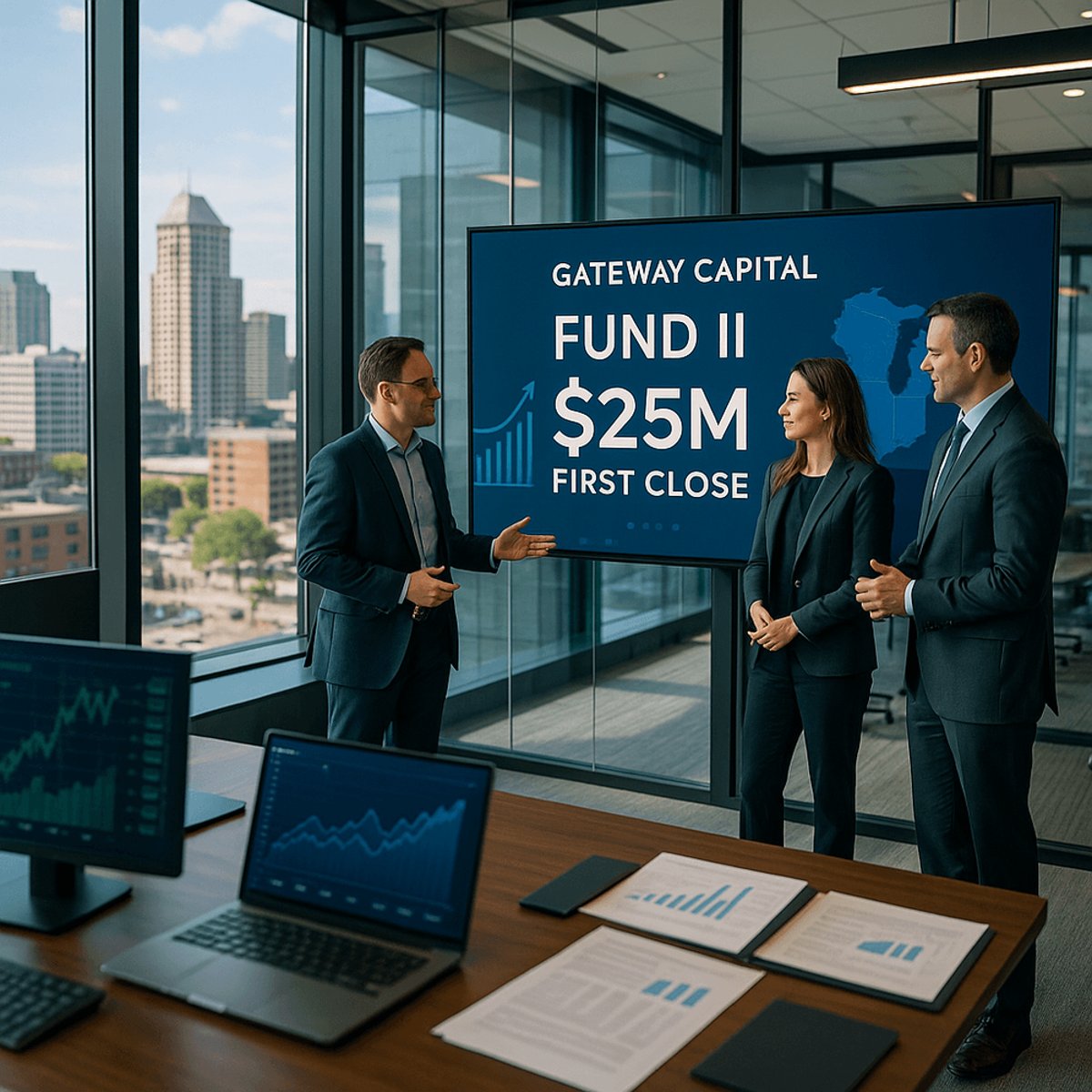
Gateway Capital just hit a milestone that signals the Midwest startup scene isn't slowing down. The Milwaukee-based venture firm founded by Dana Guthrie announced the first close of its $25 million Fund II, clearing the way to start writing checks to early-stage companies. The move comes as regional VCs continue to prove that tech investing doesn't require a Silicon Valley zip code.
Gateway Capital can now start hunting for its next portfolio companies. The Milwaukee venture firm announced it's reached the first close of its $25 million Fund II, the crucial fundraising milestone that lets VCs begin making investments while they continue raising the rest of their target amount.
Founder Dana Guthrie's firm joins a growing cohort of regional investors proving that venture capital is becoming increasingly distributed across the United States. While coastal markets still dominate deal flow, Midwest-focused funds have been steadily building momentum, backed by limited partners who see opportunity in lower valuations and less competitive deal environments.
The first close structure is standard practice in venture capital fundraising. It allows firms to start deploying capital once they've secured a minimum threshold of commitments, typically around 50-60% of their target fund size. This means Gateway Capital likely has north of $12-15 million already committed from limited partners, with the remaining capital expected to close over the coming months.
For Milwaukee's startup ecosystem, the timing couldn't be better. Regional tech hubs have been fighting for years to prove they can compete with traditional venture markets, and dedicated local capital is essential infrastructure. When founders can raise early-stage checks without relocating to San Francisco or New York, it creates a virtuous cycle that keeps talent and companies rooted in their communities.
Gateway Capital's Fund II suggests the firm found success with its first vehicle. Most VC firms only raise subsequent funds when they've demonstrated returns or at least strong portfolio performance to their existing investors. The ability to secure commitments for a second fund, even in a challenging fundraising environment, indicates limited partners see promise in Guthrie's investment thesis.
The $25 million target positions Gateway Capital in the emerging manager category, the tier of smaller, often specialized firms that have become increasingly important to the venture ecosystem. These funds typically write smaller checks than their multi-billion-dollar counterparts but can move faster and take concentrated bets on overlooked markets or underrepresented founders.
Midwest venture activity has been heating up despite broader market headwinds. Chicago, Minneapolis, and increasingly Milwaukee have developed genuine startup clusters around fintech, healthcare tech, and manufacturing innovation. The region's lower cost basis means startups can stretch venture dollars further, while proximity to major industrial companies creates natural partnership and exit opportunities that coastal startups often lack.
What remains to be seen is how Gateway Capital will differentiate its portfolio strategy. Regional funds face a persistent challenge - do they focus exclusively on local companies and risk concentration, or do they compete nationally and potentially lose their geographic advantage? The most successful regional VCs have found ways to do both, leveraging local deal flow and relationships while remaining opportunistic about exceptional companies anywhere.
The first close also starts the clock on deployment pressure. Limited partners expect venture funds to put capital to work within roughly three to four years of closing, meaning Gateway Capital will need to build or accelerate its pipeline of potential investments. That timeline typically aligns with 15-20 companies for a fund this size, assuming check sizes in the $1-2 million range for initial investments plus reserves for follow-on rounds.
Gateway Capital's first close is more than just one firm hitting a fundraising milestone - it's another data point in the ongoing story of venture capital's geographic expansion. As regional ecosystems mature and prove they can generate returns, expect more funds like this to emerge outside traditional tech hubs. For Midwest founders, the message is clear: local capital is getting deeper and more sophisticated. The question now is whether Gateway Capital can turn these commitments into portfolio wins that make Fund III even easier to raise.