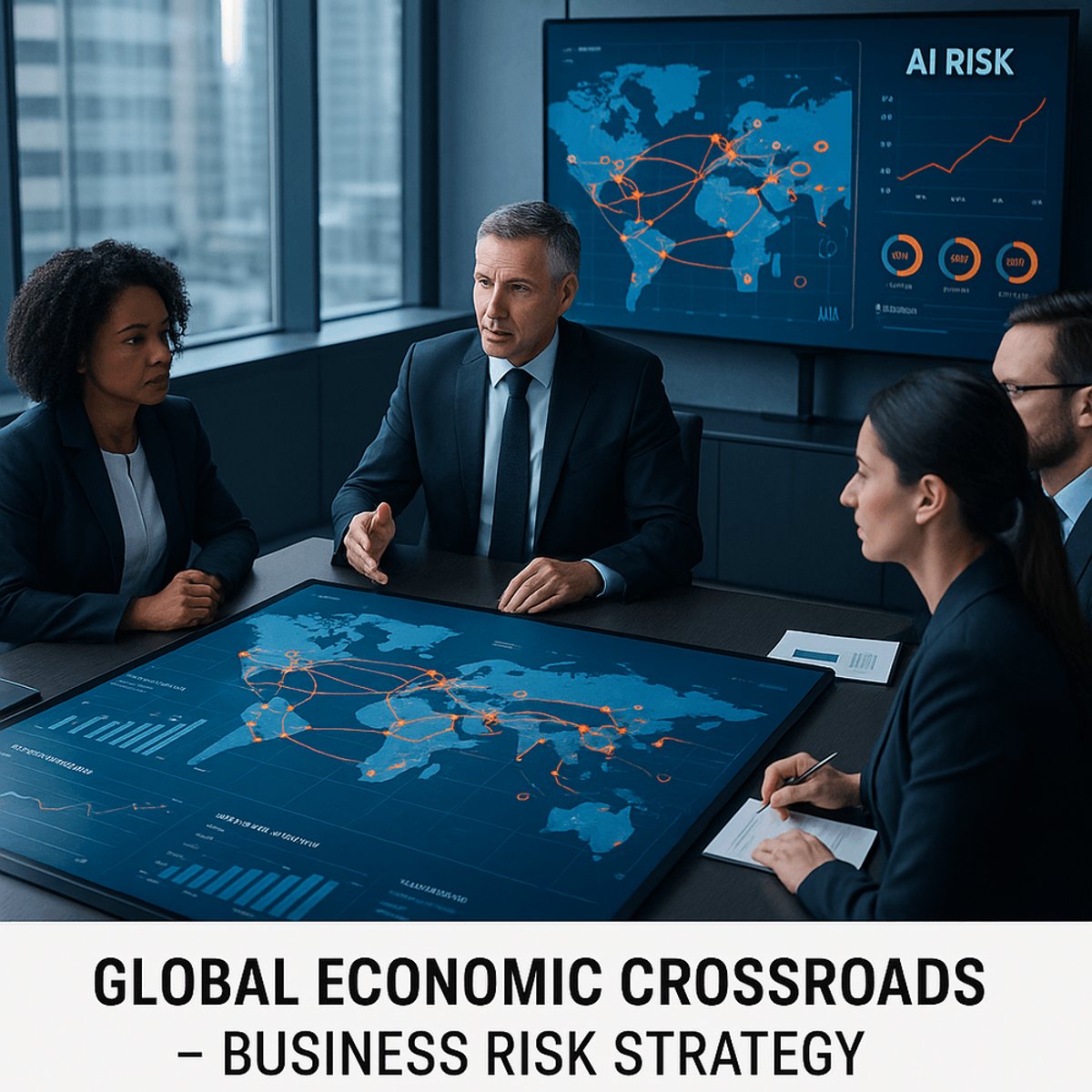
The World Economic Forum just dropped a sobering forecast: business leaders are bracing for turbulence. Half of the 1,300 executives surveyed expect rough waters over the next two years, while only 1% see calm ahead. Geoeconomic confrontation—tariffs, supply chain weaponization, capital controls—has vaulted to the top of their worry list, while the dark side of artificial intelligence is climbing faster than any other risk.
The World Economic Forum has painted a bleak picture of what's coming. According to their 2026 Global Risks Report released this week, geoeconomic confrontation has sprinted to the top of near-term business worries, surpassing everything else companies are sweating about. The 1,300 leaders in government, business, and other organizations who participated in the survey aren't mincing words: nearly half expect turbulent times, and just 1% are optimistic enough to expect calm.
This shift reflects a landscape being reshaped by weaponized economics. Tariffs, regulations, supply chain restrictions, and capital controls are becoming tools of geopolitical competition, and the collateral damage could be massive. The report warns of a potential substantial contraction in global trade—the kind of economic shock that ripples across entire industries and labor markets.
WEF Managing Director Saadia Zahidi framed the stakes in stark terms when speaking to CNBC: "It's very much about state-based armed conflict and the concerns around that. So overall, nearly a third of our respondents are very concerned in 2026 about what that means for the global economy and essentially the state of the world." That's not just C-suite anxiety—it's existential worry about the system itself. Economic risks have experienced the sharpest rises among all categories the WEF surveys, and Zahidi's own analysis captures why: "Concerns are growing over an economic downturn, rising inflation and potential asset bubbles as countries face high debt burdens and volatile markets."
Marsh, the world's largest insurance brokerage (which rebranded from Marsh McLennan this week), partners with the WEF on these assessments, and CEO John Doyle offered a more direct diagnosis in an exclusive interview with CNBC. "Today is not a moment of a big global crisis, it's a moment of poly-crises," he said. Trade wars, cultural divisions, rapid tech disruption, and extreme weather aren't standalone problems—they're converging. "It's a lot for businesses to confront and to manage," Doyle said, and the weight of managing all of it at once is clearly wearing on leadership.
But here's what's capturing the most attention: the vertiginous rise of artificial intelligence as a risk. The potential for adverse AI outcomes has soared faster than any other issue in the survey, jumping from 30th place on short-term risks last year to 5th place among long-term risks. Machine learning and quantum computing are converging, and their development is accelerating—the WEF warns this could create a "supercharged landscape" where "humans lose control." That's not hyperbole in a report like this. It's a reflection of what's keeping executives up at night.
The specific concern isn't the technology itself—it's the cascading human consequences. Labor displacement driven by AI advancement could trigger massive income inequality, deepen societal fractures, shrink consumer spending, and create vicious cycles of contraction and social discontent even as productivity skyrockets. It's the paradox of progress: automation makes everything more efficient while simultaneously creating conditions for social breakdown.
Misinformation and disinformation rank second on the WEF's short-term risk list, followed by societal polarization. These aren't isolated concerns either. They actively impede the kind of cooperation needed to address economic shocks, the report concludes. Inequality itself is identified as the topmost interconnected risk over the next decade.
Environmental risks have taken a backseat in immediate concerns, even though extreme weather remains the top long-term worry for surveyed leaders. Global insured losses from natural catastrophes hit $107 billion in 2025, and that's now the sixth consecutive year topping $100 billion—a dramatic spike from early 2000s levels. The California wildfires in early 2025 illustrated exactly why this matters. Doyle argues that regulation allowing insurance rates to accurately reflect underlying risk is crucial to attracting capital to the insurance market. "There are risk takers. There are investors and insurance companies that are willing to finance these risks," he noted. "It's also making sure that building codes are appropriate, that we learn from prior events and that the technologies are deployed so that the risk can be managed effectively."
But here's the troubling part: leaders are so distracted by immediate threats—wars that don't end, inflation, misinformation—that their collective attention on long-term existential risks like climate change has contracted. Zahidi put it plainly: "That big looming existential risk around climate is still there. But our collective capacity and mind share to act on it, that's what's been reduced."
The WEF's conclusion points to a path forward, even if a narrow one. "Coalitions of the willing"—collaborations among governments, academia, business, and citizens—are essential to building resilience. But Zahidi warned that a "retreat from multilateralism" and a "new age of competition" are working against that. The irony is brutal: risks like pandemic threats and climate change require cooperation, yet the geopolitical environment is pushing countries further apart. "Will we be able to work together when we need to?" she asked CNBC. That question might be the most important one buried in this report.
The World Economic Forum's report paints a picture of a business world trapped between competing crises. Geoeconomic weaponization is reshaping trade and investment flows right now, while AI risks are building momentum as an existential threat. For enterprises, the implication is clear: the next two years require managing multiple crises simultaneously while preparing for longer-term disruptions that nobody fully understands yet. And the most dangerous part? The geopolitical fragmentation that's causing the immediate problems is exactly what prevents the global cooperation needed to address the bigger, slower-moving threats. That's the poly-crisis Marsh's CEO warned about—and businesses without a strategy to navigate it are walking blindfolded into 2026.