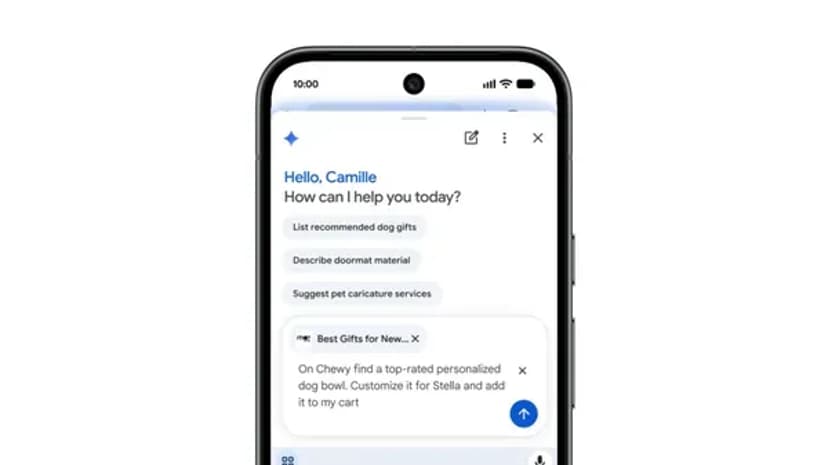
Google just flipped the switch on what could be its biggest consumer AI bet yet. The company's Gemini AI assistant is now live in Chrome for all Android users across the U.S., putting conversational AI directly into the hands of millions who browse on mobile. The move marks a major escalation in the AI assistant wars, embedding Google's flagship model into one of the world's most-used mobile browsers and potentially reshaping how people navigate the web on their phones.
Google is betting big that people want AI where they browse, not just where they search. The company announced today that Gemini is now baked into Chrome for every Android user in the U.S., making the AI assistant available without downloading a separate app or navigating to a different interface.
Charmaine Dsilva, Director of Product Management for Chrome, broke the news in a company blog post, describing the integration as giving users the ability to "tap into the power of Gemini" while browsing. The timing isn't accidental - Google's racing to cement its AI advantage before competitors catch up.
Chrome commands roughly 63% of the global browser market, with Android powering about 70% of smartphones worldwide. That puts Gemini in front of potentially hundreds of millions of users who never asked for an AI assistant but now have one living inside their browser. It's ambient AI at scale, and it fundamentally changes the calculation for how Google monetizes its search dominance.
The integration comes as the browser battlefield heats up again. Microsoft has been pushing Copilot into Edge for over a year, while Apple is preparing to roll out Apple Intelligence features across Safari and iOS. What was once a staid market - browsers as commodity infrastructure - suddenly matters again because AI assistants need a home base.
Google's approach differs from competitors in one crucial way: it's not asking users to opt in. The feature arrives as part of Chrome's standard update cycle, making it default behavior rather than experimental beta. That aggressive deployment strategy mirrors how Google rolled out Search Generative Experience, prioritizing reach over caution.
The business implications are massive. Every query handled by Gemini in Chrome is one that might not hit Google Search - and might not generate an ad click. But it also locks users deeper into Google's ecosystem, making Chrome less of a commodity browser and more of an intelligent assistant platform. The company's clearly betting that long-term engagement beats short-term ad revenue.
What remains unclear is exactly what Gemini can do inside Chrome beyond basic query answering. Google's announcement is light on technical specifics - no mention of whether the AI can interact with web pages, summarize articles, or assist with form-filling. The sparse details suggest Google wants to control the narrative around capabilities rather than overpromise.
The U.S.-only launch is strategic. Regulatory scrutiny of AI features runs hot in Europe, where Google's already fighting multiple antitrust battles around Search and Android. Rolling out domestically first lets the company iterate without immediate regulatory blowback, a lesson learned from previous product launches that stumbled overseas.
Competitors are watching closely. OpenAI has been rumored to be developing a browser of its own, while Anthropic recently launched Claude artifacts that function like micro-apps. The question isn't whether AI belongs in browsers - that's settled - but who controls the integration and captures the value.
For Android users who've watched Apple's AI announcements with envy, this is Google's counterpunch. While Apple Intelligence remains in beta and limited to newer devices, Gemini in Chrome works on any Android phone running a recent version of the OS. It's a scale play that only Google can execute, leveraging its dominance in mobile operating systems and browsers simultaneously.
The rollout also signals where Google thinks the AI competition will be won: not in standalone apps that users have to remember to open, but in the tools they're already using dozens of times a day. Chrome becomes the Trojan horse for Gemini adoption, and browsing becomes the training ground for how people learn to interact with AI.
Google's decision to embed Gemini directly into Chrome for Android represents a fundamental shift in how AI assistants reach consumers - not as apps you download, but as features you can't avoid. It's a power move that leverages Google's browser dominance to accelerate Gemini adoption while fundamentally changing what a browser can do. The real test comes in the next few months as users either embrace conversational browsing or ignore yet another AI feature they didn't ask for. Either way, Google's made its bet: the future of the web is conversational, and Chrome will be the interface.