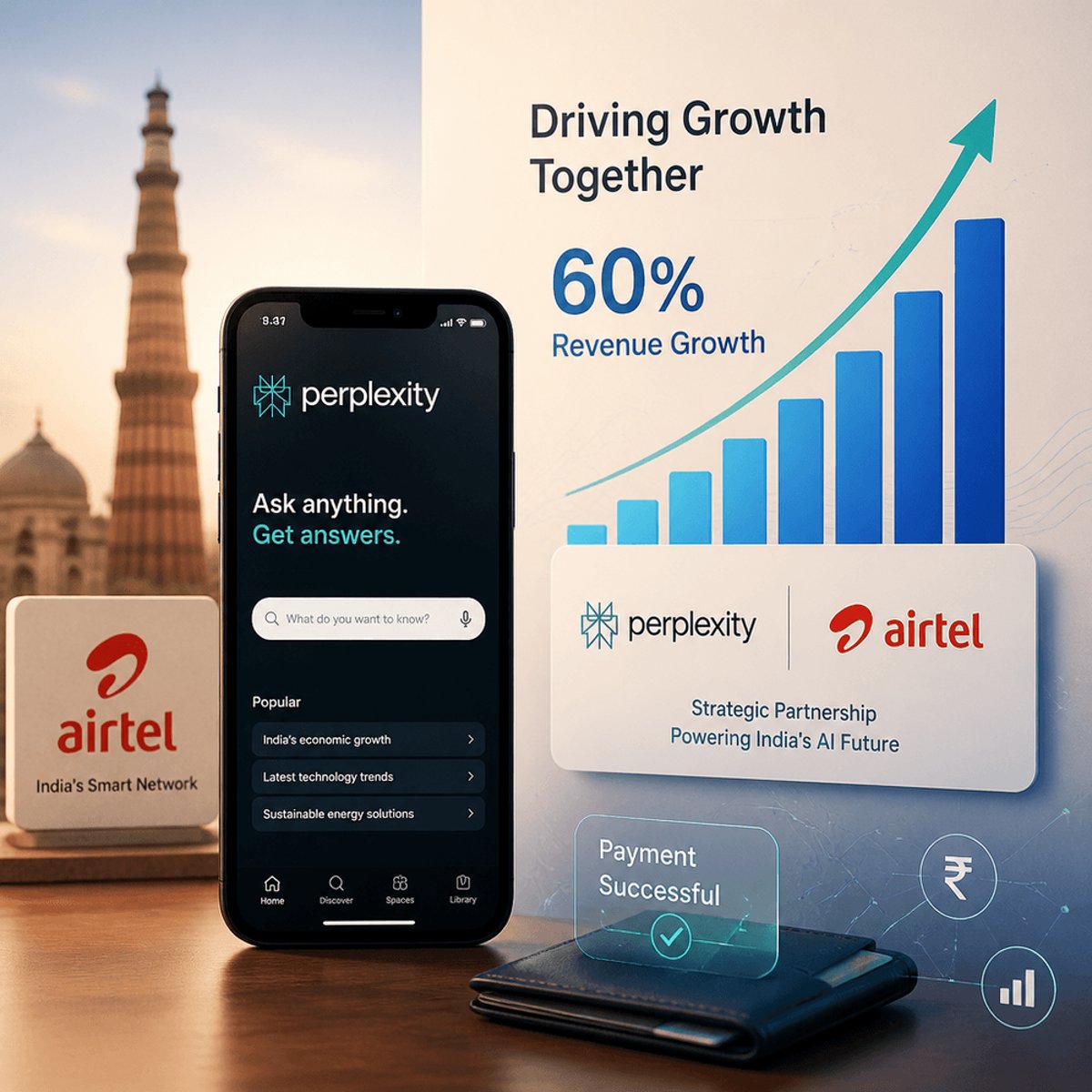
Perplexity just proved that giving away premium AI search for free can actually print money. The startup's India revenue surged roughly 60% after its partnership with telecom giant Airtel stopped offering free access to new users, even as app downloads predictably declined. The counterintuitive result shows how strategic freemium plays in emerging markets can build sustainable revenue streams, offering a playbook for AI startups eyeing international expansion beyond Silicon Valley's comfort zone.
Perplexity is discovering what happens when you turn off the free tap in one of the world's most price-sensitive markets. The AI search startup's revenue in India climbed about 60% after it stopped offering free premium access to new users through its partnership with telecom carrier Airtel, according to people familiar with the matter. Downloads declined as expected, but the conversion numbers tell a different story about emerging market strategy.
The partnership, which launched earlier this year, gave Airtel's massive subscriber base complimentary access to Perplexity Pro, the company's premium tier that typically costs around $20 monthly in the US. For months, millions of Indian users got free rein over advanced AI search features, building habits around a product they'd never paid for. When Perplexity pulled the offer for new sign-ups, existing free users stuck around and a significant chunk started paying.
It's a bet that runs counter to conventional wisdom in India's tech market, where companies typically race to the bottom on pricing. Google and Microsoft have spent years figuring out how to monetize Indian users who expect everything for free. Perplexity took a different angle by using Airtel as a distribution channel, essentially letting the telecom giant subsidize user acquisition while Perplexity built product stickiness.
The 60% revenue jump suggests those free users saw enough value to open their wallets when the partnership terms changed. That's notable in a market where converting free users to paid subscribers remains brutally difficult. India's per capita income sits well below Western markets, but the country's growing middle class and increasing smartphone penetration have created a cohort willing to pay for quality digital services.
Perplexity's timing catches India during an AI adoption surge. The country's tech-savvy population has been quick to experiment with ChatGPT, Claude, and other AI tools, but search remains the most familiar interface. By positioning itself as an AI-native alternative to traditional search, Perplexity tapped into user behavior that's already second nature, rather than asking Indians to learn entirely new interaction patterns.
The download decline after ending the Airtel offer was predictable. Free distribution through a telecom partner with hundreds of millions of subscribers naturally drives installs. When that spigot closes, downloads fall. But Perplexity appears to have played for retention and monetization rather than vanity metrics. The company's willingness to sacrifice download numbers for revenue growth signals confidence in its product-market fit.
This strategy also differentiates Perplexity from competitors like Google, which monetizes through advertising, and OpenAI, which has taken a more cautious approach to international expansion. By partnering with local telecom infrastructure, Perplexity gained distribution advantages that pure-play internet companies struggle to replicate in markets where carrier relationships still matter.
The India results come as Perplexity faces intensifying competition in AI search. Google continues integrating AI into its dominant search engine, while startups like You.com and Andi chase similar territory. Proving that users will pay for AI search, especially in price-sensitive markets, strengthens Perplexity's positioning as it reportedly explores new funding rounds at higher valuations.
For other AI startups eyeing global expansion, Perplexity's India playbook offers a template: partner with local distribution giants, subsidize initial usage to build habits, then convert users once they're hooked. It's risky because it requires patience and capital to sustain free periods, but the 60% revenue increase suggests the model can work when execution aligns with market dynamics.
The question now is whether Perplexity can replicate this pattern in other emerging markets across Southeast Asia, Latin America, and Africa, where similar dynamics around smartphone adoption and AI curiosity are playing out. If the India results hold as the partnership fully winds down, expect other AI companies to start hunting for their own telecom partners in developing economies.
Perplexity's India experiment validates a counterintuitive approach to emerging markets: give away premium features through strategic partnerships, build user dependency, then monetize when the free ride ends. The 60% revenue surge after closing new Airtel sign-ups proves that Indian users will pay for AI tools they find genuinely useful, challenging assumptions about price sensitivity in developing economies. As AI startups scramble for differentiation and sustainable business models, Perplexity's willingness to sacrifice short-term download metrics for long-term revenue growth offers a roadmap that prioritizes conversion over vanity. The real test comes next as the company attempts to replicate this playbook across other emerging markets where distribution partnerships and patient capital can unlock similar dynamics.