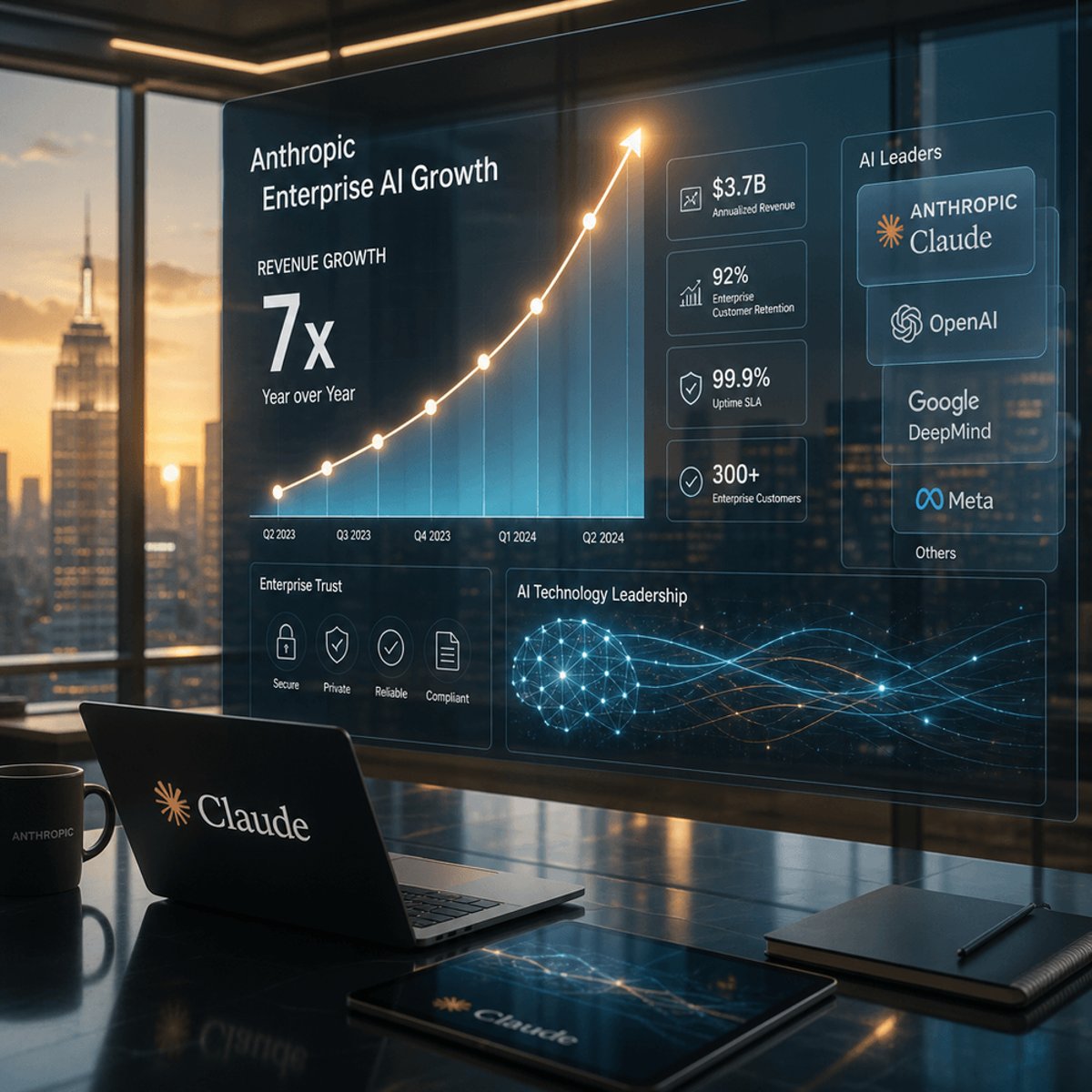
Anthropic just dropped a bombshell on the AI industry. The company told investors its annualized revenue run rate hit $65 billion in July, according to a disclosure reported by CNBC. That's a sevenfold jump from the same period last year, marking one of the most explosive growth trajectories in enterprise software history and positioning the Claude maker as the most serious commercial threat to OpenAI's dominance.
Anthropic is no longer just the scrappy OpenAI alternative. The company's latest investor update reveals an annualized revenue run rate of $65 billion as of July, representing sevenfold growth from the previous year, CNBC reported. The numbers put Anthropic firmly in the conversation as a legitimate commercial powerhouse, not just a research lab with interesting ideas about AI safety.
The growth spurt reflects how quickly enterprises have embraced Claude, Anthropic's flagship large language model. While OpenAI grabbed early mindshare with ChatGPT, Anthropic's focus on longer context windows, more predictable behavior, and constitutional AI principles appears to be resonating with corporate buyers willing to pay premium prices for reliability. The revenue surge suggests companies aren't just experimenting anymore - they're deploying at scale.
Anthropic's path mirrors the broader enterprise AI gold rush. Founded by former OpenAI research leaders Dario and Daniela Amodei in 2021, the company raised massive funding rounds from Google, Salesforce, and other deep-pocketed investors betting that AI safety and reliability would become competitive advantages. That bet looks prescient now. The constitutional AI approach, which aims to make models more steerable and less prone to harmful outputs, initially seemed like an academic exercise. But it turns out enterprise customers actually care deeply about predictability when they're processing sensitive data or customer interactions.
The competitive landscape just got more interesting. OpenAI still leads in name recognition and consumer adoption, but Anthropic's revenue velocity suggests the enterprise market remains wide open. Companies are hedging their bets, deploying multiple models for different use cases rather than going all-in on a single provider. That's created an opening for Anthropic to capture high-value contracts where Claude's strengths - extended context, nuanced reasoning, more consistent outputs - matter more than raw speed or the cheapest per-token pricing.
The numbers also reveal how quickly AI infrastructure spending is translating into actual revenue. Unlike previous hype cycles where promised returns remained perpetually on the horizon, enterprises are writing checks now. The $65 billion run rate encompasses API usage, enterprise licenses, and custom deployments. It's real money flowing through real invoices, not projected lifetime value or other creative accounting metrics. That distinction matters as investors scrutinize which AI companies can build sustainable businesses versus which are burning capital on unsustainable customer acquisition.
Anthroptic's disclosure timing is strategic. As the AI sector faces growing questions about path to profitability and capital efficiency, demonstrating this kind of revenue acceleration sends a clear signal - the business model works. The company doesn't need to rely indefinitely on venture funding or hypothetical future monetization. It's generating massive revenue right now, at a scale that supports continued model development and infrastructure investment.
But the growth also raises questions about sustainability. Sevenfold year-over-year increases can't continue forever. The real test comes when Anthropic needs to demonstrate not just revenue growth but actual profitability. Training and running large language models remains phenomenally expensive. The compute costs, engineering talent, and ongoing research investment required to stay competitive could easily consume that $65 billion run rate and then some. Investors will want to see margins, not just top-line numbers.
The broader implications extend beyond Anthropic's balance sheet. This kind of commercial success validates the entire premise that multiple AI model providers can coexist and thrive. It's not a winner-take-all market where OpenAI or Google captures everything. Different models serve different needs, and companies are willing to pay for choice, redundancy, and specialized capabilities. That's good news for the dozens of other AI startups racing to differentiate themselves.
What happens next matters enormously. If Anthropic can maintain even a fraction of this growth rate while moving toward profitability, it will have proven that ethical AI development and commercial success aren't mutually exclusive. That would reshape the entire industry's approach to safety, alignment, and responsible deployment. But if revenue growth stalls or margins never materialize, it might suggest the market for premium, safety-focused AI models is smaller than hoped.
Anthropic's $65 billion revenue run rate isn't just a milestone for one company - it's a market signal. The AI industry's competitive dynamics are solidifying faster than anyone expected, with real revenue validating that enterprises will pay significant premiums for models that prioritize reliability and safety alongside raw performance. The sevenfold growth demonstrates that being second or third in mindshare doesn't mean settling for scraps when your product solves real problems differently. For investors, this validates the multi-billion dollar bets on AI infrastructure. For competitors, it's a wake-up call that the window for establishing enterprise foothold is closing rapidly. And for enterprises themselves, it confirms what many suspected - they're going to need multiple AI providers, each optimized for different use cases, and they're willing to pay handsomely for that flexibility.