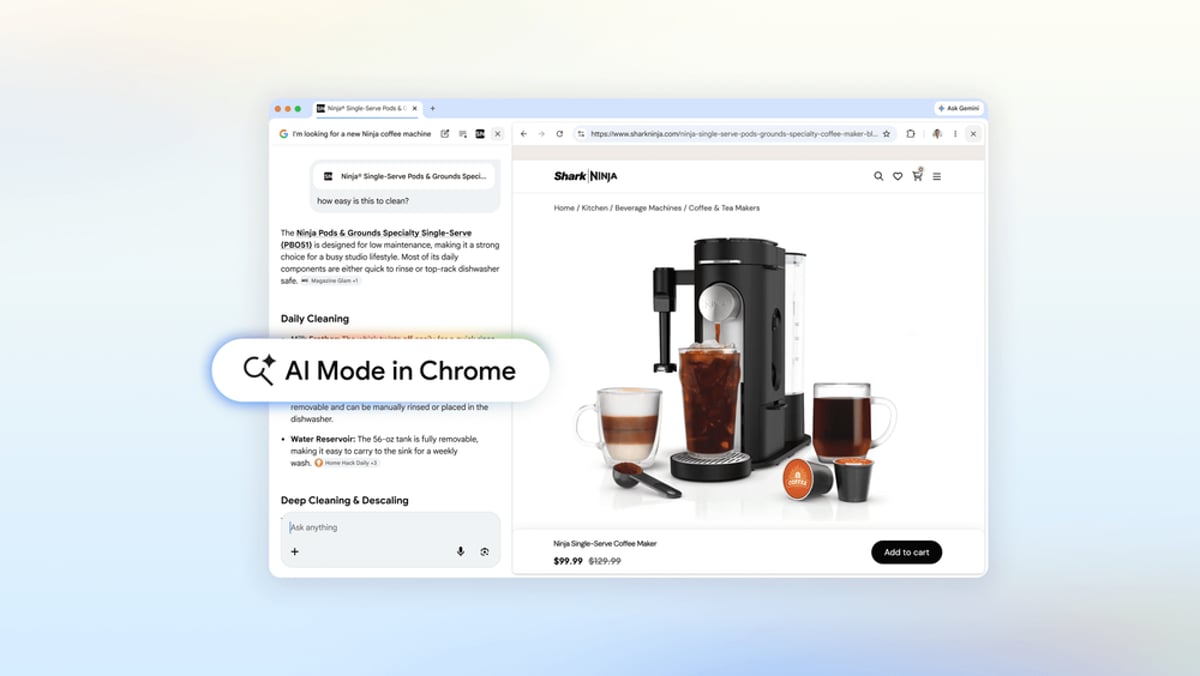
Google just made its Chrome browser a whole lot smarter. The company rolled out a new split-screen feature for AI Mode on desktop that lets you click links and view webpages side-by-side with AI assistance, fundamentally changing how users interact with AI-powered search. It's a small tweak with big implications for how we'll browse the web going forward.
Google is rewriting the rules for how AI and web browsing coexist. The company quietly pushed out an update to Chrome's AI Mode that fundamentally changes the user experience - when you click a link while using AI Mode on desktop, the webpage now appears side-by-side with your AI conversation instead of replacing it entirely.
It's a seemingly simple change that reveals Google's broader strategy. The tech giant has been racing to integrate AI across its product lineup since OpenAI kickstarted the generative AI arms race, and Chrome represents one of its most valuable battlegrounds. With over 3 billion users worldwide, Chrome gives Google a direct pipeline to reshape how people discover and consume information online.
The split-screen approach solves a problem that's plagued AI search interfaces since day one - context switching. Previously, clicking a source link meant abandoning your AI conversation entirely, forcing you to navigate back if you wanted to continue the interaction. Now you can verify claims, explore sources, and maintain your AI thread simultaneously. It's the kind of friction-reducing UX tweak that seems obvious in hindsight but took months of internal testing to get right.
What Google isn't saying publicly is just as revealing. The feature currently works only on Chrome desktop, with no timeline announced for mobile deployment. That's strategic - desktop users tend to engage in more complex, research-heavy tasks where split-screen viewing actually makes sense. Mobile browsing patterns skew toward quick, single-task interactions where screen real estate is already at a premium.
The timing matters too. Microsoft has been aggressively promoting its own AI-powered Edge browser, complete with Copilot integration that offers similar contextual assistance. OpenAI has been testing ChatGPT browser extensions that intercept search queries before they even reach Google. By embedding AI functionality deeper into Chrome's core browsing experience, Google is making it harder for competitors to poach users who've grown accustomed to AI-assisted workflows.
Under the hood, this update likely required significant architectural changes to Chrome's tab management system. Running AI Mode alongside active webpages means managing two computationally intensive processes simultaneously - the AI inference happening server-side and the full webpage rendering client-side. Google's infrastructure advantage shows here, leveraging the same data centers that power Search and Cloud to deliver responsive performance.
The broader implications extend beyond browser wars. Publishers have been nervously watching AI search developments, worried that AI-generated summaries will kill referral traffic. Google's split-screen approach represents a middle path - users still see the source webpage, but they're viewing it through Google's AI-mediated interface rather than arriving directly. Whether that translates to meaningful engagement and ad revenue for publishers remains an open question.
Some industry observers see this as Google testing the waters before a larger AI Mode expansion. The company has been noticeably cautious about rolling out generative AI features compared to scrappier competitors, likely because it has far more to lose if something goes wrong. A phased desktop-first approach lets Google gather usage data and refine the experience before committing to a full-scale mobile launch that would affect billions of users.
What's clear is that Google is committed to making AI Mode a core part of the Chrome experience rather than a novelty feature users ignore. The split-screen update suggests the company believes users want AI assistance without completely abandoning traditional web browsing - at least for now.
Google's split-screen AI Mode update won't make headlines, but it reveals the company's long-term vision for search. By keeping users anchored in AI conversations while they explore the web, Google is betting that the future of browsing isn't AI or traditional pages - it's both, seamlessly integrated. The real question is whether competitors can match the execution, or if Chrome's market dominance just became even harder to challenge. Watch for similar features to appear in mobile Chrome within the next few quarters, likely timed to coincide with Google's annual I/O developer conference.