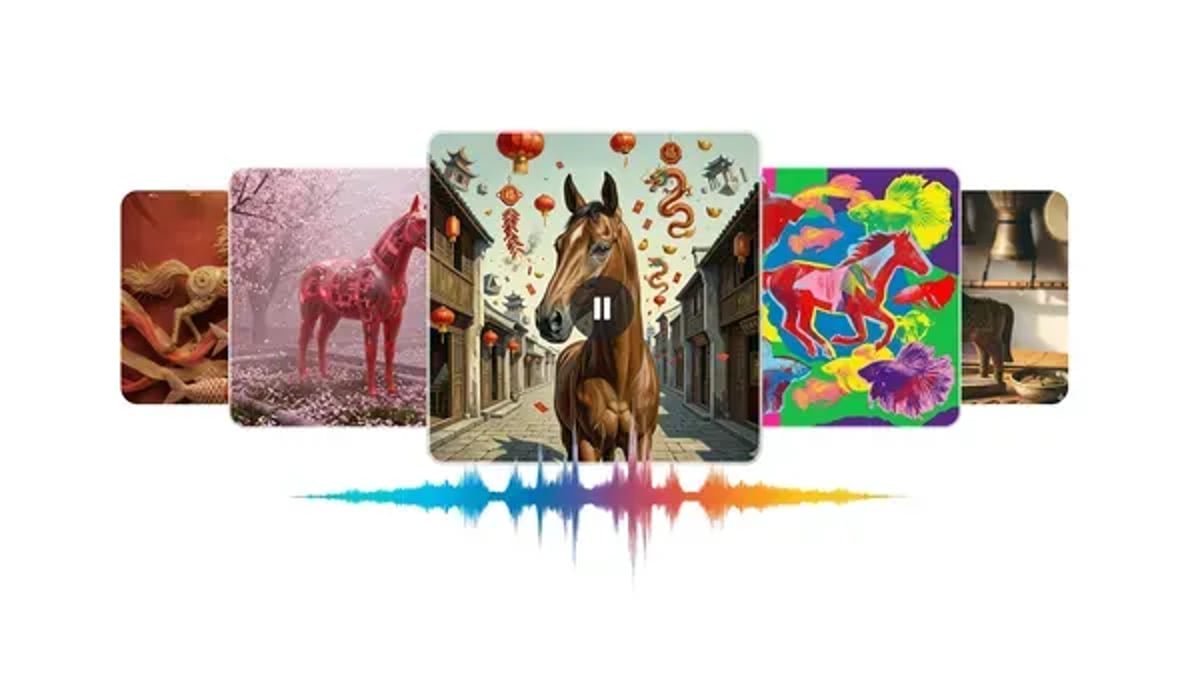
Google just made its Gemini app a music studio. The company rolled out Lyria 3, an AI music generation feature that lets users create personalized musical greetings directly inside the Gemini interface, timed to coincide with the Year of the Fire Horse celebrations. It's the latest sign that Google DeepMind is pushing generative AI beyond text and images into full-scale creative consumer applications, putting AI-composed music in the hands of millions.
Google isn't waiting for competitors to own AI-generated music. The company announced today it's embedding Lyria 3, its latest music generation model, directly into the Gemini app, letting users spin up custom musical greetings with simple text prompts. The feature launched in time for Lunar New Year celebrations, specifically targeting the Year of the Fire Horse.
According to JJ Geewax, Director of Applied AI at Google DeepMind, users can now "celebrate the Year of the Fire Horse with personalized musical greetings created directly in the Gemini app." The integration represents a significant expansion of Gemini's capabilities beyond its core text and image generation features.
The timing isn't coincidental. Google has been methodically adding creative tools to Gemini throughout 2025 and early 2026, transforming the chatbot from a productivity assistant into a full-fledged creative suite. Earlier this month, the company launched Nano Banana 2 for image generation, and now music generation joins the roster. It's a deliberate strategy to make Gemini the one-stop destination for AI-powered creativity.
Lyria 3 builds on Google DeepMind's earlier music AI research, which the lab has been developing since at least 2023. The model can generate original musical compositions based on text descriptions, handling everything from melody and harmony to instrumentation and arrangement. Users don't need musical training - they just describe what they want, and Lyria 3 handles the composition.
The consumer focus is crucial here. While OpenAI has been experimenting with creative tools and Meta has rolled out various AI features across its apps, Google is betting that tightly integrated creative capabilities inside a single app will win users over. By embedding Lyria 3 directly into Gemini rather than launching it as a standalone product, Google makes music generation as simple as asking ChatGPT a question.
The Year of the Fire Horse angle provides a natural use case - personalized musical greetings for Lunar New Year - but the feature isn't limited to holiday cards. Users can create music for any occasion, from birthday songs to background tracks for social media posts. It's the kind of casual creative tool that could drive mainstream adoption of AI music generation.
This launch also highlights how quickly the AI music space is maturing. Just two years ago, AI-generated music was mostly a novelty. Now Google is confident enough to push it directly to consumers through its flagship AI product. The company is clearly betting that quality has reached a threshold where normal people will actually use these tools regularly.
Competition is heating up fast. Meta has been testing audio generation features, and startups like Suno and Udio have gained traction with standalone music AI tools. By integrating Lyria 3 into Gemini, Google leverages its existing user base rather than asking people to try yet another new app.
The technical details remain sparse - Google hasn't disclosed model size, training data sources, or specific licensing arrangements with rights holders. Those details matter enormously given ongoing debates about AI training and copyright. The company has been careful to position previous music AI work as experimental, but pushing Lyria 3 into a consumer product suggests they've addressed at least some of those concerns internally.
What's notable is the speed of deployment. Google announced the feature and made it available immediately, no waitlist or gradual rollout. That confidence suggests the model has been thoroughly tested and that Google feels pressure to move fast against competitors who are also racing to add creative features to their AI products.
Google's decision to embed Lyria 3 directly into Gemini marks a turning point for AI music generation - it's no longer an experimental feature locked in research labs, but a consumer tool sitting alongside text and image generation. The move pressures competitors to match this capability while raising fresh questions about how AI-generated music will reshape creative expression. For now, millions of Gemini users can suddenly compose original music with nothing but a text prompt, and that accessibility alone could accelerate mainstream adoption faster than anyone expected. Watch how quickly Meta and OpenAI respond with their own integrated music features.