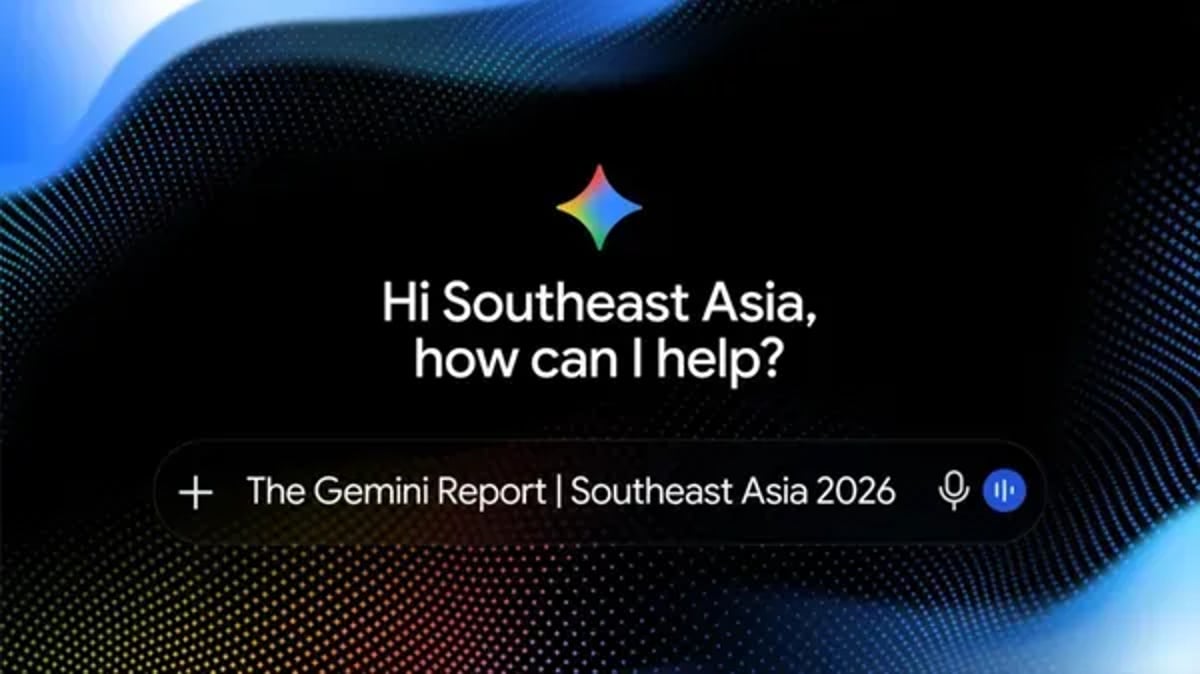
Google is making serious headway in Southeast Asia, and it's not just about throwing another AI chatbot at the region. The company's Gemini AI assistant is gaining momentum thanks to something competitors have struggled with: actually speaking the languages people use every day. According to a new report from Google, the AI's local language fluency combined with the region's mobile-first infrastructure is driving adoption rates that signal a major shift in how Southeast Asia engages with AI technology.
Google just scored a quiet win in the global AI race, and it happened thousands of miles from Silicon Valley. The company's Gemini AI assistant is taking off across Southeast Asia, driven by something that sounds obvious but competitors have fumbled: speaking the local languages people actually use.
Sapna Chadha, Google's Vice President for Southeast Asia and South Asia Frontier, revealed the momentum in a company blog post that highlights how regional characteristics are creating unexpected advantages for AI adoption. The region's mobile-first population isn't just using Gemini - they're integrating it into daily workflows in ways that mirror how the West uses desktop-based AI tools.
The strategy contrasts sharply with how OpenAI and Microsoft have approached international expansion. While ChatGPT remains primarily English-focused with limited localization, Google invested heavily in making Gemini conversant in Thai, Bahasa Indonesia, Vietnamese, and Tagalog. That decision is paying dividends in a region where English proficiency varies wildly and users prefer AI that understands cultural context, not just literal translations.
Southeast Asia's mobile penetration rate exceeds 100% in several countries, with users often owning multiple devices. Unlike Western markets where AI adoption started on desktops with tools like ChatGPT and Claude, Southeast Asian users are encountering AI first through their phones. Google's mobile-optimized Gemini app slots naturally into this ecosystem, competing directly with messaging apps and social platforms for screen time.
The timing couldn't be better for Google. The company's been playing catch-up to OpenAI in the AI assistant race since ChatGPT's explosive debut, but regional expansion offers a path to dominance that doesn't require winning Silicon Valley's approval first. Southeast Asia's 680 million people represent a massive addressable market, and Google already has infrastructure advantages through Android's regional dominance and existing partnerships with telecom providers.
But language support alone doesn't explain Gemini's traction. The assistant's integration with Google Workspace and other Google services creates a seamless experience for the region's growing knowledge economy. Small businesses in Indonesia can draft emails in Bahasa, Filipino entrepreneurs can generate marketing content in Tagalog, and Vietnamese developers can debug code with contextual help in their native language.
Competitors are taking notice. Microsoft recently announced expanded language support for Copilot, while Meta is rumored to be developing localized versions of its AI assistants specifically for Southeast Asian markets. The rush to localize reveals what tech giants have learned: the next billion AI users won't come from English-speaking markets, and whoever cracks regional adaptation first will capture outsized market share.
The mobile-first advantage extends beyond just device preference. Southeast Asian users exhibit different usage patterns - shorter, more frequent interactions rather than lengthy research sessions. They're using AI for translation, quick answers, and social media content creation rather than complex analytical tasks. Google's product team adapted Gemini's interface and response patterns to match these behaviors, creating an experience that feels native rather than imported.
There's also an economic dimension. While premium AI subscriptions struggle to gain traction in price-sensitive markets, Google's freemium model with Gemini lowers the barrier to entry. Users can experience AI capabilities without payment friction, and the company can monetize through ads and enterprise upgrades down the line. That's a playbook Google perfected with Search and YouTube, now applied to AI.
The regional expansion also serves as a testing ground for features that might eventually roll out globally. Language models trained on Southeast Asian languages develop different capabilities around tone, formality, and cultural context - learnings that could improve Gemini's performance in other non-English markets across Latin America, Africa, and the Middle East.
Google's Southeast Asia strategy reveals something crucial about the next phase of AI adoption: global dominance won't come from building the smartest model, but from building the most accessible one. While competitors battle over benchmarks and parameter counts, Google is quietly capturing entire regions by doing the unglamorous work of localization. If Gemini's Southeast Asian momentum is any indication, the AI wars will be won not in San Francisco conference rooms, but in Jakarta coffee shops and Manila startup offices where users just want technology that speaks their language and fits in their pocket.