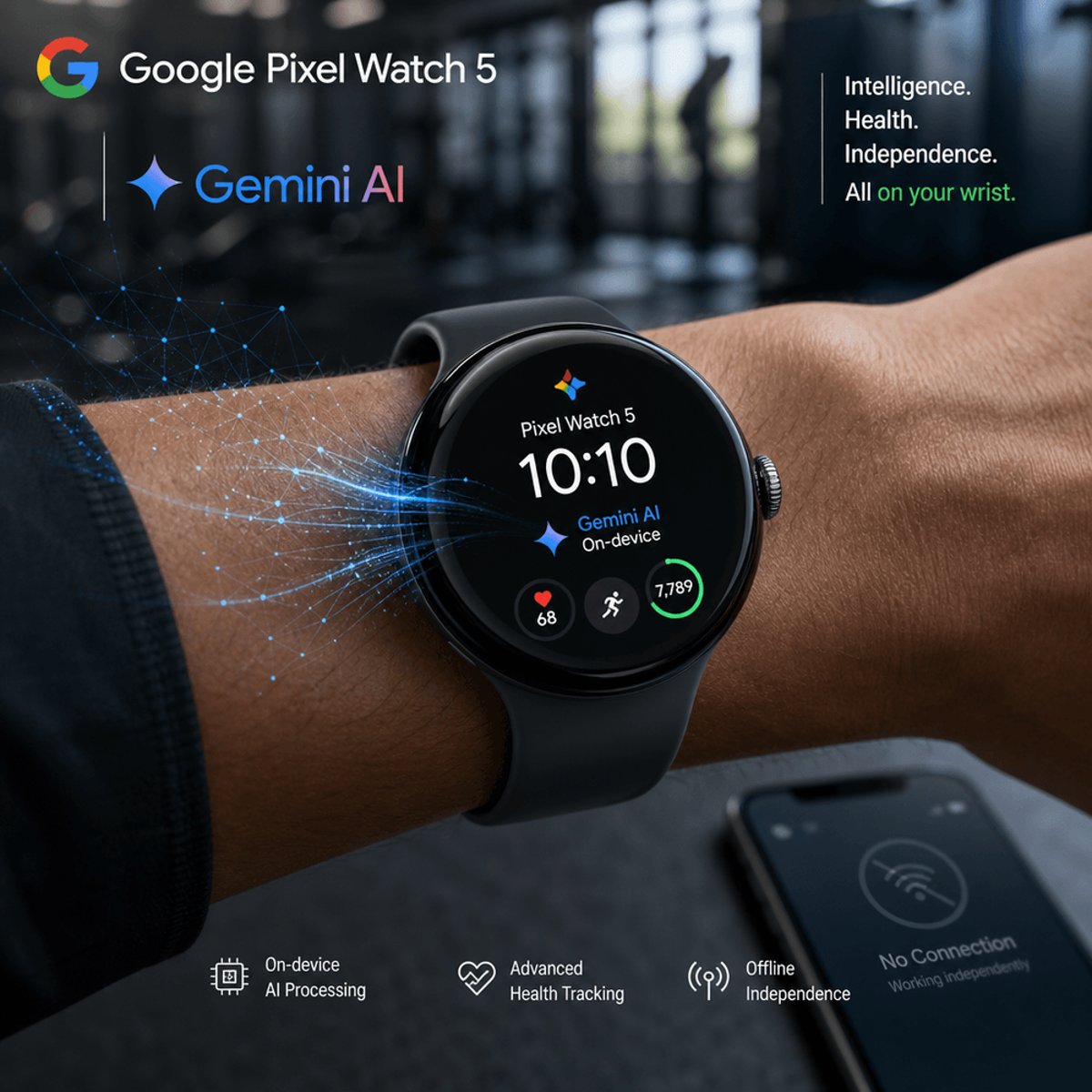
Google just raised the stakes in the smartwatch wars. The Pixel Watch 5, reviewed by Wired, introduces offline Gemini AI capabilities alongside smarter gym tracking and new health alerts - marking the first time Google's AI assistant can run entirely on-device without a network connection. It's a calculated move that positions the wearable as a serious competitor to Apple Watch while addressing one of the biggest pain points in smartwatch AI: connectivity dependence.
Google is betting that AI belongs on your wrist - even when your phone doesn't have signal. The Pixel Watch 5, detailed in a new Wired review, brings offline Gemini capabilities to the wearable for the first time, letting users query Google's AI assistant without needing an internet connection.
It's a bigger deal than it sounds. Smartwatch AI has historically been hamstrung by connectivity requirements - ask Siri or Alexa a question mid-workout in a basement gym, and you're likely to get an error message. Google's solution processes requests locally on the watch itself, using what's presumably a lightweight version of Gemini optimized for the watch's limited processing power.
The timing isn't coincidental. Apple has been telegraphing on-device AI ambitions for months, while Samsung continues integrating Galaxy AI across its wearable lineup. Google's move with offline Gemini keeps it competitive in a race where AI integration is quickly becoming table stakes rather than a luxury feature.
But the Pixel Watch 5 isn't just an AI play. According to the Wired review, Google has significantly upgraded gym tracking capabilities - addressing a weakness that's dogged previous Pixel Watch generations. The watch now offers more granular workout detection and form tracking, features that fitness-focused competitors like Garmin and Whoop have made standard.
New health alerts round out the package, though specifics remain sparse. The additions suggest Google is playing catch-up to Apple Watch's increasingly sophisticated health monitoring, which now includes everything from ECG readings to temperature sensing. For Google, which acquired Fitbit in 2021 for $2.1 billion, the Pixel Watch represents a critical opportunity to justify that investment and carve out differentiation in health tech.
The phrase 'fine-tunes a winning formula' in Wired's assessment reveals both confidence and caution. Google has steadily improved the Pixel Watch line since its rocky 2022 debut, when battery life and performance issues overshadowed an otherwise polished design. TheWatch 5 appears to build incrementally rather than revolutionize - a safer strategy but one that raises questions about whether incremental is enough.
Pricing remains a sticking point. While exact figures aren't disclosed in the preview, the review notes the improvements come 'for a price' - suggesting Google isn't backing down from premium positioning despite aggressive competition from Samsung and budget players entering the market. That's a risky bet when Apple Watch SE offers most essential features at a fraction of flagship costs.
The offline AI capability deserves closer scrutiny. On-device processing means privacy wins - your queries never leave your wrist - but it also means limitations. Lightweight AI models trade comprehensiveness for speed and efficiency. What works for quick gym questions might fall short for complex requests that benefit from cloud computing power.
Google's broader wearable strategy is coming into focus. The company is leveraging its AI advantage - something Apple and Samsung are still ramping - while simultaneously addressing fitness tracking gaps that made previous Pixel Watches feel like compromises. It's a two-front war that requires execution on both hardware and software.
For the smartwatch market, the Pixel Watch 5 represents another data point in AI's inevitable integration into wearables. What started as notification mirrors has evolved into health monitors, and now AI companions. The question isn't whether AI belongs on smartwatches - that ship has sailed - but rather which company can make it genuinely useful rather than a gimmick.
Google's decision to prioritize offline functionality suggests it learned from smartphone AI rollouts, where connectivity issues frustrated early adopters. If Gemini can deliver reliable on-device responses, it could push Apple and Samsung to accelerate their own offline AI timelines.
The watch arrives as the wearable market matures. Shipments have plateaued after years of explosive growth, forcing companies to compete on features rather than market expansion. Health monitoring, AI integration, and battery life have become the new battlegrounds - areas where differentiation actually matters to consumers deciding between increasingly capable devices.
The Pixel Watch 5 signals Google's commitment to making AI practical in everyday scenarios where connectivity fails - gyms, flights, remote areas. By bringing Gemini offline while simultaneously upgrading fitness fundamentals, Google is addressing two critical gaps that kept previous generations from truly challenging Apple Watch dominance. But execution matters more than features on a spec sheet. If the offline AI actually works reliably and the gym tracking delivers on its promise, Google might finally have the wearable to justify its Fitbit acquisition. If not, it's another incremental update in a market that's increasingly demanding transformation. The premium pricing suggests Google believes it's delivered the former - now it just needs to convince consumers to agree.