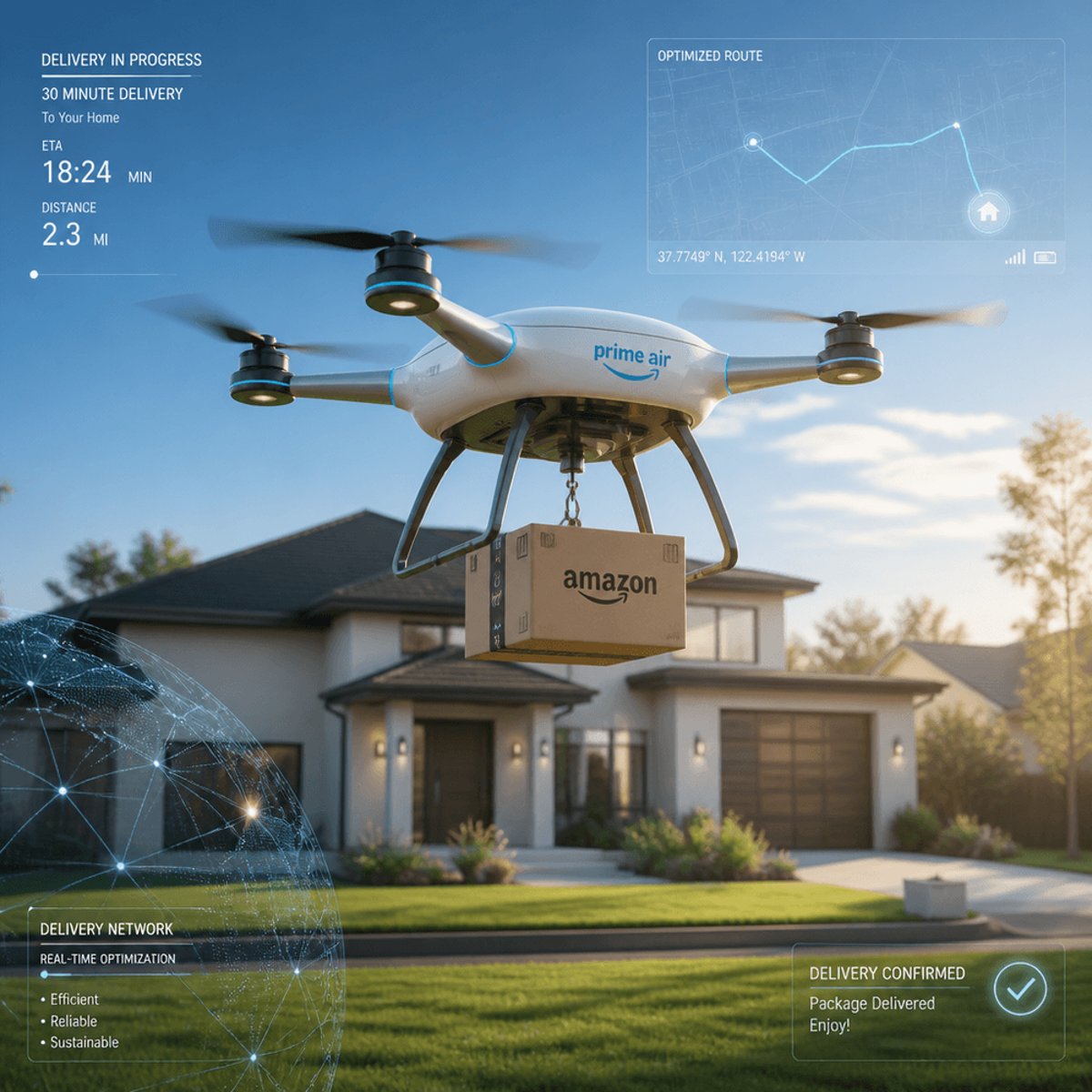
Amazon is making its biggest bet yet on aerial logistics. The company just announced Prime Air will expand to nearly 500 cities and towns by the end of this year, bringing 30-minute drone deliveries to tens of millions of customers. After years of limited pilots, the e-commerce giant is finally scaling what could become the industry's first mass-market drone delivery network—a move that puts pressure on Walmart, Google's Wing, and every retailer still figuring out last-mile economics.
Amazon is going all-in on drones. The company revealed it's expanding Prime Air to nearly 500 cities and towns this year, transforming what's been a cautious experiment into a full-scale logistics operation. According to the official announcement, Prime Air has already delivered millions of items in as fast as 30 minutes, and by year-end, the service will reach communities representing tens of millions of customers.
The timing couldn't be more strategic. While Walmart has been testing drone deliveries through partnerships with DroneUp and Zipline, and Google's Wing continues incremental rollouts in select suburbs, Amazon's aggressive expansion signals a fundamental shift. The company isn't just testing anymore—it's building infrastructure at the scale only Amazon can muster.
What makes this different from previous drone delivery promises? Amazon has spent years quietly refining the technology. Early Prime Air tests in College Station, Texas, and Lockeford, California, gave the company real-world data on weather challenges, airspace coordination, and customer acceptance. Now it's ready to deploy that knowledge across hundreds of communities simultaneously, a logistics choreography that could redefine customer expectations around delivery speed.
The economics are compelling. Drones eliminate the need for delivery drivers on certain routes, slash fuel costs, and bypass traffic entirely. For lightweight items under five pounds—think phone chargers, medications, or emergency baby supplies—30-minute drone delivery could become the new standard. That puts enormous pressure on traditional carriers like UPS and FedEx, who are still optimizing truck routes while Amazon literally flies over the problem.
But scaling drone delivery isn't just about technology. Amazon has to navigate a patchwork of FAA regulations, local noise ordinances, and airspace restrictions. The company's been working closely with regulators to secure beyond-visual-line-of-sight approvals, which are critical for operating drones at scale. Each new city requires custom flight path mapping, weather contingency planning, and community engagement—a complex rollout that makes Amazon's 500-city target all the more ambitious.
The competitive landscape is heating up fast. Walmart recently expanded its drone delivery to 60 stores across six states, partnering with multiple drone providers to hedge its bets. Google Wing focuses on smaller markets but has logged hundreds of thousands of deliveries in Australia. Even Uber has explored drone food delivery through partnerships. Amazon's scale advantage—its existing fulfillment network, Prime membership base, and technology investments—could make Prime Air the first drone service most Americans actually use.
There's also the automation angle. Amazon's been integrating AI-powered route optimization and computer vision systems that let drones navigate autonomously, avoid obstacles, and land precisely in backyards. This isn't just about drones—it's about building an end-to-end automated logistics system where humans only handle exceptions. The technology lessons learned here feed directly into Amazon's warehouse robotics, autonomous vehicle research, and broader supply chain AI initiatives.
Consumer adoption will be the real test. While 30-minute delivery sounds great, customers have to trust a drone landing in their yard, accept delivery restrictions on package size and weight, and deal with weather delays. Amazon's counting on the convenience factor outweighing the novelty concerns. Early data from pilot cities suggests customers who try drone delivery once tend to use it repeatedly, especially for urgent needs.
The infrastructure build-out is massive. Amazon needs regional drone hubs within flying distance of delivery zones, maintenance facilities, battery swapping stations, and coordination centers managing hundreds of simultaneous flights. It's essentially building a parallel logistics network in the sky, which explains why the company's been relatively quiet about Prime Air until now—they wanted the infrastructure ready before making big promises.
Amazon's drone delivery expansion represents more than faster shipping—it's a fundamental restructuring of last-mile logistics that could force every retailer to rethink their delivery strategies. If Prime Air delivers on its 500-city promise, the competitive pressure on Walmart, Target, and traditional carriers intensifies dramatically. The question isn't whether drone delivery becomes mainstream, but whether Amazon locks in such a big lead that competitors spend the next decade playing catch-up. For customers in those nearly 500 cities, 30-minute deliveries are about to shift from novelty to expectation—and that's when the real disruption begins.