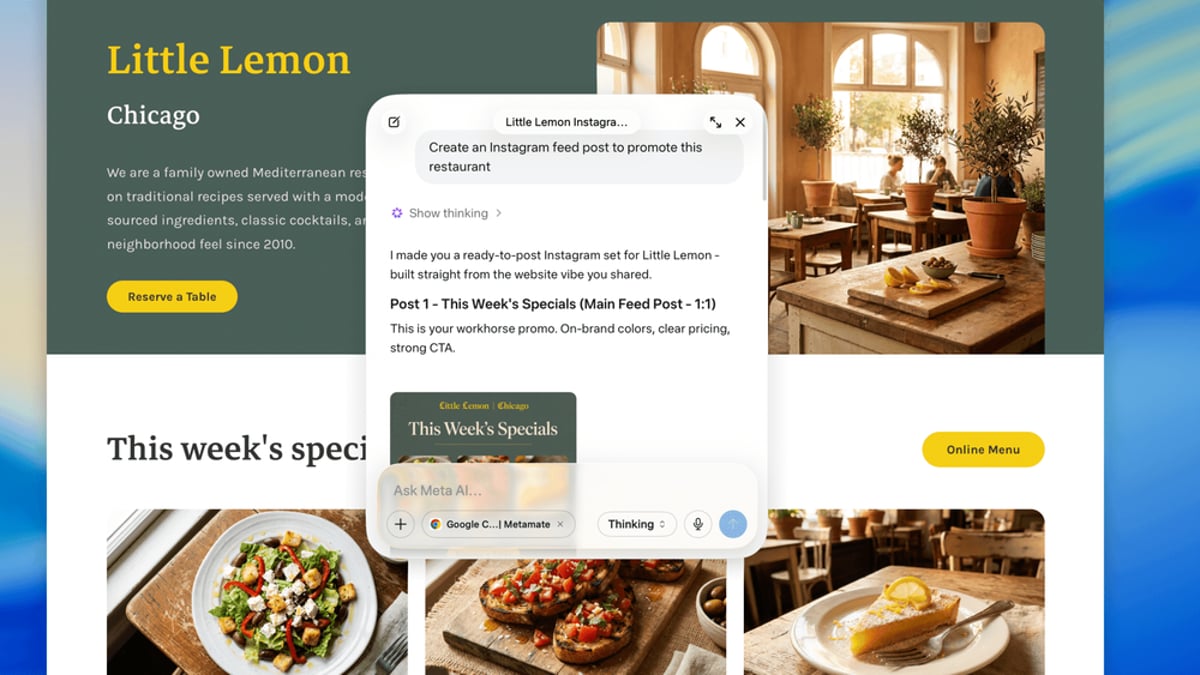
Meta just dropped a Mac app for its AI chatbot, ramping up the desktop AI assistant war with Google, OpenAI, and Anthropic. The app lets users share their screen with Meta AI, which can then suggest edits, answer questions, or generate content based on what's displayed. It's Meta's latest push to transform its chatbot from a social media add-on into a serious productivity tool that can actually compete with the desktop apps already deployed by its rivals.
Meta is making its move in the desktop AI assistant race. The company announced Wednesday it's launching a dedicated Mac app for Meta AI, complete with screen-sharing capabilities that let the chatbot see what you're working on and offer real-time suggestions, according to The Verge.
The timing isn't coincidental. Meta's been playing catch-up in the productivity space while competitors plant their flags on users' desktops. Google's Gemini already has a Mac app with window-sharing, and both OpenAI's ChatGPT and Anthropic's Claude went further by giving their chatbots actual computer control abilities. Meta's app doesn't reach that level yet, but it's a clear signal the company wants a piece of the desktop productivity market.
The Meta AI Mac app lets users share their active window with the chatbot, which can then generate content, answer questions, or make suggestions based on what it sees. The app also supports dictation across all Mac applications, making it accessible without switching contexts. It's the kind of ambient AI assistance that Meta hopes will make its chatbot indispensable for daily workflows.
This launch ties directly into Meta's broader push to reposition its AI chatbot as a productivity tool rather than just a feature embedded in Facebook and Instagram. The company's been adding workplace-focused capabilities for months, trying to shake the perception that Meta AI is primarily for generating quirky images in group chats.
But Meta faces stiff competition in a market that's already crowded. ChatGPT became the breakout hit of the AI era partly because it offered a standalone experience from day one. Anthropic's Claude won over developers and professionals with its long context window and coding abilities. Google's Gemini leveraged the company's search dominance and Android ecosystem. Meta's starting from behind, even with its massive user base across social platforms.
The desktop app strategy makes sense for Meta's AI ambitions. Mobile apps and web interfaces work fine for casual queries, but productivity users want native desktop experiences that integrate seamlessly with their workflows. That's why OpenAI, Google, and Anthropic all prioritized Mac apps. Microsoft's Copilot is baked directly into Windows 11. Desktop real estate equals mindshare for AI assistants.
What's notable is what Meta AI can't do yet. While ChatGPT and Claude can actually control your computer - clicking buttons, typing text, executing commands - Meta AI is limited to viewing and suggesting. That's a significant capability gap when power users are looking for AI that can actually complete tasks, not just advise on them.
The screen-sharing feature does open interesting possibilities though. Unlike traditional AI assistants that only see the text you feed them, Meta AI can process visual information from spreadsheets, design mockups, code editors, or documents. That multimodal capability could give Meta an edge in specific use cases, especially for creative work where visual context matters more than automation.
Meta's also betting its vast resources in AI development will pay off. The company's been pouring billions into AI infrastructure and talent, recently announcing expanded investments in Llama model development. Desktop apps give Meta a direct distribution channel for those improvements, bypassing the web browser and competing directly with rivals on user home screens.
The question is whether Meta can overcome the trust deficit it carries from years of privacy controversies. Asking users to share their screens with a Meta product requires confidence the company won't misuse that visual data. Meta will need to clearly communicate its data handling practices and privacy protections to win over skeptical professionals.
Industry watchers expect the desktop AI assistant market to consolidate around a few winners, similar to how browser wars played out. OpenAI has the brand recognition, Google has ecosystem integration, Anthropic has the enterprise trust, and Microsoft has Windows. Meta's entering with distribution advantages through its social platforms but faces an uphill battle changing perceptions about what Meta AI can do.
The Mac app represents Meta's acknowledgment that AI assistants need to live where work happens, not just where people socialize. Whether users will invite Meta's chatbot into their productivity workflows remains the billion-dollar question.
Meta's Mac app launch marks a pivotal shift in the company's AI strategy, moving beyond social media integration toward direct competition in the productivity space. While the screen-sharing capabilities put Meta on the desktop AI map, the company still trails OpenAI and Anthropic in computer control features that power users crave. Success will depend on whether Meta can convince productivity-focused users to trust a Facebook-parent company with their work screens - and whether the technical capabilities can match the ambitious positioning. The desktop AI war just got another major player, but Meta's fighting from behind in a market where first-mover advantage and user trust matter deeply.